  1. Home
  2. Space
  3. News

NASA has collected a whopping 121 grams of sample from asteroid Bennu

Add as a preferred source on Google

When the OSIRIS-REx dropped a capsule in the Utah desert last year, it made headlines around the globe for returning NASA’s first sample of an asteroid to Earth. Scientists were eager to get their hands on the sample of asteroid Bennu to learn about the early formation of the solar system, but actually getting at the sample proved to be rather trickier than imagined.

Scientists were able to extract 70 grams of material from the sample canister relatively easily, making it by far the largest asteroid sample ever brought to Earth, but two troublesome fasteners made it difficult to extract the rest of the sample. The team knew it had plenty more sample inside, but it had to be patient as special new tools were constructed that could undo the fasteners without losing a single gram of the precious sample.
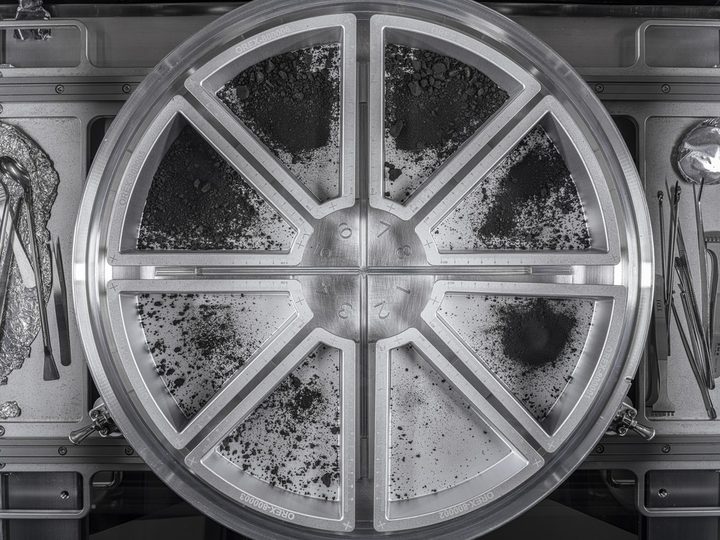
A view of eight sample trays containing the final material from asteroid Bennu. The dust and rocks were poured into the trays from the top plate of the Touch-and-Go Sample Acquisition Mechanism (TAGSAM) head. 51.2 grams were collected from this pour, bringing the final mass of asteroid sample to 121.6 grams.
A view of eight sample trays containing the final material from asteroid Bennu. The dust and rocks were poured into the trays from the top plate of the Touch-and-Go Sample Acquisition Mechanism (TAGSAM) head. 51.2 grams were collected from this pour, bringing the final mass of asteroid sample to 121.6 grams. NASA/Erika Blumenfeld & Joseph Aebersold

Now, NASA has revealed that the mission delivered a total of 4.29 ounces (121.6 grams) of material from Bennu, more than twice the mission’s goal of 60 grams. The team was able to fully remove the troublesome fasteners in January this year and completely disassemble the part holding the sample, called the Touch-and-Go Sample Acquisition Mechanism (TAGSAM) head. That let the researchers access the remaining 51 grams to go along with the 70 grams previously collected.

Recommended Videos

Next, the sample will be shared between NASA and various U.S. and international research organizations. This includes sending some of the sample to the Japanese Space Agency, JAXA, which was responsible for the first-ever return of a sample to Earth with its Hayabusa and Hayabusa 2 missions, which dropped off samples in 2010 and 2020, respectively. JAXA shared a portion of the 5 grams of sample it collected from asteroid Ryugu with NASA, and now NASA will share a portion of its sample from Bennu in return.

Some of the Bennu sample will also be set aside for preservation to be examined with new and more powerful instruments as these are developed over time. NASA says it will preserve at least 70% of the sample at its Johnson Space Center facility in Houston “for further research by scientists worldwide, including future generations.”

Georgina Torbet
Georgina has been the space writer at Digital Trends space writer for six years, covering human space exploration, planetary…
You can now walk through space and gaze into a black hole at this VR exhibit
Smithsonian Starstruck lets you drift past dying stars and see the origin point of the universe for as little as $18 a person.
Smithsonian Starstruck featured

Most planetarium shows ask you to sit still and look up. The Smithsonian's new VR exhibit takes a different approach, letting visitors walk through the vast expanse of the universe, drifting past stars, planets, and a black hole to get a physical sense of its true scale.

A $29 ticket to the edge of the galaxy

Read more
Scientists warn Elon Musk’s orbital data centers could blind Earth’s biggest telescopes
A new ESO study suggests millions of satellites could make parts of the night sky effectively unusable for astronomy.
One hour of satellites over the northern Atacama Desert in Chile (October 2025)

The race to blanket Earth with satellite internet has unlocked faster connectivity for millions. But according to the European Southern Observatory (ESO), it could also make one of humanity's oldest hobbies, and one of its most important sciences, a whole lot harder. The organization warns that the rapid growth of satellite mega-constellations could severely disrupt observations made by some of the world's most powerful telescopes.

Astronomers say the night sky is reaching its limit

Read more
Amazon’s Starlink rival just crossed a major milestone, but don’t expect perfect internet just yet
Amazon finally showed up to the space internet party
Amazon Leo satellite layout across all launch vehicles

Amazon has taken a significant step toward launching its long-awaited satellite internet service. Following its latest rocket launch, the company now has 396 Project Kuiper satellites in low-Earth orbit, enough to begin offering continuous service across select regions. The milestone keeps Amazon on track for its previously announced goal of launching commercial service by mid-2026.

https://twitter.com/Weber44Chris/status/2072575499461963938?ref_src=twsrc%5Etfw%7Ctwcamp%5Etweetembed%7Ctwterm%5E2072575499461963938%7Ctwgr%5Ed727a1b853cbf519585e7bf2655943afb2f91bb8%7Ctwcon%5Es1_&ref_url=https%3A%2F%2Fwww.theverge.com%2Fscience%2F960563%2Famazon-leo-service-tipping-point

Read more