  1. Home
  2. Space
  3. News

Odysseus lunar lander sends a ‘fitting farewell transmission’ to Earth

Add as a preferred source on Google
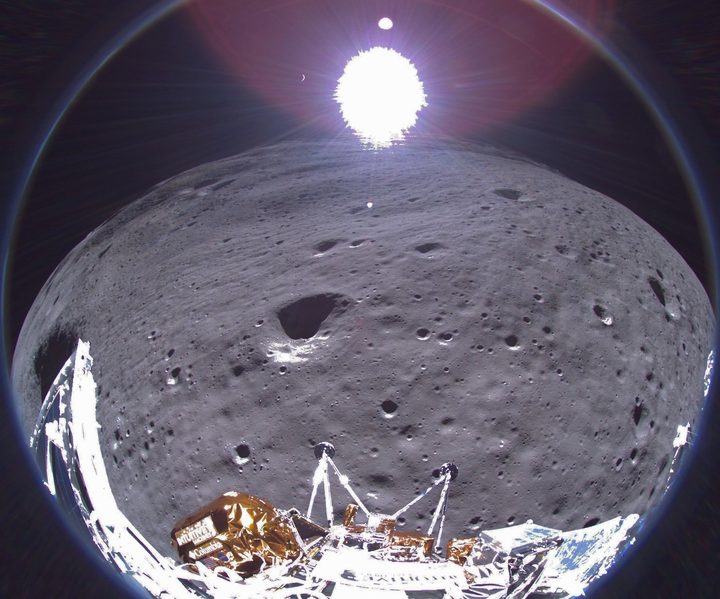
An image captured by Intuitive Machines' Odysseus lunar lander.
Intuitive Machines

Despite a messy landing that left the Odysseus spacecraft with a broken leg and tilting over, the team at Intuitive Machines has hailed its IM-1 lunar mission a success.

That’s because it managed to get Odysseus onto the lunar surface largely in one piece and operating well enough to send data back to Earth.

Recommended Videos

In achieving the feat, Texas-based Intuitive Machines became the first private company to perform a soft landing on the moon and the first U.S. endeavor to make a soft lunar landing since the final Apollo mission in 1972.

The downside is that the lander’s solar panels aren’t receiving sunlight as effectively as intended due to its wonky position. With its current energy reserves used up, Odysseus has now powered down for a lunar night, with the mission team crossing their fingers in the hope that once the sun’s rays hit its panels again later in March, the lander will come back to life.

On Thursday, Intuitive Machines shared another image (below) from the lander — this one received in the final batch of data — showing part of Odysseus, a section of the moon, and a small crescent Earth.

“Before its power was depleted, Odysseus completed a fitting farewell transmission,” Intuitive Machines said in a post on social media. “Received today, this image from February 22nd showcases the crescent Earth in the backdrop, a subtle reminder of humanity’s presence in the universe,” the post said, adding, “Goodnight, Odie. We hope to hear from you again.”

Before its power was depleted, Odysseus completed a fitting farewell transmission. Received today, this image from February 22nd showcases the crescent Earth in the backdrop, a subtle reminder of humanity’s presence in the universe.

Goodnight, Odie. We hope to hear from you… pic.twitter.com/RwOWsH1TSz

— Intuitive Machines (@Int_Machines) February 29, 2024

While Intuitive Machines is hoping to squeeze more data out of Odysseus should it spring into life in a few weeks from now, the team is also taking what it’s learned from the mission to prepare for another lunar landing effort later this year.

Like IM-1, IM-2 will launch on a SpaceX Falcon 9 rocket in a mission that’s part of NASA’s Commercial Lunar Payload Services (CLPS) initiative in which the space agency contracts commercial partners as part of its Artemis program. The CLPS missions are laying the groundwork for crewed voyages to the moon, with the first Artemis astronaut landing currently targeted for 2026.


Trevor Mogg
Contributing Editor
Not so many moons ago, Trevor moved from one tea-loving island nation that drives on the left (Britain) to another (Japan)…
Elon Musk’ Starlink could soon offer mobile services as a US carrier
Showcase of T-Mobile Starlink service on an iPhone.

Elon Musk’s Starlink has already changed how millions of people access the internet, especially in places where traditional broadband struggles to reach. Now, the satellite internet service could be preparing for an even bigger leap — becoming your mobile carrier.

According to a Financial Times report, SpaceX has told investors it’s considering launching a retail Starlink mobile service in the US. Instead of simply partnering with wireless carriers, the company could begin selling mobile plans directly to consumers, putting it in direct competition with Verizon, AT&T, and T-Mobile.

Read more
Lightsails have hit another speed bump on the road to interstellar travel
The coolest interstellar travel idea may get betrayed by the light pushing it
LightSail in Earth orbit

Laser-powered lightsails are one of the coolest answers to spaceflight. It might not be as sci-fi-sounding as a warp drive, but now, its practicality has also come under question. Using lightsails, a spacecraft could unfurl an ultra-thin reflective sail and let a powerful laser push it toward another star, without relying on fuel.

The tech was simple and elegant--except it's also more complicated than it sounds. A new preprint from researchers Chao Shen and Jiaze Li of the Harbin Institute of Technology suggests that relativistic lightsails may run into a hidden propulsion problem once they start moving extremely fast.

Read more
The galaxy has an exoplanet size mystery, and NASA’s EVE mission wants to solve it
This planet-hunting mission wants to catch baby worlds before they grow up
Artist’s Illustration of Exoplanets Orbiting Barnard’s Star

Mankind venturing into space ended up creating more questions than it answered, and one of the dilemmas is related to the planet sizes. Astronomers have found plenty of rocky super-Earths and plenty of puffier sub-Neptunes, but far fewer planets with a radius of about 1.8 times Earth’s.

That gap is known as the radius valley, and a proposed mission called the Early eVolution Explorer, or EVE, wants to figure out why it exists. NASA has a simple plan: look at planets while they are still young. The mission concept, detailed in a new arXiv preprint and covered by Phys.org, would focus on newly formed star clusters to see what small planets look like before billions of years of evolution.

Read more