  1. Home
  2. Space
  3. News

It’s exactly 20 years since a Mars rover took this historic image

Add as a preferred source on Google

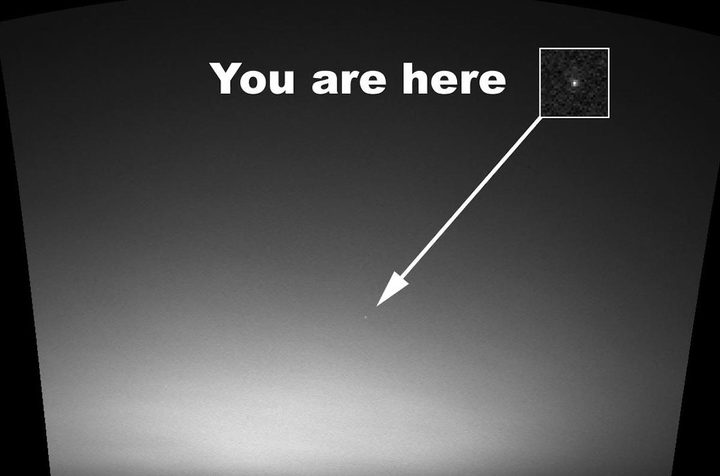
The first photo of Earth taken from the surface of another planet.
This is the first image taken of Earth from the surface of another planet. It was captured by NASA’s Mars rover, Spirit, one hour before sunrise on the 63rd martian day, or sol, of its mission in 2004. NASA/JPL/Cornell/Texas AM

Twenty years ago, on March 8, a NASA Mars rover made history when it captured the first image of Earth from the surface of another planet.

Recommended Videos

The rover, Spirit, landed on the Martian surface in January 2004. Soon after landing in Mars’ Gusev Crater, Spirit wasted little time beaming back images of its new surroundings. A couple of months later, it snapped a mind-blowing image (above) offering a view of Earth that was as fresh as it was astonishing.

“Shortly before sunrise [on March 8], Spirit’s camera managed to capture Earth as a bright star, appearing much as Venus does to terrestrial observers. This marked the first photograph of Earth from another planetary surface,” NASA said in an article on its website this week.

It was nearly another 10 years before another NASA rover, Curiosity, came along and captured its own image (below) of Earth, this one from inside Mars’ Gale Crater. Curiosity’s picture is remarkable because it also shows Earth’s moon despite being taken from 99 million miles (159 million kilometers) away.
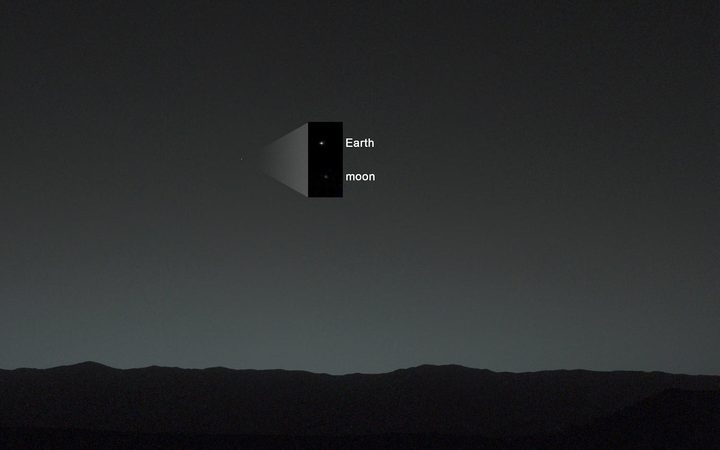
Earth captured from Mars by NASA's Curiosity rover.
NASA/JPL-Caltech/MSSS/TAMU

“These images — and others taken of Earth from ever-more distant vantage points over the past eight decades — provided a new perspective of our home planet’s place in our solar system,” NASA said.

Spirit explored the Martian surface for almost another six years, with the last contact from the rover coming on March 22, 2010. Curiosity, meanwhile, continues its work in Gale Crater until this day, and another rover, Perseverance — NASA’s most advanced to date — has been exploring Jezero Crater since arriving there in spectacular style in February 2021.

In December 1968, another iconic Earth image was captured not by a rover but by retired astronaut Bill Anders during the Apollo 8 lunar mission in December 1968. In recent years, astronauts aboard the International Space Station have also been snapping sublime images of our planet from 250 miles up.

Trevor Mogg
Contributing Editor
Not so many moons ago, Trevor moved from one tea-loving island nation that drives on the left (Britain) to another (Japan)…
Getting to Mars may require a pit stop in orbit, and NASA just tested the nozzle to make that happen
A gas pump nozzle for spacecraft sounds simple. It is not, and that's what makes this test worth paying attention to.
Architecture, Building, Factory

Getting a spacecraft to Mars or beyond requires an enormous amount of fuel, most of which has to be hauled from Earth, adding to the overall cost and weight of the spacecraft. NASA has been working on a different approach, one that could be more efficient and effective.

It wants to refuel a spacecraft in orbit before heading out for the mission. What’s even more interesting is that the space agency just finished testing a component that could make that possible: a cryocoupler.

Read more
Elon Musk’ Starlink could soon offer mobile services as a US carrier
Showcase of T-Mobile Starlink service on an iPhone.

Elon Musk’s Starlink has already changed how millions of people access the internet, especially in places where traditional broadband struggles to reach. Now, the satellite internet service could be preparing for an even bigger leap — becoming your mobile carrier.

According to a Financial Times report, SpaceX has told investors it’s considering launching a retail Starlink mobile service in the US. Instead of simply partnering with wireless carriers, the company could begin selling mobile plans directly to consumers, putting it in direct competition with Verizon, AT&T, and T-Mobile.

Read more
Lightsails have hit another speed bump on the road to interstellar travel
The coolest interstellar travel idea may get betrayed by the light pushing it
LightSail in Earth orbit

Laser-powered lightsails are one of the coolest answers to spaceflight. It might not be as sci-fi-sounding as a warp drive, but now, its practicality has also come under question. Using lightsails, a spacecraft could unfurl an ultra-thin reflective sail and let a powerful laser push it toward another star, without relying on fuel.

The tech was simple and elegant--except it's also more complicated than it sounds. A new preprint from researchers Chao Shen and Jiaze Li of the Harbin Institute of Technology suggests that relativistic lightsails may run into a hidden propulsion problem once they start moving extremely fast.

Read more