  1. Home
  2. Space
  3. News

Hubble will switch to a new mode to preserve its troublesome gyros

Add as a preferred source on Google

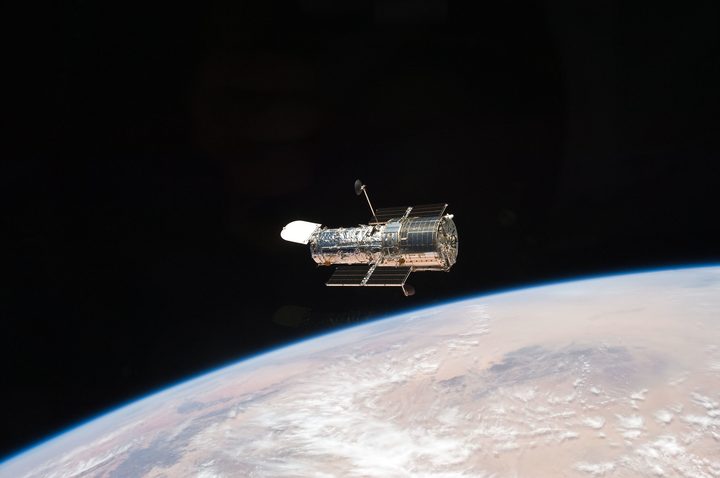
An STS-125 crew member aboard the Space Shuttle Atlantis captured this image of NASA’s Hubble Space Telescope on May 19, 2009.
An STS-125 crew member aboard the Space Shuttle Atlantis captured this image of NASA’s Hubble Space Telescope on May 19, 2009. NASA

The beloved Hubble Space Telescope will soon be changing the way it operates by limiting the speed at which it can target new objects in order to preserve its lifespan for as long as possible.

Recommended Videos

Hubble has been having problems with its gyros over the last year, causing the spacecraft to go into safe mode several times while teams on the ground worked to address the issue. The gyros, or gyroscopes, of which Hubble originally had six, are used to help the telescope turn and lock on to the target of study such as a star or galaxy. They work using an extremely fast-spinning wheel that is sealed inside a cylinder that floats in a thick, viscous fluid. This allows them to measure the speed at which Hubble is moving, so that it can accurately lock onto new targets.

Hubble originally used three gyros at a time, with the other three installed as backups. Over the years, various gyros have worn out and been replaced, leaving only three operational. Now, as one of the remaining gyros has been experiencing continuing issues, the Hubble team has decided to switch to using just one gyro at a time in order to preserve them for as long as possible.

The “one-gyro mode” will still allow Hubble to make science observations and to continue to take beautiful pictures of space. The downside of the mode is that it will take longer for the telescope to move from one target to the next, so there will be a decrease in the amount of observations it can make. It will also mean that Hubble can’t observe targets closer than Mars, such as the moon or Venus, although Hubble has rarely observed these targets in the past anyway.

“There are some limitations, but they’re not what I would call serious impediments to continuing science operations,” said Mark Clampin, director of NASA’s Astrophysics Division, in a briefing.

Clampin also emphasized that the agency expects Hubble to continue operating through the 2020s and into the 2030s. There have been previous studies of whether commercial technology like SpaceX’s Polaris could be used to boost Hubble, raising its orbit in order to extend its lifespan. Clampin said they were not planning to pursue those plans right now, but they may do so in the future.

NASA representatives also made it clear that they want to continue operating Hubble and making use of its incredible capabilities: “We do not see Hubble as being on its last legs, and we do see it as a very capable observatory capable of doing exciting science,” said Patrick Crouse, project manager for the Hubble Space Telescope.

The plan is to transition into one-gyro mode by reconfiguring both the spacecraft and some ground systems, with the aim to restart science operations in mid-June.


Georgina Torbet
Georgina has been the space writer at Digital Trends space writer for six years, covering human space exploration, planetary…
Elon Musk’ Starlink could soon offer mobile services as a US carrier
Showcase of T-Mobile Starlink service on an iPhone.

Elon Musk’s Starlink has already changed how millions of people access the internet, especially in places where traditional broadband struggles to reach. Now, the satellite internet service could be preparing for an even bigger leap — becoming your mobile carrier.

According to a Financial Times report, SpaceX has told investors it’s considering launching a retail Starlink mobile service in the US. Instead of simply partnering with wireless carriers, the company could begin selling mobile plans directly to consumers, putting it in direct competition with Verizon, AT&T, and T-Mobile.

Read more
Lightsails have hit another speed bump on the road to interstellar travel
The coolest interstellar travel idea may get betrayed by the light pushing it
LightSail in Earth orbit

Laser-powered lightsails are one of the coolest answers to spaceflight. It might not be as sci-fi-sounding as a warp drive, but now, its practicality has also come under question. Using lightsails, a spacecraft could unfurl an ultra-thin reflective sail and let a powerful laser push it toward another star, without relying on fuel.

The tech was simple and elegant--except it's also more complicated than it sounds. A new preprint from researchers Chao Shen and Jiaze Li of the Harbin Institute of Technology suggests that relativistic lightsails may run into a hidden propulsion problem once they start moving extremely fast.

Read more
The galaxy has an exoplanet size mystery, and NASA’s EVE mission wants to solve it
This planet-hunting mission wants to catch baby worlds before they grow up
Artist’s Illustration of Exoplanets Orbiting Barnard’s Star

Mankind venturing into space ended up creating more questions than it answered, and one of the dilemmas is related to the planet sizes. Astronomers have found plenty of rocky super-Earths and plenty of puffier sub-Neptunes, but far fewer planets with a radius of about 1.8 times Earth’s.

That gap is known as the radius valley, and a proposed mission called the Early eVolution Explorer, or EVE, wants to figure out why it exists. NASA has a simple plan: look at planets while they are still young. The mission concept, detailed in a new arXiv preprint and covered by Phys.org, would focus on newly formed star clusters to see what small planets look like before billions of years of evolution.

Read more