  1. Home
  2. Space
  3. News

A cosmic explosion will create a bright new star in the sky

Add as a preferred source on Google

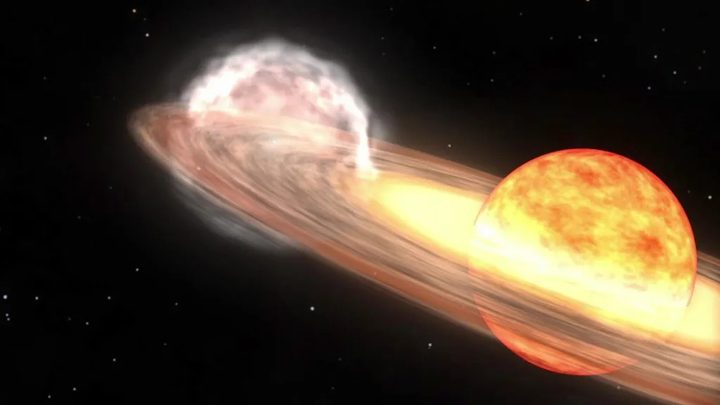
A red giant star and white dwarf orbit each other in this animation of a nova similar to T Coronae Borealis. The red giant is a large sphere in shades of red, orange, and white, with the side facing the white dwarf the lightest shades. The white dwarf is hidden in a bright glow of white and yellows, which represent an accretion disk around the star. A stream of material, shown as a diffuse cloud of red, flows from the red giant to the white dwarf. When the red giant moves behind the white dwarf, a nova explosion on the white dwarf ignites, creating a ball of ejected nova material shown in pale orange. After the fog of material clears, a small white spot remains, indicating that the white dwarf has survived the explosion.
A red giant star and white dwarf orbit each other in this animation of a nova similar to T Coronae Borealis. NASA/Goddard Space Flight Center

The night sky will soon be getting a brand new star when an expected cosmic explosion that will be visible from Earth even with the naked eye occurs this summer. It is the result of a phenomenon called a nova, where a binary star system called T Corona Borealis (T CrB) will explode in a flash of light that will take it from its dim form, currently visible only with a telescope, to a bright dot visible overhead.

Recommended Videos

A nova eruption happens in binary systems where two stars orbit each other. In the case of T Corona Borealis, the pair consists of a large dim star called a red giant and a smaller, but much denser star called a white dwarf. The white dwarf is the core left behind of what was once a star like our sun, and its density means it has strong gravity that allows it to eat away material from its companion.

“The ultra-dense white dwarf can steal material from the companion star in a process known as accretion, causing a layer of hydrogen to build up on the white dwarf surface,” explains astronomer Mark Hollands from the U.K.’s University of Warwick. “Once sufficient material has built up, this layer will reach a critical temperature, igniting hydrogen fusion. This powerful nuclear detonation ejects the gas from the white dwarf surface in a hot luminous shell. What we then see is the system becoming thousands of times brighter and is responsible for the observed nova.”

Typically, these nova explosions happen just once and are hard to predict. This system, though, is unusual it in that it erupts repeatedly, around every 80 years.

Astronomers have already observed telltale dips in the brightness of the system, and they expect the nova to occur within the next few months. Once the eruption happens, it should be easy to spot in the sky.

“The best thing you can do now is to get familiar with the patch of sky around the constellation Corona Borealis, using a star chart or phone app,” Hollands said. “Once you get to know what stars are visible in that part of the sky, you’ll really appreciate the difference when one night in the next few months there is one extra member of the constellation. The nova will be visible to the naked eye for a few nights and reach a similar brightness to other stars in the Corona Borealis constellation, but if you miss that window, it’ll still be visible for a few weeks with a good pair of binoculars.”

Georgina Torbet
Georgina has been the space writer at Digital Trends space writer for six years, covering human space exploration, planetary…
Elon Musk’ Starlink could soon offer mobile services as a US carrier
Showcase of T-Mobile Starlink service on an iPhone.

Elon Musk’s Starlink has already changed how millions of people access the internet, especially in places where traditional broadband struggles to reach. Now, the satellite internet service could be preparing for an even bigger leap — becoming your mobile carrier.

According to a Financial Times report, SpaceX has told investors it’s considering launching a retail Starlink mobile service in the US. Instead of simply partnering with wireless carriers, the company could begin selling mobile plans directly to consumers, putting it in direct competition with Verizon, AT&T, and T-Mobile.

Read more
Lightsails have hit another speed bump on the road to interstellar travel
The coolest interstellar travel idea may get betrayed by the light pushing it
LightSail in Earth orbit

Laser-powered lightsails are one of the coolest answers to spaceflight. It might not be as sci-fi-sounding as a warp drive, but now, its practicality has also come under question. Using lightsails, a spacecraft could unfurl an ultra-thin reflective sail and let a powerful laser push it toward another star, without relying on fuel.

The tech was simple and elegant--except it's also more complicated than it sounds. A new preprint from researchers Chao Shen and Jiaze Li of the Harbin Institute of Technology suggests that relativistic lightsails may run into a hidden propulsion problem once they start moving extremely fast.

Read more
The galaxy has an exoplanet size mystery, and NASA’s EVE mission wants to solve it
This planet-hunting mission wants to catch baby worlds before they grow up
Artist’s Illustration of Exoplanets Orbiting Barnard’s Star

Mankind venturing into space ended up creating more questions than it answered, and one of the dilemmas is related to the planet sizes. Astronomers have found plenty of rocky super-Earths and plenty of puffier sub-Neptunes, but far fewer planets with a radius of about 1.8 times Earth’s.

That gap is known as the radius valley, and a proposed mission called the Early eVolution Explorer, or EVE, wants to figure out why it exists. NASA has a simple plan: look at planets while they are still young. The mission concept, detailed in a new arXiv preprint and covered by Phys.org, would focus on newly formed star clusters to see what small planets look like before billions of years of evolution.

Read more