  1. Home
  2. Computing
  3. News

Apple may have just killed this 16-year old Mac product

Add as a preferred source on Google
CD in a CD drive on a Macbook Pro.
Chris Yates / Unsplash
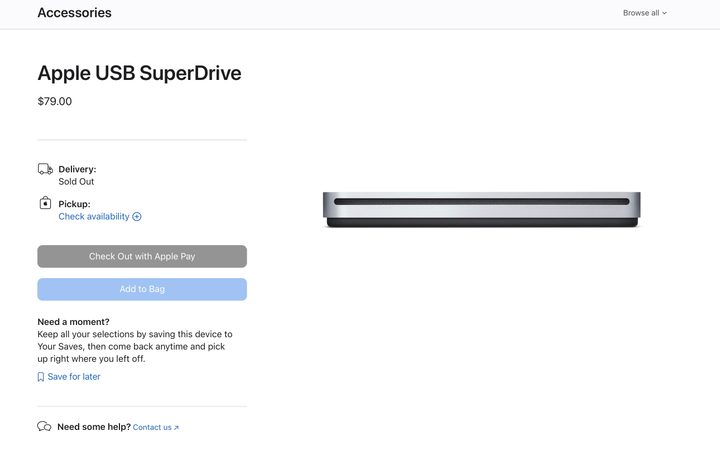
Sold out Apple SuperDrive screenshot.
Apple

After first going out of stock in the U.S. and later in every country in the world, people (and MacRumors) are beginning to assume the 16-year-old Apple SuperDrive isn’t coming back. The company hasn’t said anything about it officially, but many of its current customers probably don’t know or remember that it exists or is still sold.

When the first MacBook Air launched in 2008, its big selling point was the same as it is now — it’s superthin and light. Getting the size down to fit in a Manila envelope meant removing lots of ports, and that included the disc drive. It felt like a pretty bold move at the time. After all, how would you download software? Or what if you needed to burn a mix CD for your high school crush?

Recommended Videos

Well, to give people the option to still play CDs and DVDs on their Macs, Apple released a stand-alone disc drive called the SuperDrive. It uses a USB-A connector, which was fine at the time of release, but if you wanted to use one now, you’d have to buy a USB-C to USB-A adapter as well. It’s also too old to be compatible with Blu-ray discs, so it really is quite out of date.

Of course, USB ports aren’t the only thing that has changed over the past 16 years. Physical media like DVDs have become a bit of a niche in the age of streaming and digital downloads. This transition is likely why Apple never upgraded the SuperDrive to USB-C, and ultimately why it’s now disappeared from the Apple Store now.

So, let’s pour one out for the SuperDrive, a unique solution to an innovation that took us one step closer to where we are today.

Willow Roberts
Willow Roberts has been a Computing Writer at Digital Trends for a year and has been writing for about a decade. She has a…
Claude Opus 5 is here, and Anthropic says it can rival Fable 5 in some tasks
Major software engineering improvements put Opus 5 closer to Anthropic’s top model
Claude Opus 5 logo

Anthropic has launched Claude Opus 5, its latest frontier AI model for coding, research, business work, and other complex tasks. The company says it delivers a major performance jump over Claude Opus 4.8 while keeping the same API price. Anthropic also claims it comes close to Claude Fable 5 on some coding and computer-use tests while costing far less per task.

Opus 5 is available across Claude’s apps and API. It is now the default model for Claude Max subscribers and the strongest option included with Claude Pro.

Read more
Humans actually prefer talking to an AI than a support person, says gas giant as it cuts jobs
British Gas cuts 1,300 support jobs as its CEO points to changing customer habits
Executive, Person, Electronics

Centrica, owner of British Gas, is cutting 1,300 call centre jobs, and its chief executive says changing customer behaviour is the main reason. The company plans to remove 800 roles as part of a “targeted deployment of AI tools,” on top of the 500 cuts announced last month. Customer service teams in Glasgow, Edinburgh, Cardiff, Leicester, Stockport, and Leeds will be affected over the next two years.

Some positions will disappear when employees leave and are not replaced, while the remaining cuts will come through redundancies. Trade unions have warned that Centrica’s AI investment will hand hundreds of human jobs to chatbots.

Read more
Intel just pulled its 14A production schedule forward by a year
Risk production for 14A is now planned for late 2027
Intel Core Ultra Desktop CPU

Intel has moved up the schedule for its next-generation 14A (1.4-nanometer) manufacturing process, giving its foundry turnaround an important new target.

During Intel’s Q2 2026 earnings call, CEO Lip-Bu Tan said 14A risk production for internal products is now planned for the second half of 2027. High-volume production is expected to begin in 2028. This is earlier than the previous timeline, when Intel was expected to begin risk production in 2028 and move to volume production in 2029.

Read more