1. Home
  2. Computing
  3. News

Intel wants to take modular laptops mainstream

Add as a preferred source on Google

Intel has released a paper detailing potential plans to manufacture modular laptops and mini PCs. This approach would decrease e-waste and minimize carbon footprint, as well as make devices repairable and upgradable for users.

Although desktop PCs are already completely modular with users often buying cases and parts separately and putting them together at home, laptops and mini PCs are pretty much the opposite. If you open up your laptop, you’ll see many of the parts are layered on top of each other and soldered in place.

Recommended Videos

This means you can’t remove them or reach what’s beneath them. This is called an all-in-one motherboard design, and Intel’s paper proposes splitting it into three separate parts: the motherboard and two IO modules. The IO modules would be designed to work with fanless, single-fan, and dual-fan systems for both consumer and commercial markets. By using common parts across multiple models, Intel could significantly improve the efficiency of the manufacturing process.
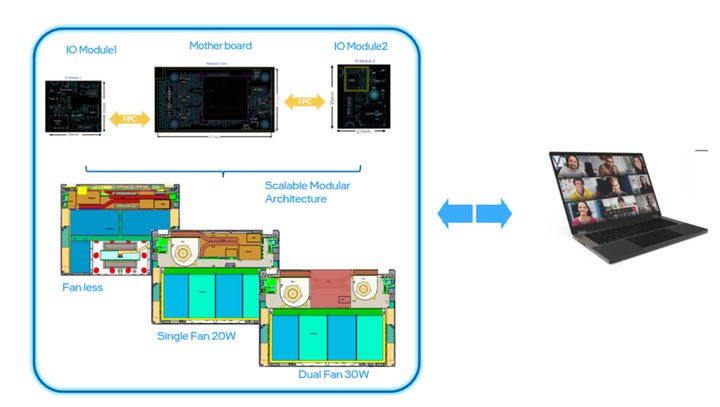
Intel graphic showing modular laptop parts.
Intel

The modules could also be used across generations so laptops wouldn’t need to be overhauled to accommodate new processors. Corporations may think repairability and upgradability will cause their profits to take a hit, but the simplicity and reusability they could bring would also cut costs for them. For consumers, modularity would mean you could keep the same laptop for much longer by swapping out memory and processors to keep performance up to date with current technology.

As for mini PCs, their current all-in-one design would also be broken down into three — a GPU module, a CPU module, and a Platform Controller Hub (PCH) module. This would work pretty much like a miniature desktop PC, letting you replace the modules and other parts as you want.
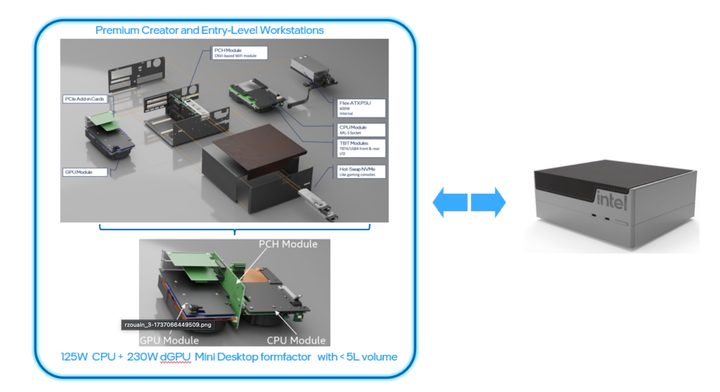
Intel graphic showing modular mini PC parts.
Intel

At the moment, Framework is one of the only laptop manufacturers that offers this kind of modular device — but delivering this modularity requires quite a few compromises. Current Framework laptops simply don’t feel high-quality enough to satisfy the average consumer, so the products only really work for those who see repairability and upgradability as top priorities.

If Intel were to get into modularity, however, it would essentially make the practice mainstream and many other manufacturers would follow suit. This would bring down prices, fuel new ideas, and make sure we get high-quality devices targeting all kinds of needs.

Willow Roberts
Willow Roberts has been a Computing Writer at Digital Trends for a year and has been writing for about a decade. She has a…
I let Radial menu take over my Mac, and I’m never going back
One mouse jiggle, endless shortcuts. My Mac has never felt this fast.
Radial app running on Mac

I have been testing Radial for the past week, and it's quickly become one of those apps I didn’t know how I could live without. It's a radial menu for macOS that puts your shortcuts, scripts, and automations right where your cursor is, so you never have to go hunting through menus to find what you need.

The app just received its 5.0 update, adding AI actions powered by Claude, window layouts, variables, a redesigned settings interface, a new Atmosphere background effect, and a squircle menu shape. I got to try most of these, and here's what I found.

Read more
Android desktop mode made me miss my laptop in record time
I tried writing and publishing from Google’s phone-to-monitor setup, and the future of mobile computing immediately started sweating.
Computer, Electronics, Laptop

Android 17 desktop mode has a very simple pitch. Plug your phone into a monitor, add a keyboard and mouse, and watch the slab in your pocket pretend to be a computer. I wanted to give that pitch a fair shot, so I tried using it for an actual workday instead of a cute demo.

The goal was boring on purpose: write an article, edit it, build the page in WordPress, upload whatever needed uploading, and publish the thing without running back to my laptop like a coward.

Read more
As AI turbocharges digital abuse, UK agencies urge parents to limit who sees kids’ photos online
The National Crime Agency and Internet Watch Foundation are asking parents to tighten privacy settings as AI-generated abuse material rises.
Social Media

Parents who post pictures of their kids online are being told to rethink the habit. The UK's National Crime Agency and the Internet Watch Foundation have issued new guidance urging families to lock down their social media accounts, warning that publicly shared photos are increasingly being pulled and altered by AI tools to create child sexual abuse material.

The two organizations say most parents have no idea this is happening. Criminals no longer need to contact a child directly to generate such material. They can scrape an ordinary photo and run it through widely available nudify apps.

Read more