1. Home
  2. Space
  3. News

Dramatic satellite footage shows dust storm tearing across landscape

Add as a preferred source on Google
A dust storm sweeps across Mexico.
NOAA

Striking footage showing a dust storm sweeping across a part of Mexico has been shared by CIRA (Cooperative Institute for Research in the Atmosphere).

The dramatic clip, which plays at faster-than-normal speed, shows the enormous cloud of dust moving across the land like a huge wave of water. After watching it, Colorado-based scientist Dakota Smith described the recent weather event as “an all-timer.”

An incredible view of a dust storm charging south across Mexico. pic.twitter.com/pYVajCbbs0

— CIRA (@CIRA_CSU) April 21, 2025

The CIMSS Satellite Blog — an educational and informational site operated by the Cooperative Institute for Meteorological Satellite Studies — reported on the event last week, explaining how strong winds in the wake of a cold front had lofted areas of dust across parts of southern New Mexico, southwestern Texas and northern Mexico.

Recommended Videos

“The peak wind gust at El Paso, Texas was 50 kts (58 mph), and blowing dust reduced the visibility to 1/4 mile at Carlsbad, New Mexico,” the report said, adding that “the leading edge of the blowing dust was moving at speeds up to 35 kts across northern Mexico.”

The footage was captured by the National Oceanic and Atmospheric Administration’s (NOAA) Geostationary Operational Environmental Satellite-18 (GOES-18), which launched to orbit from Cape Canaveral, Florida, in 2022. NOAA debuted the satellite’s first hi-res imagery soon after its deployment.

GOES-18 is part of a network of satellites that enable meteorologists to accurately monitor and forecast local weather events that impact public safety, among them thunderstorms, tornadoes, hurricanes, fog, flash floods, and — you got it — dust storms. It also detects and monitors environmental hazards, such as wildfires and volcanic eruptions.

The GOES-19 satellite was built by Lockheed Martin and cover a vast area that includes the U.S. West Coast, Alaska, Hawaii, Mexico, Central America, and the Pacific Ocean.

The advanced technology carried by the GOES-18 satellite enables information on severe weather events to be sent to NOAA’s Satellite Operations Facility in Maryland every 30 seconds, where it can be quickly analyzed.

Media outlets like The Weather Channel and AccuWeather also use GOES satellite imagery in their forecasts.

Trevor Mogg
Contributing Editor
Not so many moons ago, Trevor moved from one tea-loving island nation that drives on the left (Britain) to another (Japan)…
Space is becoming Bezos and Musk’s next data center site, and we have every reason to worry
The AI boom is coming for the night sky
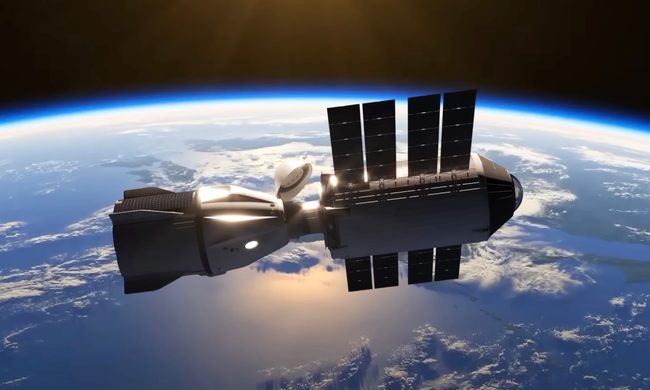
How Vast's space station will look in orbit.

AI data centers already consume vast amounts of electricity and water on Earth, so Silicon Valley has begun looking somewhere considerably more spacious... literally.

Elon Musk's SpaceX and Jeff Bezos' Blue Origin, along with several other companies, have proposed enormous constellations of satellites designed to operate as orbital data centers. However, environmental groups and former space officials are now warning that putting them into orbit at the proposed scale could have severe consequences for Earth's atmosphere and the night sky.

Read more
The first possible exomoon is here, and it makes our Moon look hilariously tiny
Scientists may have found the first exomoon, except this one is the size of Jupiter
This artist’s concept depicts a potential volcanic moon between the exoplanet WASP-49 b, left, and its parent star. New evidence indicating that a massive sodium cloud observed near WASP-49 b is produced by neither the planet nor the star has prompted researchers to ask if its origin could be an exomoon.

We have already discovered more than 6,000 planets outside of our immediate neighborhood. Yet, finding a moon orbiting one of those distant worlds has proved considerably harder. Astronomers may finally have something close to the real deal, but this particular object stretches the word “moon” almost beyond recognition.

Using the European Southern Observatory’s Very Large Telescope in Chile, researchers detected strong evidence for a moon-like object in the CD-35 2722 system. Further observations are still necessary to confirm the discovery, but it could become the first confidently detected natural satellite outside our solar system. There is still one tiny complication though. This moon is apparently massive.

Read more
China’s answer to SpaceX’s reusable rockets literally catches boosters in a net
SpaceX catches boosters on legs. China just used a net.
Ammunition, Missile, Weapon

SpaceX's playbook for recovering a rocket booster generally involves legs, a precisely controlled vertical landing, and either a concrete pad or a drone ship. 

China just managed to pull off something similar, but in a slightly different way, and on July 10, it tested the method as well.

Read more