Most modern big-budget games don’t have the most complicated sales pitches these days. Assassin’s Creed Shadows? It’s an open-world action-adventure game with stealth. Doom: The Dark Ages? It’s a first-person shooter with some extra melee combat. The First Berserker: Khazan? Soulslike. They all have elevator pitches that are easy to boil down to a quick genre descriptor. Capcom’s Pragmata, on the other hand, is the rare modern AAA project that will make you sound like you’re making a game up when describing it.
I know that feeling firsthand because it was playable for the first time at this year’s Summer Game Fest. I had a demo scheduled for it on day two of the event, but those who played it before me kept hyping it up to me. I asked what it is, expecting a reply like “it’s a third-person sci-fi shooter.” Instead, I was given a sales pitch about how I had to do puzzles in order to shoot. I couldn’t even picture what that looked like from the description, and that’s exactly what makes Pragmata special. It is a throwback to a specific kind of early 2010s action game that is built around a wild idea that you need to try to truly appreciate.
Hack in
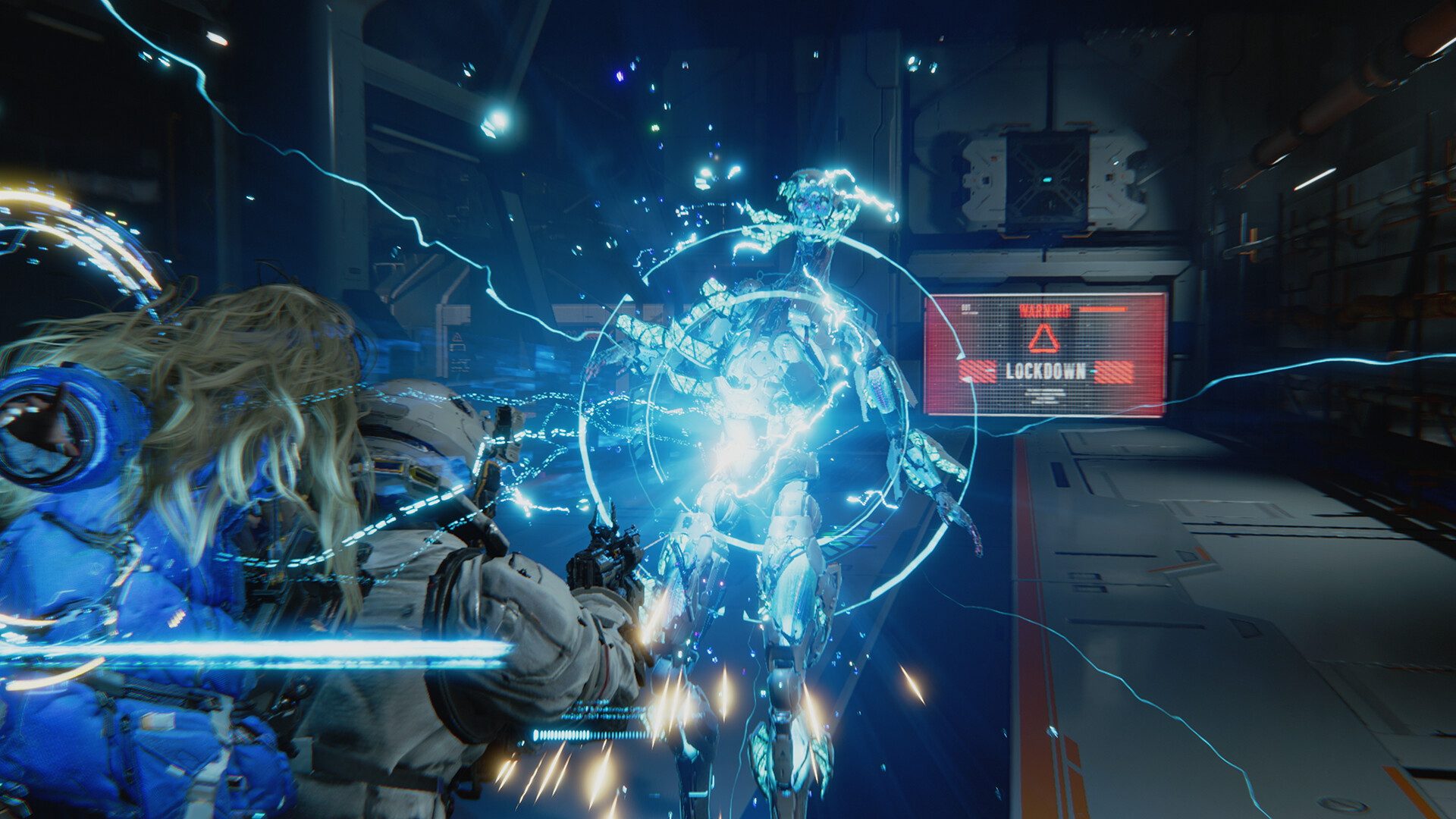
My demo takes me through around 20 minutes of gameplay that introduces the world and gameplay of Pragmata with efficiency. I get a quick introduction to my hero, Hugh Williams, a guy in a cybernetic spacesuit. He wakes up in a confused panic during the demo before meeting Diana, an android who takes the form of a small blonde child. Their meeting is quick as the two are ambushed by a robot. Hugh tells Diana to stay behind him so he can protect her, but his shots are doing next to nothing against the metalloid maniac. That’s when Diana disobeys his orders, hops up on his shoulders, and lends a hand.
This is where Pragmata gets fascinating. In order to do real damage to an enemy via your standard third-person shooting, players first need to complete an on-screen hacking minigame. Whenever I hold the left trigger to aim at a target, Diana opens a hacking interface on the right side of the screen. It’s a small grid, keypad like in nature, with some symbols on it. Using ABXY like direction arrow keys, I need to essentially draw a line from the starting point to a marked end point somewhere on the grid. There are other symbols on the grid, and passing through those before hitting the exit will add extra damage to my guns when the hack finishes. When I complete the puzzle, my enemy’s defense drops for a short amount of time and my shots can now tear them apart. When their shields regenerate, I need to hack them again.
Note that the game doesn’t pause while that puzzle is active. I still have full control of Hugh underneath the interface and need to use my control sticks to keep him out of harm’s way. If that sounds like a demanding multitasking operation, it’s not. While it took me a second to get the hang of it, the grid puzzles can be completed in lightning speed. By the end of the demo, I was zipping through them in no more than two or three seconds.
It’s an incredibly satisfying little hook and I feel like Capcom barely showed me how deep it goes. During my demo, I eventually began finding grid panels from crates around the world. Those would add new buffs on my grid that I could pass through on next hack, allowing me to take enemy defenses down even more if they are part of my line. I can see that idea escalating into a more engaging puzzle hook that lets skilled players stack up several buffs at once during a well routed hack. Pragmata will need that kind of evolution, because I can imagine that the simple nature of the early grids could get old after 10 or 15 hours (we don’t know how long Pragmata is yet, but I’d wager it’s a fairly typical compact action game from the linear slice I played).
The combat twist goes a long way towards making Pragmata feel special, because the third-person shooter under it would feel fairly typical without it. It’s your average over the shoulder shooter where players swap between four weapons, from a basic pistol to a more devastating blaster with limited ammo. The robotic enemies have plenty of weak points in their metal joints, so it’s important to take aim at those while their defenses are down. The mission I played had me unlocking a door by looking for four locks in a facility that I could hack. The light exploration and minigames were interspersed with moments where a few enemies would ambush me and I’d need to stop and take care of them. It’s all very straightforward, but the hacking was enough to leave me raving about it by the end of Summer Game Fest.
What stands out to me is how Pragmata feels like a game from another era. It has the energy of a Sega game circa 2010. Vanquish was the first point of comparison that came to my mind after playing even though the two games are nothing alike in terms of gameplay (though they have a similar sci-fi aesthetic). It’s more that the two have the same design philosophy: build an action game around one out-there gameplay idea that nothing else can claim. A lot of modern AAA games feel too afraid to take that experimental approach these days, instead cobbling together gameplay features from a menu. Doom: The Dark Ages‘ idea of a twist is adding parrying, and a lot of other games have the same idea. That makes for a lot of reliable experiences, but ones that leave the landscape feeling less vibrant than it used to be. Pragmata feels restorative in some way, bringing us back to a time where “gimmick” wasn’t such a dirty word.
The trick here will be making sure Pragmata doesn’t run a great idea into the ground. This is the kind of hook that makes for a fantastic 20-minute slice, but I’m itching to see it in a wider context. I don’t necessarily need combat depth here — nor do I actually want it — but I do want to see how much more Capcom can play with the hacking idea to create even stronger puzzles. I saw some different UI minigames while hunting for door locks, so it seems like more twists are coming. It’s not going to take much more to sell me though; I’m already sold on the idea of playing a glitzy action game that’s unlike anything else out today. That’s the only sales pitch I need these days.
Pragmata will launch in 2026 for PS5, Xbox Series X/S, and PC.