Whenever I get a new video game handheld (there are a lot of them these days), my first goal is always to find my “go-to game.” I seek out the kind of replayable puzzlers or roguelikes that I will always keep installed and come back to whenever I don’t have anything new to play. On Nintendo 3DS, it was Dr. Mario Miracle Cure. On Nintendo Switch, it was Tetris 99. On Steam Deck, it was Vampire Survivors. And now on Nintendo Switch 2, it’s Battle Train.
The new deckbuilding roguelike, published by Bandai Namco, has everything I want from a long-term console staple. It has that all-important “one more run” hook, strategic depth that reveals itself with each attempt, and tons of unlockables. It’s right up there with StarVaders as one of 2025’s most inventive and purely pleasurable games.
Battle Train (not to be confused with Monster Train) presents itself as a game show in which competing conductors try to destroy one another’s outposts by crashing trains into them. A surprising amount of work has gone into bringing that premise to life rather than treating it as loose set dressing placed around the clever central gameplay. It’s fully voice acted, looks like an Adult Swim cartoon, and includes over 50 unlockable story cutscenes that are structured like “behind the scenes” footage. It’s an incredible amount of effort put into a bit that would usually be reserved for a thin visual motif in a game like this.
That dedication to craft is reflected in the creative hybrid genre gameplay. A run is structured like Slay the Spire, with branching paths I can choose from that include battles, shops, and special events. That’s typical for the genre, but the fights are completely unique. In every battle, my computer-controlled opponent and I are dropped into an arena-like grid. We each start with one or two stations from which we can build tracks. The goal is to create a path from a station to an opponent’s outpost, which allows me to send an exploding train car into it and take down its health. To pull that off, I manage a growing deck of track cards which let me place down different track shapes. I need to spend crystals to do that, and routing a track through mines will raise how many actions I can play in a turn.
There is an immediate satisfaction to that gameplay hook. It feels like I’m playing a board game, placing down connecting tiles as I would in Carcassonne. That turns each battle into a clever puzzle game where I need to figure out how to build efficient railways that can get to my opponent quick, while passing through as many mines, supply drops, and coins as I go.
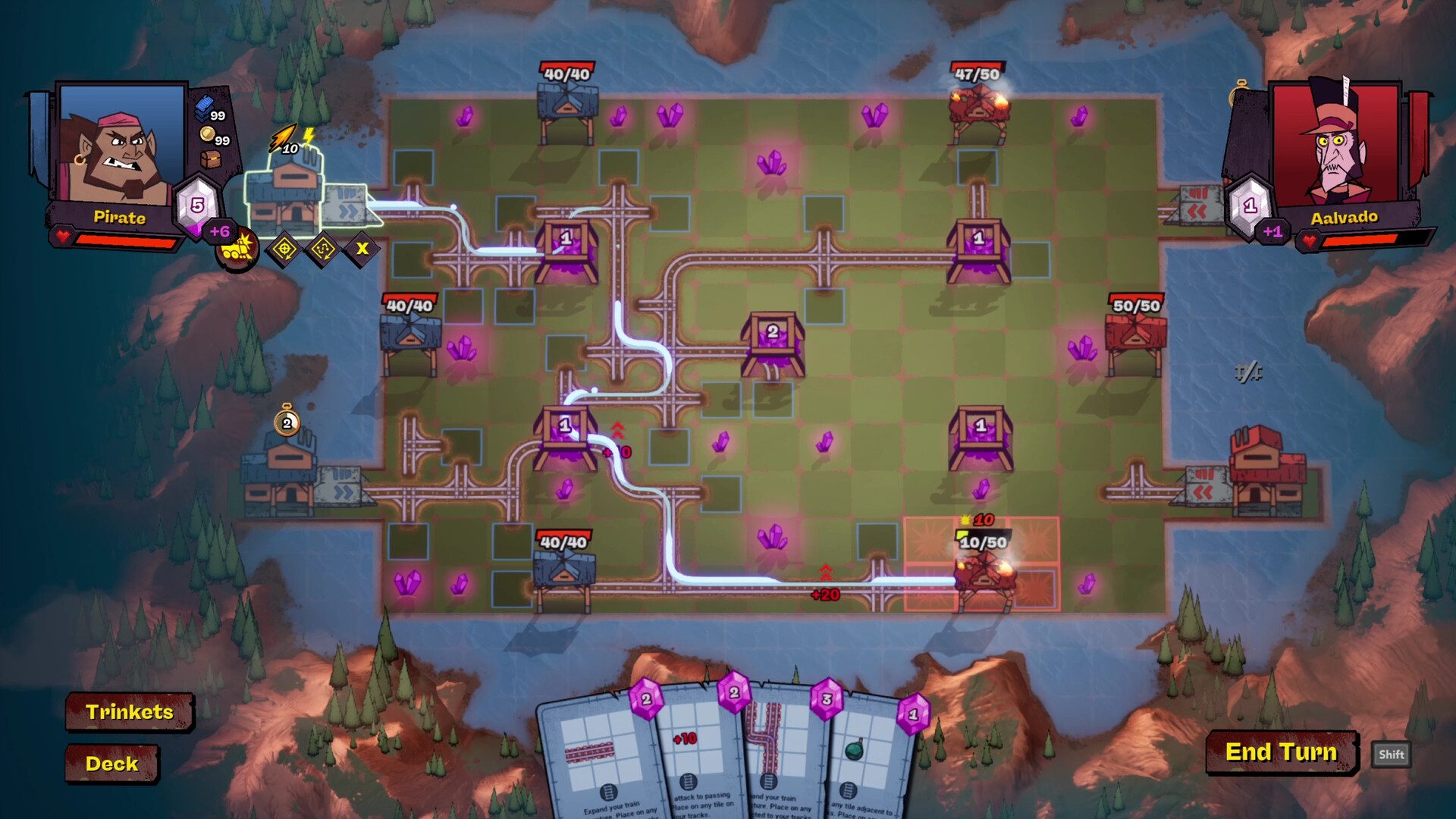
That’s only the first layer of the system’s depth. Soon, I realize that I can connect my track to my opponents’, which will give me all of their mine bonuses and let me build off of their work. If they’ve built a track that passes by one of their far off outposts, for instance, I could connect to their track to get close to their base quicker. In another run, I realize that I can also use my tracks to box my opponent out and limit where they can build. There’s strategy in keeping an enemy away from mines to keep them from generating more than a few crystals per turn, all while leaving them with few spaces they can build on in the process. The more I played, the more engrossed I was with just how much strategizing I could pull off with a deceptively simple puzzle system.
And even then, there’s way more I’m learning with each run. In addition to track cards, I can also play bombs that can blow up tracks, barricades that absorbs damage if an enemy attack passes through them, and more tools that let me manage the battlefield. I can even buy and earn mods for my train, which act as relics that give passive buffs. Some real build crafting potential springs from those tools. In one run, I gained a perk that cut the health of my outposts but made track cards free. I loaded up my deck with elaborate patterns that would usually cost two or three energy and created long, elaborate tracks on my very first turn. In another run, I crafted a deck that was all about planting towers that would damage outposts every turn and pairing that with a card that would let me trigger it whenever I wanted. I didn’t even have to built to a far off outpost to destroy it. No two runs have been the same for me so far, and each one has taught me more and more about how I can approach my task in creative ways.
If I have any issue here, it’s that I got too good at Battle Train too fast. A run goes through three biomes, each ending in a boss fight. If you clear that, you have a chance to move to a fourth area and beat an ultimate boss. It’s a sort of end game “super victory” but it’s not something that can be accessed right away. The fourth area is gated by a door that only opens once players have seen enough story events and gotten a high enough score. I cleared my first run in around seven attempts only to find that I’d need to unlocks dozens more cutscenes to get to the true ending. It feels like Battle Train expects players to take much longer to get to that point than it does, which can make for a bit of a buzzkill. It could desperately use an option to speed up enemy turns, too. There’s room for tweaking here, but none of this has stopped me from loading it up over and over again.
Even with two wins under my belt, I feel like I’ve only just begun to understand Battle Train‘s depth. There are more strategies I want to try, plenty of cards I’ve yet to unlock, and tons of comedic cutscenes to find. Mario Kart World may have eaten up hours of my time in my first week with the Switch 2, but Battle Train feels like it will stay on my home screen even longer.
Battle Train launches on June 18 for Nintendo Switch and PC.