
Modern economies depend on complex networks to move food, medicine, and essential components across borders. But in practice, most companies still struggle to understand what’s happening across their networks before things go wrong.
“We don’t need more data, but better ways to turn that information into decisions, in real time,” says Michael Hartmann, part of the founding team at Rome AI, “because timely decisions mean the difference between a minor issue and a major disruption.”
For years, enterprise software has focused on visibility: dashboards, metrics, status updates – that struggle to keep up with a world this volatile. Today’s challenge isn’t just knowing what’s happening. It’s being able to do something about it – immediately and reliably. Rome’s platform equips the Fortune 500 with AI agents that intervene when exceptions occur, resolving routine disruptions autonomously and escalating complex, high-stakes issues with the right context at the right time.
“Our goal isn’t more alerts. It’s fewer situations that require them”, adds Hartmann, who architected the infrastructure enabling AI agents to turn noisy signals into coordinated action. By detecting risks early, evaluating what matters, and helping teams respond before problems escalate, Rome is working to modernize the digital backbone of global supply chains.
The Systems Behind the Global Economy
It’s a field that rarely draws attention – until it fails. When a supplier misses a delivery or a container reroutes without notice, response often depends not on technology but on who opens their inbox first.
In practice, this work is embedded deep inside the workflows of the world’s largest manufacturers and distributors. It’s less about trying to model every possible future than helping people navigate the present: identifying what’s changed, surfacing what matters, and ensuring decisions are made before delays turn into disruptions.
“Michael brought a very specific kind of thinking to the table,” says Johannes Herter, the machine learning architect who is responsible for Rome’s data infrastructure. “It’s a mindset that treats breakdowns as part of the design space, not exceptions to it.”
Hartmann’s background blends scientific research with applied engineering, spanning AI infrastructure and software design. Before Rome, he co-founded a platform to support meaningful human interaction.
“The beauty of science is about connecting the dots,” he reflects. “The further the dots are apart, the more interesting it can be. In the context of frontier supply chain AI, connecting theoretical models to complex, real-world logistics opens up entirely new possibilities for optimization and intelligent decision-making.”
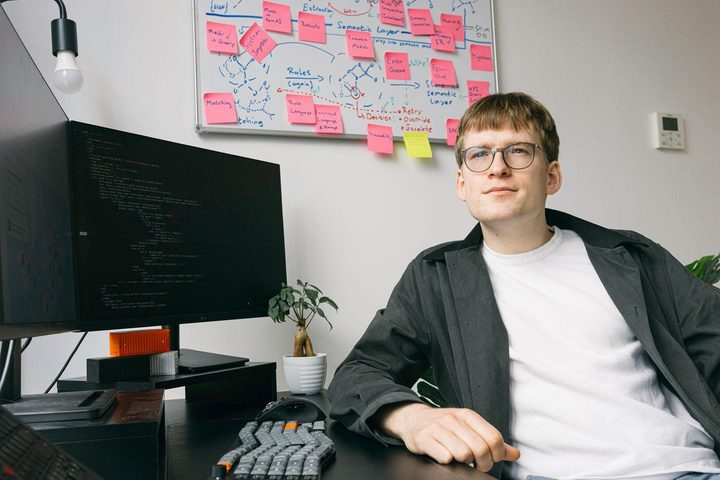
Trade Policy Moves Faster Than Most Systems Can
There is now a renewed interest in supply chain software.
“Such an architecture cannot be built for perfect conditions,” Mr. Herter said. “It has to be built for the moment something breaks.”
This way of thinking has become foundational to Rome’s approach: an emphasis on systems that function under pressure, adapt to edge cases and provide clarity in environments that are anything but clean.
From Awareness to Action
Across conversations with supply chain leaders, one idea keeps surfacing: AI’s value isn’t just in long-range forecasts but in empowering decision-makers today.
Asked what he sees as the missing link to making AI useful in the supply chain, Hartmann highlights the power of unstructured data. “Resilience doesn’t come from planning alone. It comes from designing systems that can leverage the messy, real-world signals that reflect what’s actually happening, not just what was supposed to.”
AI is beginning to deliver on that promise by reconfiguring the digital infrastructure supply chains depend on. And in an environment defined by speed and uncertainty, the ability to respond with clarity may prove more essential than prediction.


