
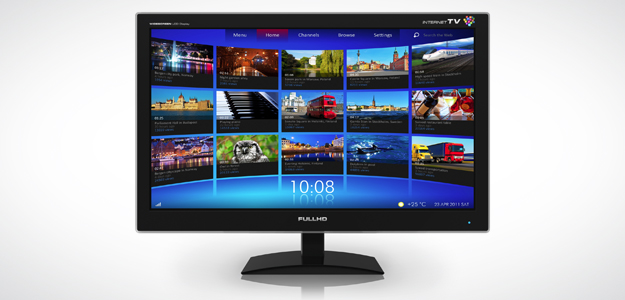
 The television, the tube, the TV, the box – Whatever moniker you ascribe to it, however you feel about its use or overuse, it is clear that, with respect to entertainment, it’s on the short list of the most important technological advancements ever. What’s also clear is that television is changing, morphing into a more customize-able, personalize-able experience; but it’s taken another of our watershed technological advances to spur it through its metamorphosis – the Internet.
Smart TVs are beginning to realize their potential as they dual-wield the powers of connectivity and computation, and provide the consumer with a myriad of entertainment options that extend beyond plain old cable. This kind of maturation, however, may only be the tip of the iceberg. For now, Smart TV mostly takes advantage of a pre-set, on-demand cache of TV shows and movies. While these represent an enticing entertainment option, they’re not a substitute to live TV, but rather a supplement. Recently, however, we’ve begun to see the next step(s) plotted out.
Earlier this year, we reported that Dish Network and Viacom were discussing the prospect of partnering on an Internet TV service that bundled networks into smaller, lower cost packages, designed to cater to the interests of different demographics. Though this method of delivery has been slow out of the blocks, many see it as the presumptive favorite for the “future of TV” mantle. The only impediment in its way is the networks. Old fashioned cable delivery is easier to understand and to measure, and bundling services in a “leave no man behind” manner has proved effective in the past. Still, it now looks as if recent developments may force even the more obdurate networks to read the writing on the digital wall.
Media giants Apple and Microsoft enjoy a special status among media providers in that they don’t just capitalize on trends, they create them. That said, it’s hard not to raise an eyebrow when you hear that the two giants have both been skulking around, seeking out content deals from television networks. More interesting still, is what they plan to do with the content they accrue.
Multiple reports have both Apple and Microsoft working on building their own, Internet-based TV subscription services. Though Microsoft balked a bit when it priced such an endeavor out, Apple seems to be heading full steam ahead. Steve Jobs’ iconic brainchild is even working on an Apple television (which may or may not be imminent), that would feature its own Smart platform, and possibly its in-the-works subscription service. If the TV world has learned anything from the music world, it is this: when Apple comes knocking, best batten down the hatches.
Also disconcerting to the old guard is the fact that Verizon has partnered with LG on an app that lets Verizon Fios customers watch live TV, sans set-top box. Verizon’s willingness to enter into such an agreement may signify that they’ve whipped out the old anemometer and are content to ride the prevailing winds. It’s one thing when the upstarts are ruffling feathers by trying to take things in a different direction, but when tenured, influential entities change course, its difficult to put the cat back in the bag.
Verizon Spokesman Bill Kula expressed a similar sentiment. “We’ve already seen that the tide has turned and its not going to change,” he said. He also told Digital Trends that he expects more than half of Verizon’s customers to be watching the majority of their television from streaming internet sources within five years, saying, “we’re already well into the era of the 2nd and 3rd screen. The train has left the station and we’re already well down the track.”
Adding even more momentum to this brewing revolution is that it has the support of one very important but yet unmentioned group: the consumers. Remember them? People are suddenly beginning to ask why they’re paying a premium for sports they don’t watch, or for stations like Home & Garden TV, when they feel it’s tantamount to a sedative. If you’re not interested in half of the package deal, then it’s not really a package deal is it?
So what’s taking so long? Well, it’s a complicated situation. Much of the industry is still dug in on the idea of packaged, take-it-all-or-leave-it-all type cable, and box-less Internet TV still represents an unexplored frontier. Content providers haven’t developed an effective way to measure every single viewer on the net, a reality that makes it more difficult to sell advertisements, or to assess the viability of certain programs.
Still, it appears that we’re finally eyeing the threshold at which the investment in the future will overtake the investment in the past. Once that threshold is crossed, it’s just a matter of time before TV, like most other entertainment, is subsumed by the driving force behind 21st century life – the Internet.


