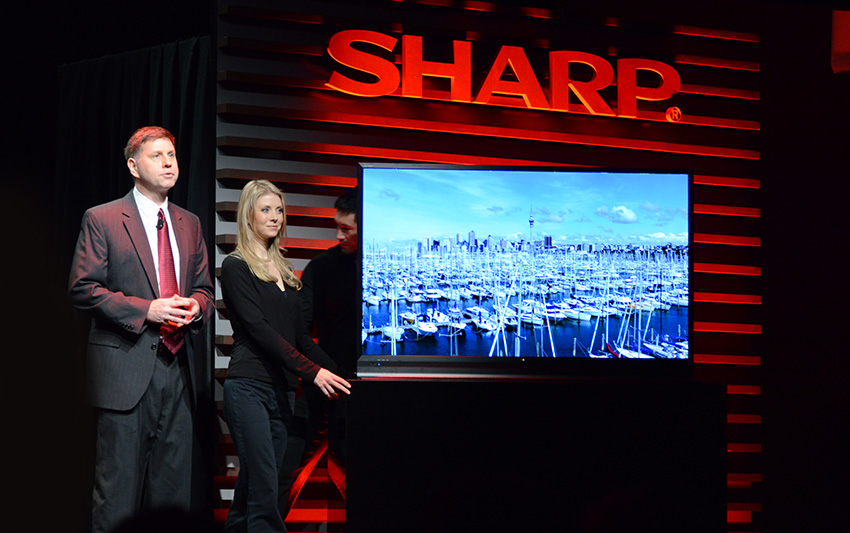
In the world of HD TV technology, Sharp has taken a backseat in recent years. Its Korean competitors, Samsung and LG, have been the talk of the industry with their massive 4K, Ultra HD TV’s, leaving us wondering when exactly Sharp will respond. In a conference room fairly modest for the magnitude of CES, Sharp’s CEO Toshi Osawa, accompanied by other company bigwigs, came out swinging with a big counter punch, unveiling a bevvy of new technologies and TVs that the company hopes will bring it swiftly back into competition in 2013 and beyond.
IGZO
It’s a funny name, but get used to hearing it. Sharp is implementing the new LCD technology in almost all of it’s new products for 2013, including phones, tablets, and HD TV’s. IGZO stands for Indium Gallium Zinc Oxygen, which is the construct of the new semiconductor that drives Sharp’s latest LCD’s, and we gotta say it looks pretty amazing. Sharp believes IGZO will be the “leading display technology for the next decade” running not only LCD’s, but also the next generation of OLED TV’s. The benefits Sharp touts for IGZO are many, including up to 80 percent power increase over normal LCD, increased touch targeting sensitivity, doubling the resolution of each pixel, and even an ability to stay lit after the device is powered off. Using Corning’s new Optis glass as the substrate, IGZO promises to be something to watch very closely in the coming months, and we’re excited to see if the new conductors can live up to the hype.
For more information on gallium, check out our DT explainer.
At last 4K TVs… sort of
After being seriously beaten to the punch by the big guys out of Korea, Sharp announced two brand new 4K TVs to be released “some time next summer”: the 60-inch Purios Ultra, which incorporates Sharp’s ICC (Intuitive Cognitive Creation) and the 70-inch Auqos Ultra HD TVs. Both TVs have stunning picture quality at the upscaled 4K resolution, and should help put Sharp back in the running. Even more exciting, though less concrete, is Sharp’s 85-inch 8K TV which has 16 — count it —16 times the resolution of normal 1080P HD! Sharp also showed 8K technology at last year’s CES, and it remains in the prototype category again this year. But it’s waiting somewhere tantalizingly close at Sharp’s booth, and we’re eager to get a second look. We’re also hoping Sharp has some kind of plan for content for this, the “Sharpest” of sharp Ultra HD screens, as most of it’s competitors are still working on 4K content.

2014 – The Year of the Moth?
Another crazy piece of future-tech Sharp teased us with today is it’s new Moth Eye nanoscale cone structure surfacing, due out some time in 2014. Copying the micro technology that moths utilize to hide from their prey by stopping all light reflection, Moth Eye surfacing is touted to produce almost zero glare back at the viewer, eliminating the need to shut yourself up in your house with shades drawn vampire-style while glued to your favorite movies, sports, and video games when that pesky sun is shining.
Big TVs, and smart central
Along with all the other Total Recall-style technology Sharp revealed today, it’s proven it really knows how to make some big TVs. Sharp is releasing 21 TV models in 2013 that are 60 inches or bigger. It’s also got 10 models of Smart televisions in it’s Auqos line up. The TVs use Sharp’s dual core “Smart Central” technology, bringing all the frills of online TV including streaming of your favorite content, connectivity to your smartphone, and even split screen viewing, all available in 60-, 70-, and even the mammoth 90-inch sizes.
It seems we’re just scratching the surface to what’s coming next for Sharp. We got a lot more than we bargained for in today’s press conference, and we can’t wait to see and hear more from the floor of CES. We’ll keep you posted about what we find in the next few days, but for now, rest assured that Sharp is fighting back in a big way to regain a serious presence in the HDTV market.