1. Home
  2. Space
  3. News

Watch Vast Space edge closer to the first commercial space station

The deployment of its technology testbed on Sunday is a big step toward commercial space habitation.

Add as a preferred source on Google
Vast Space's deploys a solar array in low-Earth orbit.
Vast Space

SpaceX successfully launched its Bandwagon-4 mission on Sunday, sending 18 satellites into low-Earth orbit using its trusty Falcon 9 rocket.​

The mission’s highlight was the successful deployment of Vast Space’s Haven Demo satellite, which is designed to test key technologies — including propulsion, flight computers, and navigation systems — for Haven-1, the company’s planned space station that aims to become the first privately operated habitable outpost.

Recommended Videos

Several hours after launch, Vast Space shared footage of the Haven Demo’s solar array deploying high above Earth. 

Haven Demo achieved mission success after deploying from SpaceX’s Bandwagon-4 flight on Nov 2, 2025. Following nominal separation and stable sun-pointing, the spacecraft captured 4K video of its solar array deployment and is power-positive. 🇺🇸 pic.twitter.com/rlGBjZVi4S

— Vast (@vast) November 3, 2025

NASA is searching for a replacement for the International Space Station (ISS), which is set to be decommissioned around 2030 due to its aging hardware and high maintenance costs.

Rather than fund the replacement itself, NASA intends to choose the best designs put forward by commercial organizations, Vast among them.

After selecting the best options — yes, there could be more than one — NASA will purchase “station services” from the new provider/s, with the station hosting astronauts for extended periods, as the ISS does now. Similarly, astronauts will conduct scientific research in microgravity conditions aboard the facility as it orbits Earth.

As part of the demonstration phase, Vast is aiming to launch its first space station module in May 2026.

Vast is competing with other firms for NASA’s nod, among them Axiom Space, Blue Origin, Starlab Space (a consortium including Voyager Space, Nanoracks, and Lockheed Martin), Northrop Grumman, Sierra Space, and SpaceX.

It’s also possible that some companies will develop and deploy space stations independently, without direct NASA contracts or selection. 

Sunday’s Bandwagon-4 mission included other payloads such as weather radar satellites from Tomorrow Companies, defense satellites from Korea, a number of technology and IoT small satellites from Turkey, and data processing technology from Starcloud, which is testing NVIDIA’s H100 AI chip for space-based computing.​

The launch, from Cape Canaveral in Florida, marked the third flight of this particular first-stage Falcon 9 booster, which previously launched KF-02 and KF-03. Following stage separation, the first stage landed on Landing Zone 2 (LZ-2) at Cape Canaveral Space Force Station, paving the way for a fourth mission using the same booster.

Trevor Mogg
Contributing Editor
Not so many moons ago, Trevor moved from one tea-loving island nation that drives on the left (Britain) to another (Japan)…
Amazon’s Starlink rival is set to launch satellite internet later this year
After launching nearly 400 satellites, Amazon says its Leo broadband service will go live later this year.
Atlas V launches 29 Amazon Leo satellites from Cape Canaveral, Florida

Amazon's long-awaited answer to SpaceX's Starlink is finally nearing liftoff. According to an exclusive report from Reuters, the company plans to begin offering its Leo satellite internet service later this year, after its latest rocket launch pushed the constellation to 394 satellites in orbit.

The pieces are finally falling into place for Project Kuiper

Read more
NASA is investing $590 million in private contractors to build humanity’s first Moon outpost
NASA is counting on private companies to land its Moon Base dream.
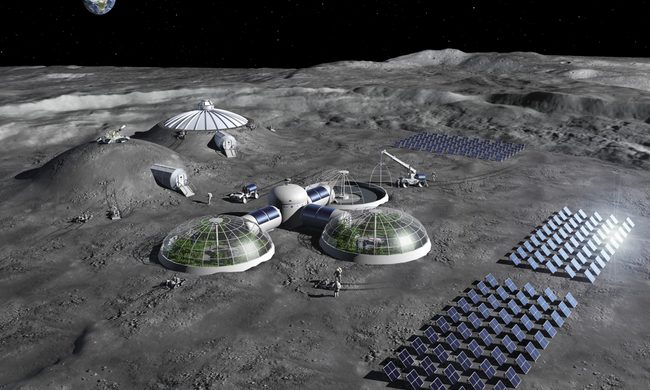
Artist impression of a Moon Base concept, with solar arrays for energy generation, greenhouses for food production, and habitats shielded with regolith.

Building a permanent base on the Moon sounds like science fiction, but NASA is making it feel a lot more real. The agency just handed $590 million in contracts to three private companies for four uncrewed lunar lander missions launching in late 2028.

These missions are part of Phase 1 of NASA's broader $30 billion Moon Base program, which needs to deliver landers, rovers, and scientific cargo up there before astronauts eventually move in. These efforts are closely tied NASA's Artemis program, which sent humans on a lunar flyby in April for the first time since the Apollo era.

Read more
Getting to Mars may require a pit stop in orbit, and NASA just tested the nozzle to make that happen
A gas pump nozzle for spacecraft sounds simple. It is not, and that's what makes this test worth paying attention to.
Architecture, Building, Factory

Getting a spacecraft to Mars or beyond requires an enormous amount of fuel, most of which has to be hauled from Earth, adding to the overall cost and weight of the spacecraft. NASA has been working on a different approach, one that could be more efficient and effective.

It wants to refuel a spacecraft in orbit before heading out for the mission. What’s even more interesting is that the space agency just finished testing a component that could make that possible: a cryocoupler.

Read more