1. Home
  2. Space
  3. News

NASA shares stunning Mars images on orbiter’s 20th anniversary

The images were captured from more than 150 miles above the red planet.

Add as a preferred source on Google
Mars captured by NASA orbiter.
NASA/JPL-Caltech/Univ. of Arizona

NASA launched the Mars Reconnaissance Orbiter in August 2005 and the following year, on March 10, it entered the orbit of the red planet where it continues to operate today.

Data returned to Earth by the MRO has revealed Mars in unprecedented detail and over the years has helped scientists to find out more about the fascinating planet. 

Recommended Videos

For example, during its work, the MRO has found signs that liquid water may appear seasonally on present-day Mars. Thanks to the orbiter’s ultra-sharp HiRISE camera, the discovery not only revealed details about Mars’ geology and climate, but also helped assess the planet’s potential to support microbial life.

The trusty spacecraft also gathers data on the planet’s temperatures and minerals, and can even explore beneath the surface using its radar technology. 

While its scientific work is as important as it is exciting, the spacecraft is best known for the incredible imagery that it captures from its orbit about 155–196 miles (250–316 km) up.

On the 20th anniversary on Tuesday, NASA shared some of those images in a post on X:

For 20 years, our Mars Reconnaissance Orbiter has searched the planet for signs of long-ago water. It has sent back photos that are not only stunning, but useful – they’ll help us when future astronauts land on Mars to explore it. Which is your favorite? pic.twitter.com/mc4wHYjqm5

— NASA (@NASA) March 10, 2026

Below is a photo of a Mars crater spanning about 100 feet (30 meters) in diameter, surrounded by a large blast zone. The explosion that made this crater threw ejecta as far as 9.3 miles (15 km). Blue tones have been added to enhance the details. 

The next image, caught by chance, shows a towering dust devil tearing across the martian surface. Captured from 185 miles (297 kilometers) above the ground, the length of the whirlwind’s shadow tells us that it was more than half a mile (800 meters) high, which is similar to the height of the United Arab Emirate’s Burj Khalifa, the world’s tallest building.

The image below shows an area with unusual texture on the floor of Gale Crater, which is where NASA’s Curiosity rover landed in 2012. Blue tones have been added for a clearer view.

The rover is still operating there today (the MRO has even photographed it!), slowly climbing the base of Mount Sharp (Aeolis Mons), the large mountain at the center of the crater. It’s worth noting that the MRO also serves as a vital communications bridge, transmitting data from the Curiosity and Perseverance rovers back to Earth.

Again, blue tones have been added to the capture below to bring out details such as the tops of dunes and ripples. Like on Earth, many of these features change over time, with martian winds constantly blowing the sand, reshaping the landscape. 

NASA will continue operating the MRO for as long as the spacecraft remains healthy and has enough fuel, with plans for it to continue into the late 2020s, and possibly beyond. 

That means we can look forward to lots more incredible images from the veteran Mars orbiter.

Trevor Mogg
Contributing Editor
Not so many moons ago, Trevor moved from one tea-loving island nation that drives on the left (Britain) to another (Japan)…
Space is becoming Bezos and Musk’s next data center site, and we have every reason to worry
The AI boom is coming for the night sky
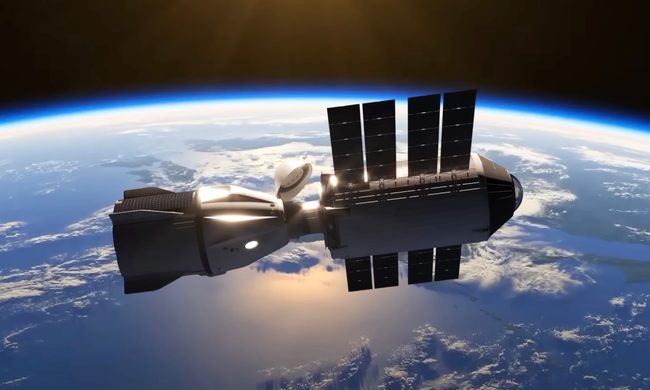
How Vast's space station will look in orbit.

AI data centers already consume vast amounts of electricity and water on Earth, so Silicon Valley has begun looking somewhere considerably more spacious... literally.

Elon Musk's SpaceX and Jeff Bezos' Blue Origin, along with several other companies, have proposed enormous constellations of satellites designed to operate as orbital data centers. However, environmental groups and former space officials are now warning that putting them into orbit at the proposed scale could have severe consequences for Earth's atmosphere and the night sky.

Read more
The first possible exomoon is here, and it makes our Moon look hilariously tiny
Scientists may have found the first exomoon, except this one is the size of Jupiter
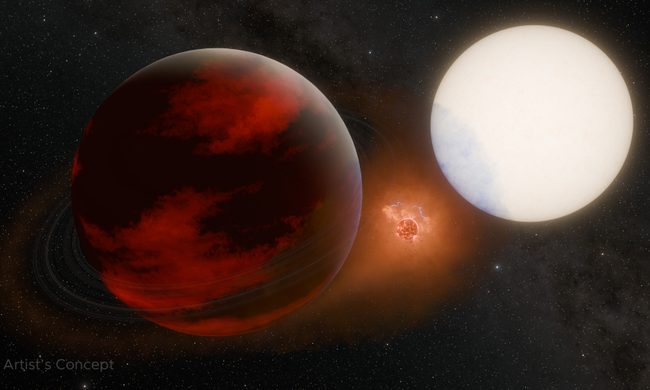
This artist’s concept depicts a potential volcanic moon between the exoplanet WASP-49 b, left, and its parent star. New evidence indicating that a massive sodium cloud observed near WASP-49 b is produced by neither the planet nor the star has prompted researchers to ask if its origin could be an exomoon.

We have already discovered more than 6,000 planets outside of our immediate neighborhood. Yet, finding a moon orbiting one of those distant worlds has proved considerably harder. Astronomers may finally have something close to the real deal, but this particular object stretches the word ā€œmoonā€ almost beyond recognition.

Using the European Southern Observatory’s Very Large Telescope in Chile, researchers detected strong evidence for a moon-like object in the CD-35 2722 system. Further observations are still necessary to confirm the discovery, but it could become the first confidently detected natural satellite outside our solar system. There is still one tiny complication though. This moon is apparently massive.

Read more
China’s answer to SpaceX’s reusable rockets literally catches boosters in a net
SpaceX catches boosters on legs. China just used a net.
Ammunition, Missile, Weapon

SpaceX's playbook for recovering a rocket booster generally involves legs, a precisely controlled vertical landing, and either a concrete pad or a drone ship.Ā 

China just managed to pull off something similar, but in a slightly different way, and on July 10, it tested the method as well.

Read more