  1. Home
  2. Computing
  3. News

Anthropic just taught Claude to dream between tasks, and it makes agents meaningfully smarter

Dreaming turns Claude from an AI that forgets everything the moment a session ends into one that quietly gets better at its job every time it's not actively working.

Add as a preferred source on Google
Claude Dreaming featured image.
Claude

Anthropic just gave Claude something that sounds like a perfect science fiction plot: the ability to dream. The company has announced three upgrades to Claude Managed Agents: Dreaming, Outcomes, and Multiagent Orchestration. 

While I agree that the Dreaming clearly has the most evocative name, it’s also the one with the most practical implications for developers building AI agents that can handle complex, long-running work. 

Live from Code with Claude: we’re launching dreaming in Claude Managed Agents as a research preview.

Outcomes, multiagent orchestration, and webhooks are now in public beta. pic.twitter.com/p4DFRzFEd8

— Claude (@claudeai) May 6, 2026

What is Claude’s Dreaming feature?

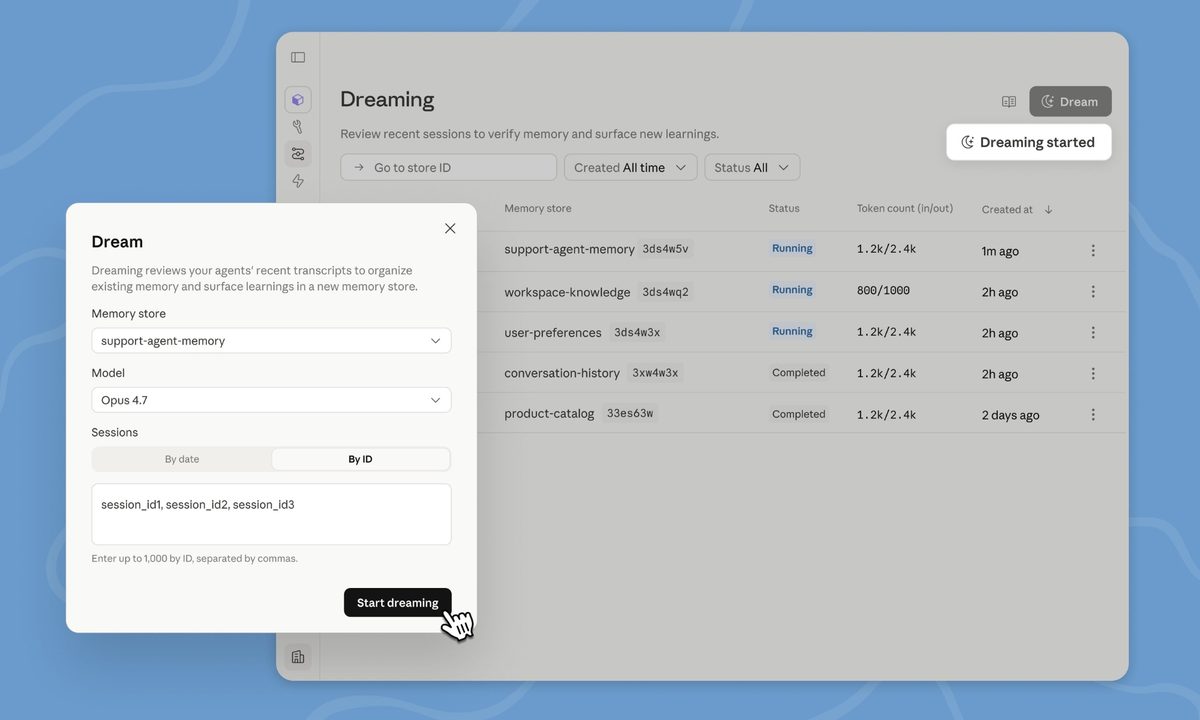
Despite the poetic name, Dreaming is a scheduled background process that takes place between active sessions. Its purpose is to review everything that an agent has previously done, including past conversations, logged memory, completed tasks, and look for patterns between them. 

Recommended Videos

Dreaming scans all the tasks performed by the agent, spots the mistakes it keeps repeating, the approaches it naturally prefers (built over sessions), and shares the insights across multiple agents working in parallel (when multiple Claude agents are working simultaneously). 

Once the agent figures everything out, it then locks those learnings into its memory, so that every new session starts with the same context of what worked and what didn’t the last time. Developers can either let Dreaming update memory automatically or keep reviewing the changes before they are applied. 

Outcomes lets you set the bar for quality. You write a rubric, a separate grader checks the output, and the agent iterates until it gets there.

Subscribe to webhooks to get notified when it’s done.

— Claude (@claudeai) May 6, 2026

What do Outcomes and Multiagent Orchestration add?

Currently, the Dreaming feature is available in research preview on the Claude Platform. The feature is a self-improvement mechanism that will help the agent compound its usefulness over time, particularly by acknowledging the mistakes it committed in the previous sessions.

Outcomes, as the name suggests, let developers define a set of parameters, requirements, or a standard against which the agent’s output is evaluated. The evaluation is conducted by a separate grading system that makes sure isn’t influenced by the agent’s own reasoning. If the agent’s response doesn’t meet the criteria, the grader demands another attempt.

Multiagent Orchestration allows multiple Claude agents to work in tandem on different parts of a complex task. This reduces the time and expands the scope of responses in a single workflow. Webhooks round out the update by enabling event-driven triggers for agents without constant manual prompting.

Shikhar Mehrotra
For more than five years, Shikhar has consistently simplified developments in the field of consumer tech and presented them…
Gemini will now take notes for you in Google Meet for you, if you the minimum $20 AI tax
Yet another Google subscription just dropped for Gemini
Google Meet Take Notes for me Gemini

Google has just released a useful Gemini feature, which you can try if you are a paying member of course. The company is now bringing "Take notes for me" for Gemini, which will be available in Google Meet for Google AI Pro and Google AI Ultra subscribers, along with eligible Workspace business customers.

For personal users, the feature starts with Google AI Pro, which costs $19.99 per month in the US. In other words, Gemini can now take your Google Meet notes, provided you pay the minimum AI tax.

Read more
After iPad Pro and MacBook Pro, the iMac could be the next in line for an OLED screen upgrade
iMac with M4

The iPhone got an OLED panel in 2017, while the iPad Pro followed in 2024. Even the MacBook Pro is expected to follow later this year or early next year. But what about the iMac?

According to TrendForce, the iMac could get an OLED upgrade. There's no timeline yet, but the direction is clear. Apple wants to replace its current display technologies with OLED, raising the bar for color quality for both regular users and professionals.

Read more
This $1,299 gaming PC wants to be a Steam Machine without waiting for Valve
Valve’s Steam Machine dream is already real in MetaPC's new prebuilt
MetaPC's Steamroller is a new Steam Machine rival

Valve’s Steam Machine may be the face of SteamOS, but the platform isn't exclusive to it. A big announcement after Steam Machine's unveiling was that SteamOS would be arriving on systems outside of the new hybrid console. Now, MetaPCs is one of the first to take advantage of this by opening the preorders for the Steamroller, a new prebuilt gaming desktop that ships with SteamOS installed by default.

Though Steamroller is not trying to be a tiny console-like cube. It is a normal desktop PC with standard parts and a real upgrade path. The system costs $1,299 and is listed with a preorder date of July 3, 2026.

Read more