
  1. Home
  2. Computing
  3. Social Media
  4. News

As AI turbocharges digital abuse, UK agencies urge parents to limit who sees kids’ photos online

The National Crime Agency and Internet Watch Foundation are asking parents to tighten privacy settings as AI-generated abuse material rises.

Add as a preferred source on Google
Social Media
Unsplash

Parents who post pictures of their kids online are being told to rethink the habit. The UK’s National Crime Agency and the Internet Watch Foundation have issued new guidance urging families to lock down their social media accounts, warning that publicly shared photos are increasingly being pulled and altered by AI tools to create child sexual abuse material.

The two organizations say most parents have no idea this is happening. Criminals no longer need to contact a child directly to generate such material. They can scrape an ordinary photo and run it through widely available nudify apps.

What the guidance recommends

The NCA and IWF are not telling parents to stop posting images of their kids entirely, according to The Guardian. Their guidance focuses on limiting who can see those photos by making social media accounts private or sharing images within a “close friends” list. Parents are also being asked to check their accounts for old photos that could be misused, including photos posted by relatives or friends.

Tim Wright, a senior manager at the NCA, said the changes only require a few simple actions. Lorna Sinclair, a child sexual abuse education manager at the agency, said many parents don’t take those steps because they don’t realize the problem exists in the first place.

The scale of the problem

The IWF says AI-generated abuse material rose 14 percent last year, with more than 8,000 confirmed images and videos identified in 2025 alone. Cases have included blackmail attempts against teenagers and school websites targeted specifically for photos of students’ faces, echoing findings from an earlier report on how generative AI has scaled abusive content online.

Recommended Videos

Even the IWF’s own technology chief admits the advice feels uncomfortable to give, since it puts the burden on families rather than the platforms or AI developers. Until stronger safeguards exist, tightening privacy settings may be the only real protection parents have.

Pranob Mehrotra
Pranob is a seasoned tech journalist with over eight years of experience covering consumer technology. His work has been…
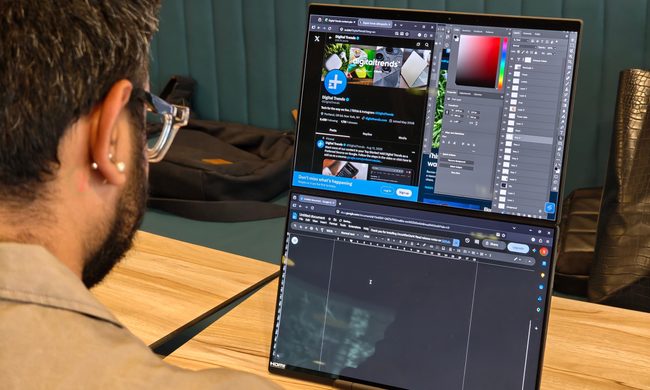
I used ASUS’ dual-screen laptop as a portable creative station, and my desk PC started collecting dust
The Zenbook Duo might be the creator setup I wanted in college
Computer Hardware, Electronics, Hardware

With laptops, brands are constantly in a balancing act between portability and workspace productivity. The ASUS Zenbook Duo UX8407AA tries to dodge that choice with a design that brings a whole setup in a compact form factor.

I used the Zenbook Duo as a creative machine, mainly with design apps, illustration work, writing, and multitasking. The model I tried runs on Intel’s Core Ultra 7 355, paired with 32GB of memory and a 1TB SSD. That gives it enough horsepower to handle Photoshop and Animate, for sketches and animations, and a lot more without breaking a sweat.

Read more
macOS clipboard app Maccy has a fake out there stealing passwords
PamStealer malware is disguising itself as Maccy to target Mac users
Depicting of the Maccy clipboard app for macOS on a laptop with letters inb the background.

A fake version of Maccy, a popular clipboard manager for macOS, is being used to deliver a newly discovered Mac malware strain called PamStealer. Researchers at Jamf say the malware impersonates the real open-source app, but its actual purpose is to steal data and capture a victim’s login password.

PamStealer arrives as a disk image containing an AppleScript file that impersonates Maccy. Once the user opens that file, macOS launches it in Script Editor, where the on-screen instructions tell them to press Command-R. To someone expecting a normal app installer, that may look like an odd setup step. In reality, that action runs hidden malware code and starts the attack.

Read more
A new technology teaching drones to feel pain could stop your self-driving car from harming itself
Drones first, autonomous cars next. A pain-sensing system that detects failure before it happens has real stakes for self-driving vehicles.
Transportation, Vehicle, Car

When you sprain your ankle in the middle of a run, your body sends a pain signal to your brain, forcing you to stop. Essentially, the ability to sense pain stops you from pushing through the injury and causing further self-harm.

Researchers at Delft University of Technology and Wageningen University have applied this exact concept to drones, giving them a digital equivalent of a nervous system that recognizes a faulty part and triggers a pain-like warning signal. What's even more interesting is that the technology could find use in self-driving cars.

Read more