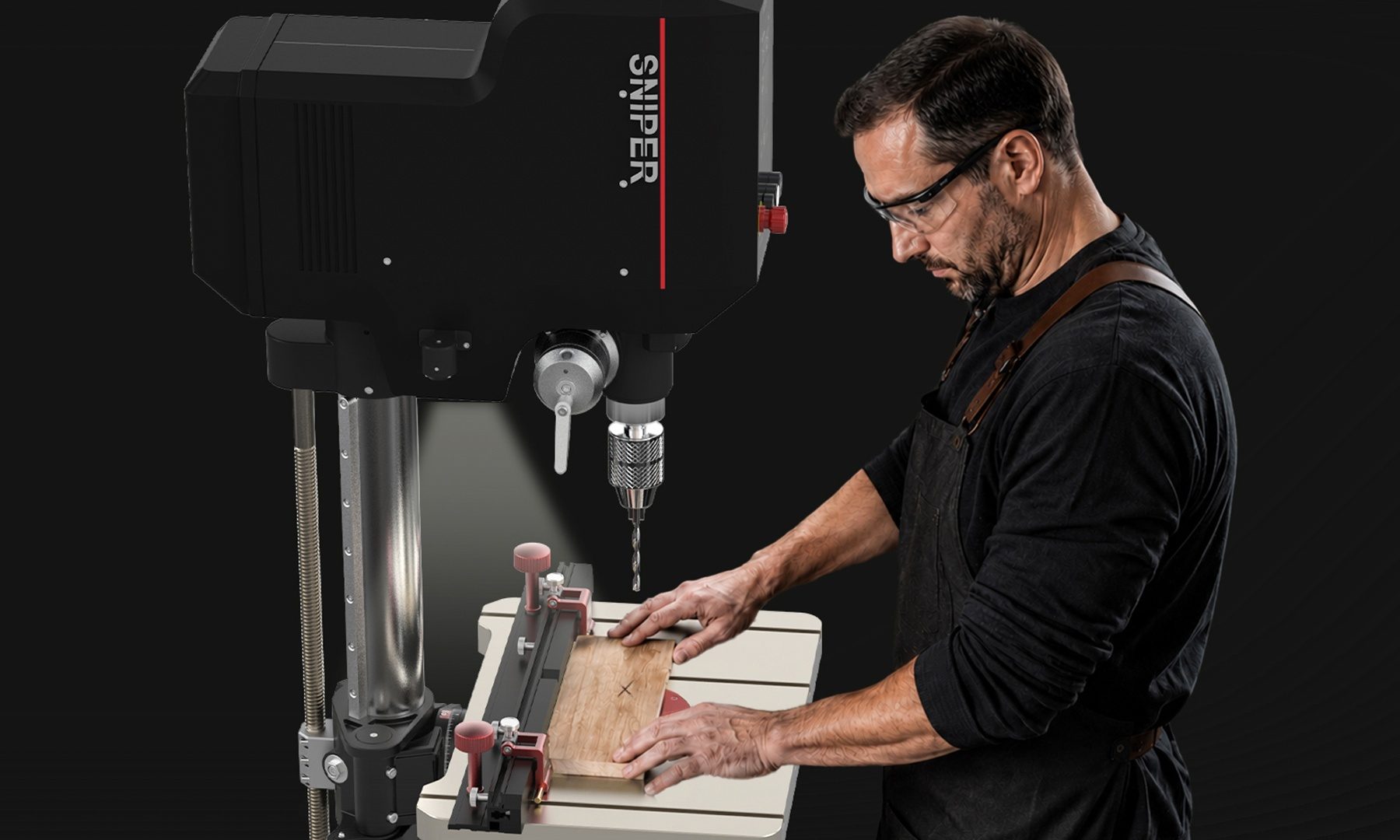
For roughly a century, the drill press was the most stubbornly unchanged tool in the workshop. CNC routers went digital. Laser cutters got software brains. Even the table saw picked up intelligent blade-detection technology. The drill press, meanwhile, remained a cast-iron column with a chuck on top, the same basic machine it had been in 1925.
That’s starting to change, and the shift is happening faster than most woodworkers expected.
A Longer Time Coming
The broader power-tool industry has been absorbing smarter technology for years, mostly at the motor and interface level. Variable-speed drives, digital readouts, preset memory, and automatic depth stops arrived in stages. Tools became more consistent and easier to repeat across a production run. Those were meaningful upgrades. They still left one part of the process entirely up to the operator, though: finding the mark and getting the bit over it.
Alignment has always been the hidden labor cost of drilling. Mark the board, lower the bit, squint, lift, adjust, lower again, check the divot, correct, and drill. On a 30-hole shelf-pin pattern, that sequence can eat an afternoon. The repetition is tedious enough on its own, and it also introduces small, compounding errors that are hard to catch until a shelf wobbles or a joint doesn’t close.
The intelligence spread through much of the shop without ever quite reaching the drill press.
What Embedded Computer Vision Changes
The next wave of development in workshop tools is pulling the intelligence closer to the work itself, away from phone apps and separate accessories and into the machine directly. Computer vision, once limited to expensive industrial equipment, has become inexpensive enough to embed in tools aimed at small shops and serious hobbyists.
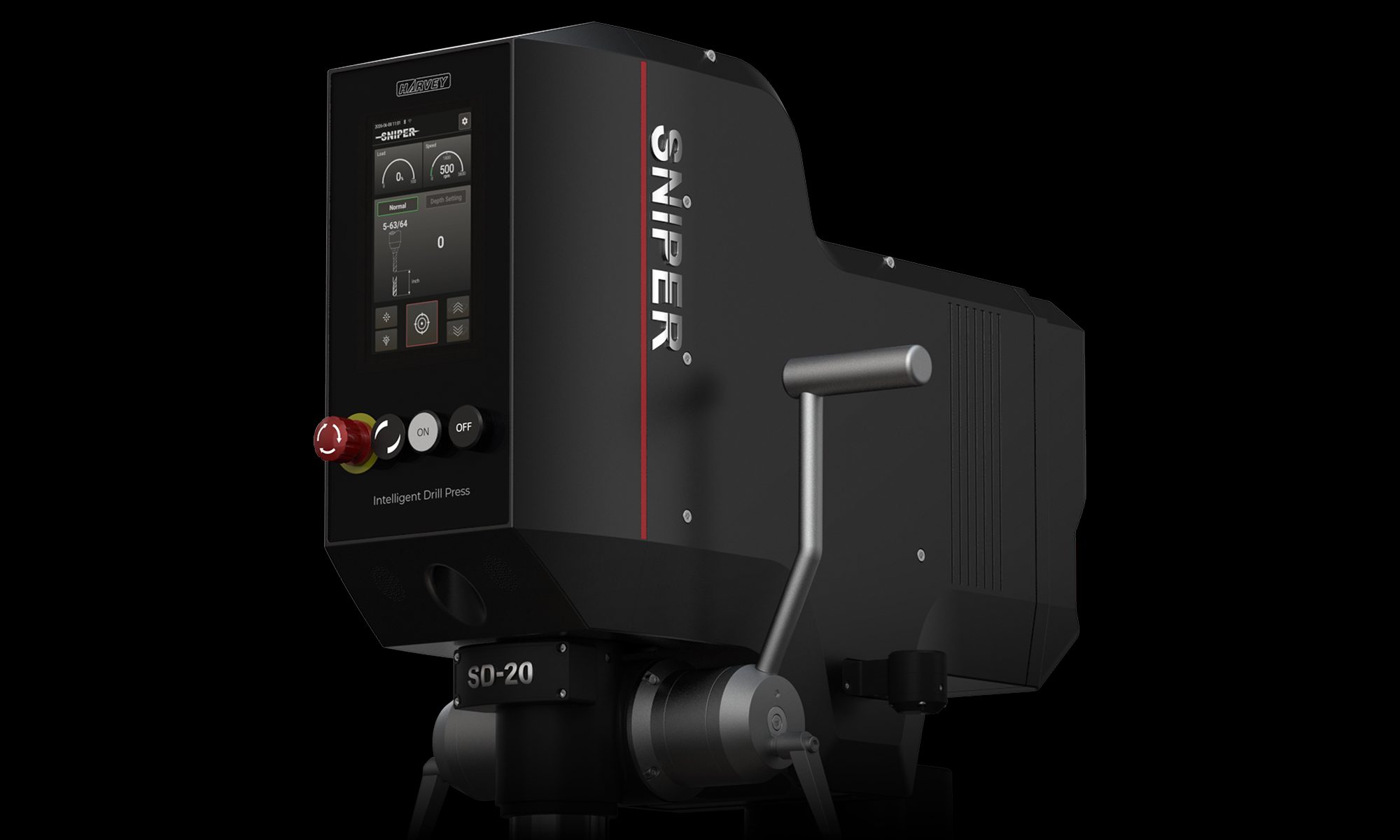
Harvey Industries is among the companies pushing in this direction. Their new Intelligent Drill Press, called Sniper, uses a downward-facing camera array, a neural network, and a robotic dual-axis servo platform to locate a pencil mark on a workpiece and move the spindle directly over it, with no repositioning required from the operator. Positioning accuracy is rated around 0.004 inches, which puts it in the range of shop-CNC precision in a machine sized for a one-car garage.
The neural network component handles what a simple camera cannot: distinguishing a valid target mark from sawdust, shadows, or the grain of figured wood. That kind of pattern recognition used to require controlled industrial environments.
The International Federation of Robotics has noted that falling costs for computer vision and AI components are enabling exactly this kind of capability shift. Machine intelligence that once lived on factory floors is now finding its way into smaller-scale professional and prosumer tools.
Safety as a Software Feature
Embedded vision is also reshaping how power-tool safety works. That change may be more consequential over time than any productivity gain.
Traditional power-tool safety has relied on physical systems: guards, kill switches, and friction brakes. They are effective, and once a tool ships, its safety profile is essentially fixed.
Vision-based systems open up a different approach. The same camera array that tracks a pencil mark can simultaneously monitor the operator’s hands. Harvey’s implementation, which the company calls the Proactive Safety Protection System, cuts spindle power and motion in the blink of an eye if a hand enters the danger zone. The interrupt occurs at the hardware level, which keeps response time tight regardless of software load.
The broader implication is philosophical. Safety systems built into software and firmware can be improved after the tool is already in the shop. A machine that ships in 2026 could be meaningfully safer in 2028 without any hardware change. Tool ownership starts to resemble the kind of ongoing development cycle familiar in consumer electronics, where the product on the shelf today is not necessarily the one it will be in two years.
What Comes Next for the Shop
Harvey Industries’ Sniper is one data point in a broader pattern. Phone apps now flag knots and grain defects before a board is cut. CNC routers communicate directly with design software. Table saws can distinguish wood from flesh in milliseconds. Computer vision and servo motion control are all converging in workshop tools at a pace that would have seemed implausible a decade ago.
Professional cabinet shops see the benefit in production costs. Hobbyists find the barrier to consistent results is lower than it used to be. In both cases, the machine is absorbing the positioning, monitoring, and correction work surrounding each cut, while the operator retains full control of the actual drilling.
Harvey Industries plans to release Sniper this summer. Pricing targets the custom-shop and advanced-hobbyist market, which is where most category-defining tools tend to start before the technology spreads more broadly.
The drill press took about a hundred years to learn to move. The next decade of workshop tools probably won’t need that long.