  1. Home
  2. Cars
  3. Legacy Archives

Outdated maps not cutting it? Continental’s ‘eHorizon’ could provide real-time HD updates

Add as a preferred source on Google

Today, when you scroll through in-car navigation or your smartphone’s mapping applications, the images you see are rarely current.

Satellite and street views often go months, even years between updates, which doesn’t do you much good if you’re trying to get a quick glance at the roads or perhaps spy on your neighbors.

Recommended Videos

Furthermore, dynamic events like weather and construction are not usually included, meaning potential delays could be lying in wait.

At the 2015 Consumer Electronics Show, German automotive manufacturer Continental AG spoke about its upcoming ‘eHorizon’ navigation unit, which could be a big step toward changing that.

Due out in 2017, the high-definition mapping system is designed to read and transmit road conditions back to Continental’s servers, which will then be sent out to eHorizon-equipped vehicles with little conceivable delay. Sure, you could survey weather forecasts, traffic reports, and DOT dispatches to get that information, but Continental’s tech could put it all in one place.

That means slippery roads, construction detours, accidents, and other traffic catalysts could be programmed directly into vehicle electronics. The technology will reportedly have the ability to accurately display roads within 20 centimeters.

To give you an idea of Continental’s track record, in 2012, the company released a ‘static map’ to a Swedish commercial vehicle manufacturer called Scania AB. Scania used the maps to chart out the location, grade, and height of every hill its trucks would use to predict the most efficient gear. After it was all said and done, the drivers reportedly reduced fuel consumption by 3 percent in one year.

The firm’s senior VP of interior electronic solutions, Ralf Lenniger, spoke to Automotive News at the conference, hinting that one automaker will showcase eHorizon before anyone else.

“We have a customer that we are intensively working with,” Lenninger said. “We’ll be ready in 2017, but that depends on the automaker.”

Partnerships with IBM, networking firm Cisco, and mapping company HERE are moving the project along, setting up servers, adding security, and scanning roads with lasers in anticipation of the technology’s debut.

Andrew Hard
Andrew first started writing in middle school and hasn't put the pen down since. Whether it's technology, music, sports, or…
Volvo is rolling out Apple Music to over 2 million cars with a simple OTA update
Your Volvo may soon get Apple Music without needing CarPlay
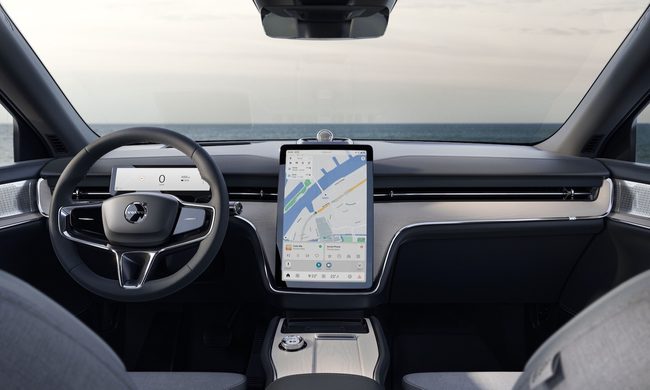
Interior view of the 2024 Volvo EX90.

The line between your smartphone and your car continues to blur. Volvo has announced that it is rolling out an over-the-air software update that brings Apple Music directly to the infotainment systems of more than 2 million vehicles worldwide. Instead of relying on Apple CarPlay or plugging in an iPhone, eligible drivers will be able to stream music natively from their car's built-in system, making Apple Music another integrated feature of Volvo's software experience.

The update is arriving for a wide range of Volvo models, including the EX90, ES90, XC90, S90, V90, XC60, S60, V60, XC40, EX40 and EC40, covering model year 2020 onwards. Availability, however, may vary depending on the vehicle.

Read more
Chery’s latest EV packs flagship tech for the price of a base Tesla, but you can’t buy it
Here's everything packed into Exeed's 2027 Exlantix ES, from its 27-sensor autonomous driving suite to its 860 km range, all starting under $31,000.
Car, Transportation, Vehicle

Chery's premium arm just dropped a sedan that makes you wonder why American EVs cost twice as much for half the tech.

Exeed's 2027 Exlantix ES ships with a driver-assist system called Falcon 700. It is built around an Nvidia Orin-Y chip and a genuinely stacked sensor suite.

Read more
A new AI model wants self-driving cars to think before they swerve
Forget guessing games, this self-driving AI actually shows its work.
Self driving car

Self-driving cars have gotten pretty good at driving. The harder problem is teaching them to drive safely in situations nobody planned for. We have heard horror stories of self-driving cars, behaving erratically in emergency situations, often times delaying first responders from reaching the scene.

A team at Seoul National University, led by professor Jun Won Choi from the Department of Electrical and Computer Engineering, thinks they have cracked part of that puzzle with a new AI model called SafeDrive. The research was recently selected as a highlight paper at CVPR 2026, a distinction that goes only to roughly 3% of all submissions.

Read more