1. Home
  2. Cars
  3. News

Tesla’s Bioweapon Defense Mode can save you from a military-grade chemical attack

Add as a preferred source on Google

Like most electrics, Teslas are generally known as environmentally conscious vehicles. They don’t burn a drop of fuel or spout any harmful emissions from their nonexistent tailpipes, but we had no idea just how eco-friendly they really were. According to a new test by the brand, the new Model X and Model S can literally cleanse the air of deadly chemicals, both inside the car and out.

In a blog post published Monday, Tesla detailed its state-of-the-art HEPA filtration system, which includes what is arguably the best-named feature of all time — Bioweapon Defense Mode. It sounds a bit cartoony at first, but according to the automaker, it’s powerful enough to protect vehicle occupants from a military-grade chemical attack, meaning everyday pollutants don’t stand a chance.

Recommended Videos

Read more: Blisteringly fast and blissfully refined, Tesla’s P90D is ludicrously livable

“Health and safety are important to us,” says Tesla. “Just as we’ve designed Model S and Model X to avoid collisions or protect their occupants when one happens, we felt compelled to protect them against the statistically more relevant hazard of air pollution. Inspired by the air-filtration systems used in hospitals, clean rooms, and the space industry, we developed a HEPA filtration system capable of stripping the outside air of pollen, bacteria, and pollution before they enter the cabin and systematically scrubbing the air inside the cabin to eliminate any trace of these particles.”

The result, says Tesla, is a system that is “hundreds of times” more capable at improving air quality than the filters you’ll find in most cars.
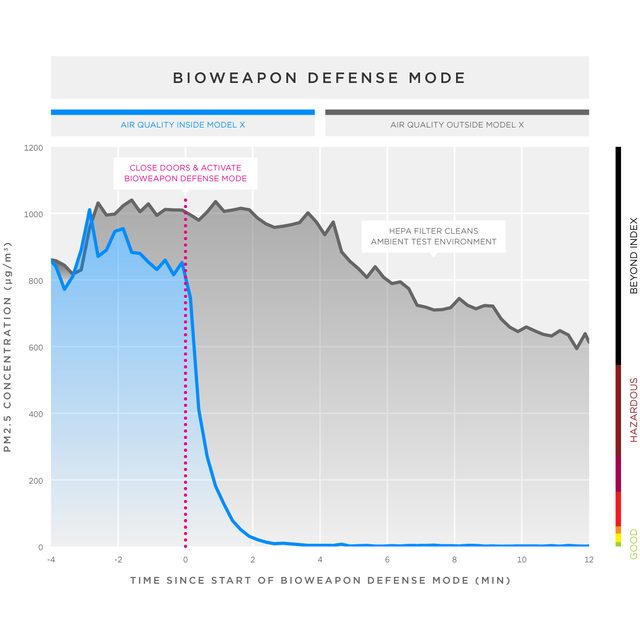
Tesla HEPA test results
Image used with permission by copyright holder

To test Bioweapon Defense Mode, the automaker drove a Model X through the smog-ridden cityscapes of California, but later decided to stage an extreme experiment inside a controlled environment. Essentially, Tesla put the SUV inside of a giant plastic bubble, pumped it full of toxins, and flipped on Bioweapon Defense Mode. In less than two minutes, the HEPA filters had brought the air inside the cabin back down to hospitable levels, and as you can see on the graph above, the Model X even purified the surrounding environment somewhat.

“Bioweapon Defense Mode is not a marketing statement, it is real,” the brand proclaims. “You can literally survive a military-grade bio attack by sitting in your car.”

Let’s hope we never have to find that out for real.

Andrew Hard
Andrew first started writing in middle school and hasn't put the pen down since. Whether it's technology, music, sports, or…
Tesla launches the six-seat Model Y Long Wheelbase in the US
The stretched electric SUV brings more space, more comfort, and up to 325 miles of range.
Tesla Model Y Long Wheelbase Featured

Tesla is giving the Model Y a little more breathing room. The company has officially launched the Model Y Long Wheelbase in the United States and Puerto Rico, introducing a stretched version of its best-selling electric SUV with a three-row, six-seat layout that's designed to make family road trips a lot more comfortable.

A bigger Model Y with a focus on comfort

Read more
A stolen Kia reveals the hidden limits of connected car technology
Kia can see where your stolen car is. GDPR means it won't share that in real time. That is the entire problem.
Kia EV3 design

If you’re buying a car with connected car technology, thinking it would help you to recover it in the event of theft, you might want to recalibrate your expectations. 

A recent incident in the UK, in which a car owner had three tracking devices installed in his car and still couldn’t recover it, led the carmaker to state that connected-car technology isn’t a “certified security vehicle tracker” (via the BBC).

Read more
Cambrige experts find utterly simple fix for longer lasting EV batteries. Just put some pressure on it.
Scientists found a way to make EV batteries last longer without reinventing the battery
EV Charging

EV battery breakthroughs typically involve new chemistry, exotic materials, or faster charging/higher capacity. But a new study reveals that you can skip all the fancy stuff and go with a very simple solution, Researchers from the University of Cambridge found that putting the battery under the right amount of pressure actually helps.

The study was about how physical pressure affects lithium-ion battery life, which found that keeping cells under constant pressure could double their lifespan. The work was published in Nature Energy, and the team says the improvement came without changing the active materials, electrolyte, or basic battery chemistry.

Read more