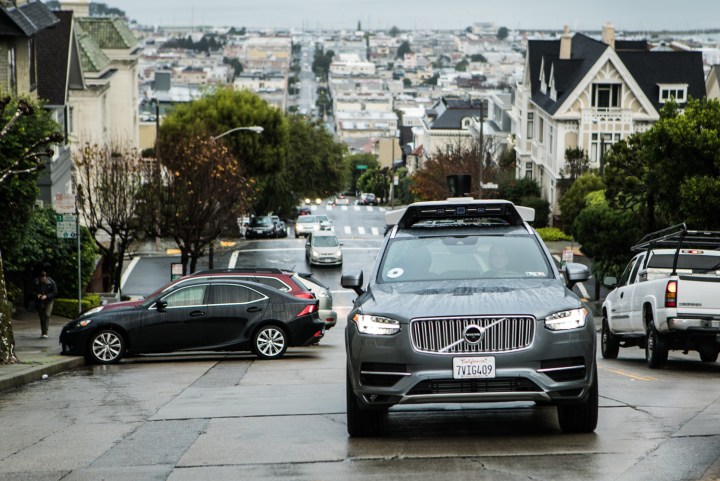
The run-in with California regulators in December centered on whether the ride-hailing giant had the necessary permission to test its autonomous cars on state roads. When the Department of Motor Vehicles concluded that it didn’t, Uber took its vehicles east to Tempe, Arizona. Much was made of their arrival by local officials.
In the continuing saga, Uber on Thursday confirmed its intention to resume testing on public streets in San Francisco, telling local media it was currently “taking steps to complete our application to apply for a Department of Motor Vehicles (DMV) testing permit.”
Rather than bring back its fleet of 16 self-driving Volvo XC90 vehicles from Arizona, Uber will presumably introduce new cars to San Francisco’s roads for continued testing of its driverless technology.
It’s not known when exactly the company plans to restart its pilot program in the city.
Uber had been quietly testing its cars on San Francisco’s roads for about a week last December when several safety-related incidents brought it more publicity than it perhaps wanted. The DMV soon demanded Uber apply for a $150 permit to test its driverless technology on California roads, just as numerous other companies had already done, among them Google, Tesla, Ford, and BMW.
But Uber insisted it didn’t need the permit because an on-board technician was constantly monitoring the vehicle’s behavior and was ready to take control of the car if an issue ever arose. Some suggested the company was reluctant to purchase the permit because its conditions meant it’d have to disclose details of any accidents and notify officials every time a car’s autonomous mode was switched off. The DMV was having none of it and revoked the registration of Uber’s cars, forcing them off the road.
The ride-hailing company has evidently had a rethink and, with its tail somewhat between its legs, now feels the time is right to finally purchase the permit and fall in line behind all the other tech firms testing autonomous kit for cars in the state.
While Uber still uses human drivers for its service, the long-term plan is to use self-driving cars to do the same work, though it’s likely to be many years before a full-fledged service becomes a reality.
Editors' Recommendations
- Waymo robotaxi attacked and set on fire in San Francisco
- Waymo expands robotaxi service area in San Francisco
- Robotaxi firm Cruise ordered to halve fleet following incidents
- Volkswagen is launching its own self-driving car testing program in the U.S.
- Waymo’s robotaxis are coming to Uber’s ridesharing app