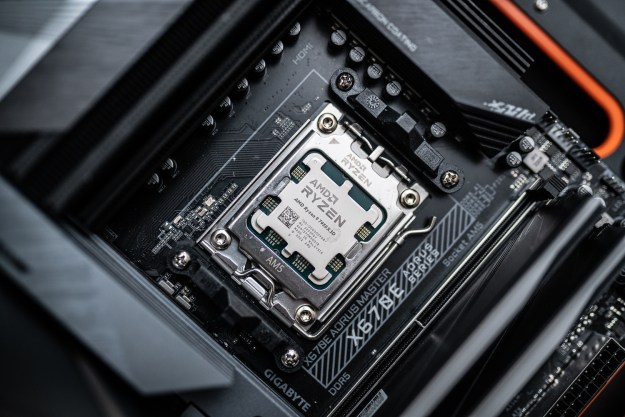
With a simple upgrade path to more efficient computing, based on AMD’s existing system infrastructure and industry-standard architecture, enterprise customers can expect more efficient processing power without the penalties of increased power consumption and heat dissipation. The dual-core AMD Opteron processor for servers and workstations is expected to offer the best performance per watt in the market when AMD plans to make it available in mid-2005.
“This industry milestone changes the dynamics of the computing business,” said Dirk Meyer, executive vice president, AMD Computation Products Group. “Once again, AMD is delivering a simplified approach to more efficient processing power, with products that will deliver multi-core 64-bit computing to our strong customer base.”
This announcement follows a series of impressive firsts from AMD. As the first company to ship products that meet customer demands for high-performance, simultaneous x86-based 32- and 64-bit computing, AMD set in motion an industry-wide transition to pervasive 64-bit computing. Next, AMD was the first company to implement 64-bit computing and Enhanced Virus Protection (enabled by the Windows(R) Service Pack 2) in desktop and low-power mobile PC processors. AMD64 continues to lead the industry transition to pervasive 64-bit computing and AMD’s processor roadmap continues to leverage the efficiency and benefits made possible by AMD64 technology.
“Dual-core technology provides an attractive path for increasing processor performance with little or no increase in power consumption or heat dissipation,” observed Nathan Brookwood, principal analyst at Insight64. “AMD laid the groundwork for its dual-core processors years ago, when it gave its single-core AMD64 processors the on-chip plumbing they would need to support a second core at a later date. As AMD moves dual-core technology from theory to practice, it is reassuring to see that current investments in core logic and platform technology will remain relevant for years to come.”
“AMD has recognized the importance of keeping a compatible system architecture while still meeting today’s demanding computing needs,” said Kevin Krewell, editor-in-chief, Microprocessor Report, Instat-MDR. “AMD’s demonstration of a current platform operating on dual-core AMD Opteron processors based on AMD64 technology represents another industry first for AMD as the company continues to provide industry-leading innovations to the industry-standard architecture.”
Industry Support
By collaborating with strong partners, AMD continues to lead technology transitions in the x86 industry, demonstrating technology that will enable the transition to dual-core products.
“Dual- and multi-core processor technologies on industry-standard servers will redefine scalability, performance and value for enterprise and SMB customers,” said Paul Miller, vice president of marketing, HP Industry Standard Servers. “Having the industry’s first dual-core x86 processors from AMD up and running on HP ProLiant servers demonstrates both HP’s close relationship and collaboration with AMD and our ongoing commitment to rapidly deliver the best new technologies to our customers.”
“As AMD’s strategic partner, we are in a unique position to support AMD64 dual-core technology with our hardware and software products,” said John Fowler, executive vice president of the Network Systems group at Sun Microsystems, Inc. “The Solaris OS combined with the AMD Opteron processor-based Sun servers and workstations will take full advantage of the AMD64 dual-core architecture, managing multi-threaded applications with superior efficiency and performance.”
Innovation from an industry leader
Based on the existing 940-socket infrastructure, AMD expects the upcoming dual-core AMD Opteron processor to provide better performance on a majority of server/workstation workloads by combining two processing cores on a single die. The form factor, energy consumption and performance needs of today’s computer designs demand new innovations. Dual-core processor technology will equip customers with more balanced performance based on industry-standard system architecture.
Dual-core processors are a natural extension of AMD64 technology with Direct Connect Architecture. In addition to being the first to help eliminate the bottlenecks inherent in x86 front-side bus architectures, AMD is now demonstrating the capabilities of being the first to directly connect two cores on the same die along with the memory controller, I/O and other processors – which will improve the overall system performance and efficiency.
Availability
AMD plans to introduce a full dual-core processor line-up for the one- to eight-socket server and workstation market in mid-2005 based on the existing 940-pin socket. Dual-core processors for the client market are expected to follow in the second half of 2005.
For more information on today’s announcement, visit www.amd.com/dualcore2