  1. Home
  2. Computing
  3. News

Claude chats will now be used for AI training, but you can escape

Add as a preferred source on Google
Anthropic brand home page.
Anthropic

Claude — one of the most popular AI chatbots out there and a potential candidate for Apple to enhance Siri — will soon start saving a transcript of all your chats for AI training purposes. The policy change announced by Anthropic has already started appearing to users and gives them until September 28th to accept the terms. 

What’s changing?  

Anthropic says the log of users’ interactions with Claude and its developer-focused Claude Code tool will be used for training, model improvement, and strengthening the safety guardrails. So far, the AI company hasn’t tapped into user data for AI training. 

Recommended Videos

“By participating, you’ll help us improve model safety, making our systems for detecting harmful content more accurate and less likely to flag harmless conversations,” says the company. The policy change is not mandatory, and users can choose to opt out of it. 
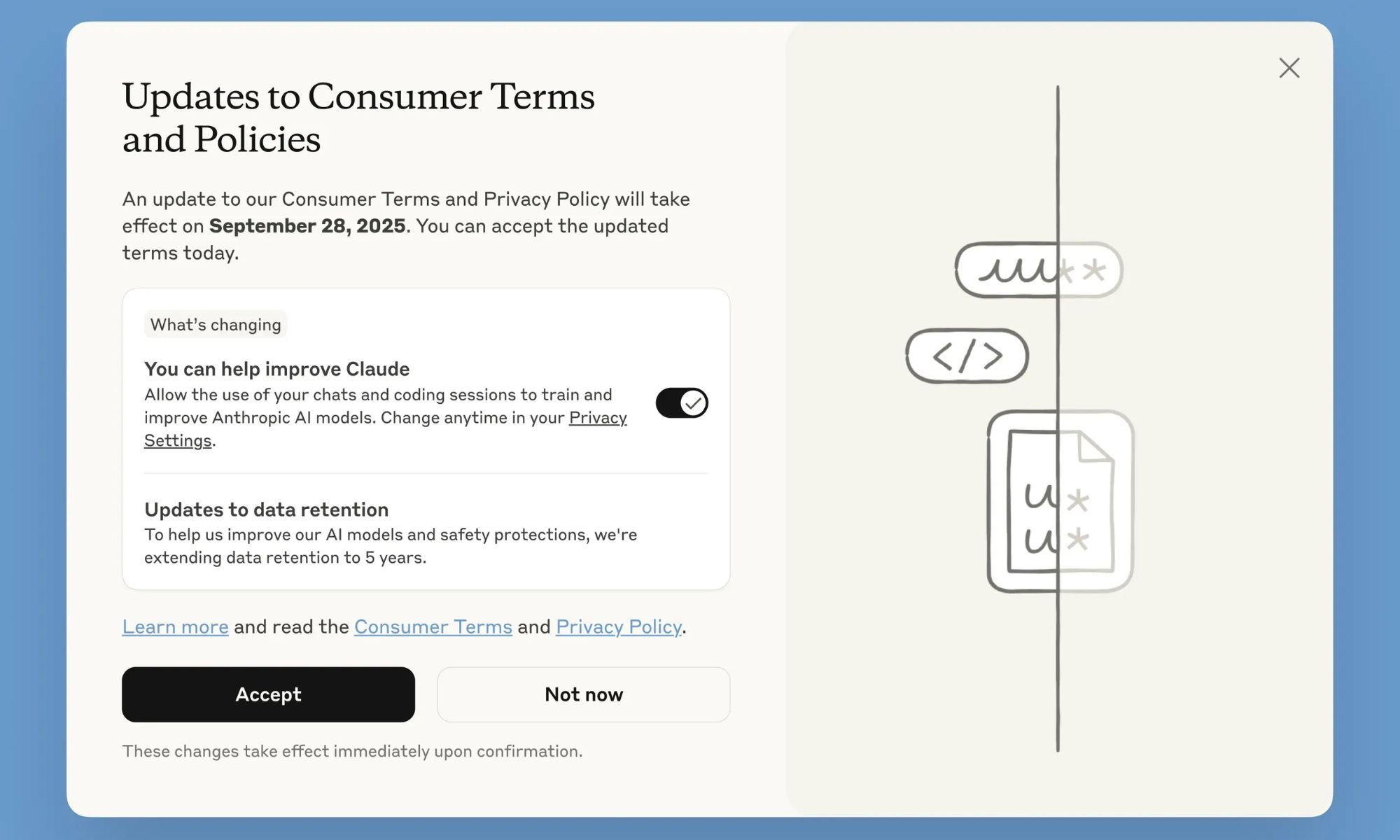
Users will see a notification alert about the data usage policy until September 28. The pop-up will let them easily disable the toggle that says “You can help improve Claude,” and then save their preference by hitting the Accept button. After September 28, users will have to manually change their preference from the model training settings dashboard.

What’s the bottom line? 

The updated training policy only covers new chats with Claude, or those you resume, but not old chats. But why the reversal? The road to AI supremacy is pretty straightforward. The more training material you can get your hands on, the better the AI model’s performance.
The industry is already running into a data shortage, so Anthropic’s move is not surprising. If you are an existing Claude user, you can opt out by following this path: Settings > Privacy > Help Improve Claude.

Anthropic’s new user data policy covers the Claude Free, Pro, and Max plans. It, however, doesn’t apply to Claude for Work, Claude Gov, Claude for Education, APU use, or when connected to third-party platforms such as Google’s Vertex AI and Amazon Bedrock. 

In addition to this, Anthropic is also changing its data retention rules. Now, the company can keep a copy of user data for up to five years. Chats that have been manually deleted by users will not be used for AI training. 

Nadeem Sarwar
Nadeem is the Managing Editor at Digital Trends.
Microsoft wants Copilot Notebooks to handle the work that comes after an AI answer
Built-in Office editing gives users somewhere to revise what Copilot produces
Copilot graphics

Microsoft is bringing Office editing into Copilot Notebooks through its Frontier preview. Users can work on Word, Excel and PowerPoint files alongside their project references, making changes themselves or asking Copilot to handle them.

Generating a report or presentation with AI still leaves someone responsible for getting it ready to share. The October update puts editing tools where that work begins, though having a document neatly formatted doesn’t make its contents correct.

Read more
Apple is reportedly giving the MacBook Pro a touchscreen and the iPad Mini a higher price tag
Apple might finally admit that touching a screen is useful on a laptop
A Macbook Pro sitting on a chair, illuminated with neon lighting.

Apple is preparing for a major Mac and iPad launch towards the end of October, with redesigned MacBook Pro models expected to take centre stage. According to Bloomberg’s Mark Gurman in his latest Power On newsletter, Apple is planning an event on or around October 27, where it could introduce touchscreen MacBook Pro laptops, updated Macs and a new iPad mini.

The launch could mark a significant shift for the MacBook Pro, which is reportedly getting its most substantial redesign in years. Apple had initially targeted a late-2025 release for the touchscreen laptop, but development priorities and supply-chain delays pushed the launch back. The new models are now said to be ready for their debut.

Read more
ChatGPT’s yes-man era may finally be coming to an end
ChatGPT is learning that agreeing with everything you say isn’t always helpful
ChatGPT

OpenAI says it is making progress in reducing a troubling behaviour in ChatGPT: the tendency to agree with users too readily, even when their beliefs may be false or harmful. The improvements come as researchers and mental-health professionals raise concerns about prolonged chatbot conversations reinforcing delusions, encouraging unhealthy dependence and failing to direct vulnerable users towards human support.

According to a report by The Wall Street Journal published on October 10, OpenAI’s older GPT-4o model was associated with several reported cases of serious harm following lengthy interactions. The report cited at least seven suicides, one murder-suicide and one mass shooting linked to extended ChatGPT conversations last year, while noting that other AI models were implicated in some cases. These reported associations do not, by themselves, establish that chatbot use caused each incident.

Read more