This appears to be a week of published patents as news of a single Microsoft invention has surfaced among a sea of recently published inventions by Apple. Microsoft’s latest patent, “Inductive Peripheral Retention Device,” was filed in September and details accessories for the company’s Surface Pen that not only keeps the tool strapped to a Windows 10 device, but recharges it in the process.
The first batch of images provided in the patent illustrates a rounded accessory with a USB connector. As shown below, the design is rather simple, showing the Surface Pen seated within the accessory’s rounded portion and docked alongside a Windows 10 device. However, the patent also shows the pen/accessory combo plugged into the USB port of a desktop monitor so the Surface Pen is easily accessible without cluttering the desktop space.
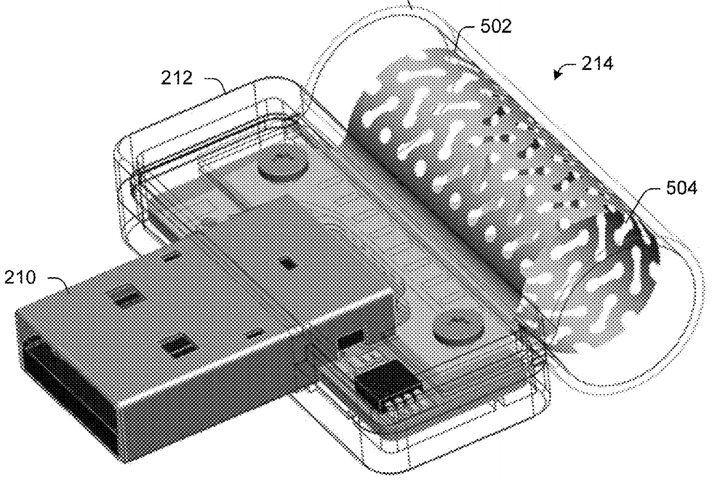
Microsoft’s patent is based on inductive (wireless) charging. The loop portion of the accessory consists of an inductive element that is bent to form a flexible loop. This element includes perforations and traces, the latter of which carry an electrical current. It is housed within fabric so the Surface Pen has a comfortable fit, and connects to the USB jack’s circuit board inside what Microsoft describes as the “peripheral securing portion.”
“The plug is securable to and removable from the device using one or more hands of a user,” the abstract states. “The apparatus also includes a peripheral securing portion connected to the plug and configured to removably engage a peripheral device via an inductive element formed as a flexible loop and configured to form a communicative coupling between the peripheral device and the device, which may be used to support charging of the apparatus.”
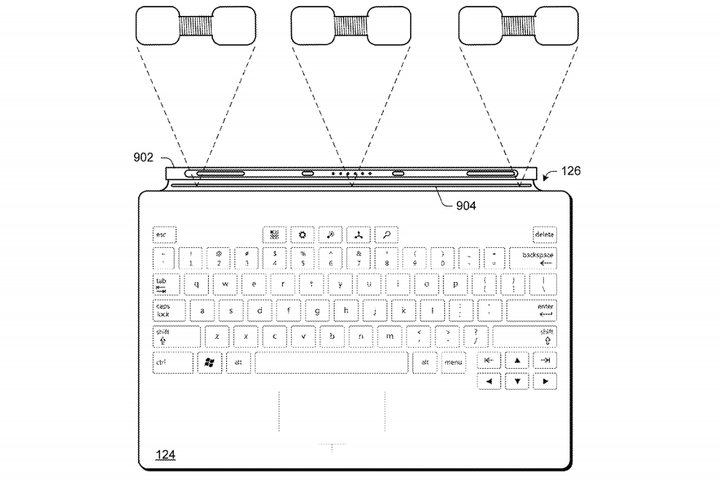
The patent also goes on to illustrate a detachable keyboard with a flexible hinge for Surface devices. As illustrated above, this peripheral includes a mid-spine section between the keyboard area and the computing device connection portion that consists of three inductive coils. Thus, the user could simply place the Surface Pen down into this narrow region for a wireless recharge. The Surface Pen could also receive a charge if placed in a pen clip that is secured to the flexible hinge.
“This may be utilized to charge the stylus, transfer data (e.g., to authenticate the peripheral device), and so on,” the patent states. “Further, flux flow lines may also support a rotationally invariant shape such that the flexible hinge may move yet still support the communicative coupling.”
The authors behind Microsoft’s filed patent include Timothy Allen Jakoboski, Shiu Sang Ng, and William H. Standing. Microsoft Technology Licensing is listed as the assignee.
Given that this patent is merely in the filing stage, its current state does not mean Microsoft is not working hard to bring this invention into the hands of customers. However, right now, the new patent serves as a glimpse of the avenues Microsoft is taking to provide a great computing experience to customers with the least number of physical cords.