“Anker’s Soundcore Infini will save you a pretty penny, but you’re better off using a piggy bank instead.”
- Slick, intuitive design
- Super-simple setup
- Muffled midrange
- Metallic treble
- Poor balance
“Why you can trust Digital Trends – We have a 20-year history of testing, reviewing, and rating products, services and apps to help you make a sound buying decision. Find out more about how we test and score products.“
Best known for its battery chargers and accessories, Anker’s Soundcore audio lineup started small with highly affordable Bluetooth speakers, and has since expanded its audio presence with impressive noise-canceling headphones and a growing collection of soundbars. The new Soundcore Infini soundbar promises no fuss setup, all the features you want from a budget bar, and “room-shaking bass” for just $100. But, as our review points out, a low price doesn’t always equate to a value pick.
Out of the box, onto the stand
There’s nothing much to the Infini’s packaging (and no, the name isn’t “Infinity” like you’d think), but you’ll get all the accessories you need, including a decently sized remote and batteries, digital optical and Aux cables for connection, a small mounting kit, and a packet of instructions in multiple languages.


You aren’t likely to need the latter, as it’s extremely easy to get things going; simply connect the optical cable between the bar and your TV, plug in the power, and make sure the front-facing LED strip turns teal-green for the digital input. For those with TVs tipping toward the antique shop, there’s also a 3.5mm input and a coaxial digital input, but no HDMI connection (not that we expected one from a $100 soundbar).
Simple and smart
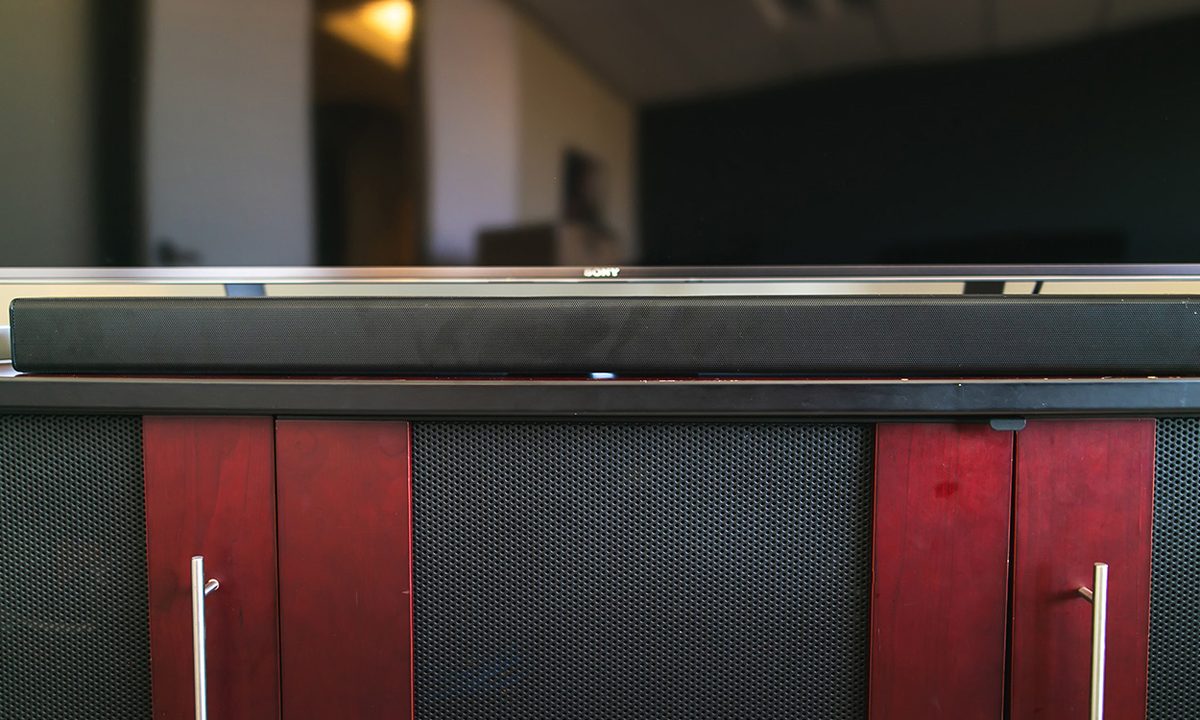
The Infini is as plain Jane as they come, with no real defining characteristics to break up its matte-black body, save the shiny plastic bass ports at the end caps of its 36-inch frame. That said, the design is intuitive, with thoughtful inclusions like a cable guide at the back and a rubberized button strip for power, volume, and source switching up top.
Angled placement of the dual tweeters allows the bar to sit flat or flip forward for mounting.
Angled placement of dual tweeters set beneath the Infini’s mesh metal grill allows the bar to sit on your TV console, or flip forward for wall mounting via screw holes on its bottom. Those are complemented by a pair of up-firing 2 x 3-inch drivers, which account for the Infini’s built in “subwoofers,” with no way to add a separate subwoofer later, unfortunately.
The Infini’s lack of ARC HDMI connection means you won’t be able to use your TV remote for basic functionality, requiring one more remote to add to your arsenal. To make things simpler, though, the Infini goes into standby mode whenever it’s at rest for more than 30 minutes, automatically booting back up when it receives an audio signal.
The remote offers a relatively intuitive collection of buttons, including quick keys for switching between Movie, Dialogue, and Music modes, volume and source control, and a Bluetooth key for audio streaming from your smartphone or other device.
Performance
You might think such a tiny collection of drivers would have trouble reproducing convincing cinema sound — and you’d be right. But it’s not a lack of punch or power that keeps the Infini from outclassing the sound performance of competing bars (or even upper crest TVs). It does a poor job of keeping things balanced, forcing you to choose between muffled or tinny sound.

Unfortunately, scrolling through all three sound modes reveals no real Goldilocks Zone. The Movie mode offers a solid punch of bass, but the midrange struggles, creating throaty, boom-y voices and low-end effects and eschewing dialogue to the point that you have to ramp up the volume for clarity.
Higher voices and effects resonate with an aluminum clang.
Switching to the Dialogue mode offers some relief from the smoosh-y midrange and much more clarity in the treble, but it does so by sacrificing bass. What’s more, higher voices and effects tend to resonate with an aluminum clang, as if bouncing off sheet metal. The Music mode offers a bit more balance between registers, but the problems aren’t eliminated. Frankly, we found ourselves preferring our TV’s built-in speakers in some cases for intelligible dialogue.
We will applaud the Infini for its ability to get plenty loud, and when it comes to bass response, it’s certainly a major step up from your TV speakers. For our money, though, that’s not enough to make it a worthwhile buy.
Our Take
Anker’s Soundcore Infini soundbar will save you a pretty penny, but you’re better off using a piggy bank instead.
Is there a better alternative?
You may not want to hear this, but we actually suggest you triple down and move up to Yamaha’s YAS-207, one of the best value propositions on the market, or — if you want something truly tiny — Polk’s Magnifi Mini. If you absolutely can’t go above $100, however, we recommend trading your Benjamin for Vizio’s SB3621 instead.
How long will it last?
A basic product of this kind, without HDMI connection, isn’t exactly future proof, but the unit appears to be relatively robust for its price point and should last a few years at the least.
Should you buy it?
No. It’s not the worst you could do for $100, but you can invest that money more wisely elsewhere.