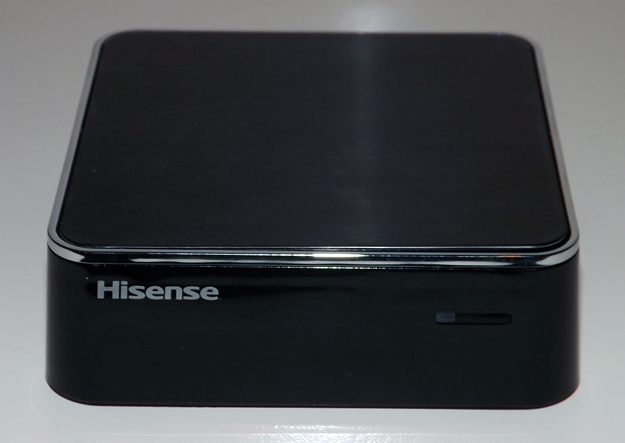
Despite the off-brand name, much has been made of Hisense’s Pulse Google TV box. After hearing about its $100 price point and specs, we scratched our collective heads wondering what the catch was. Well, after some hands-on time with the Pulse, suffice it to say that our heads are still feeling itchy.
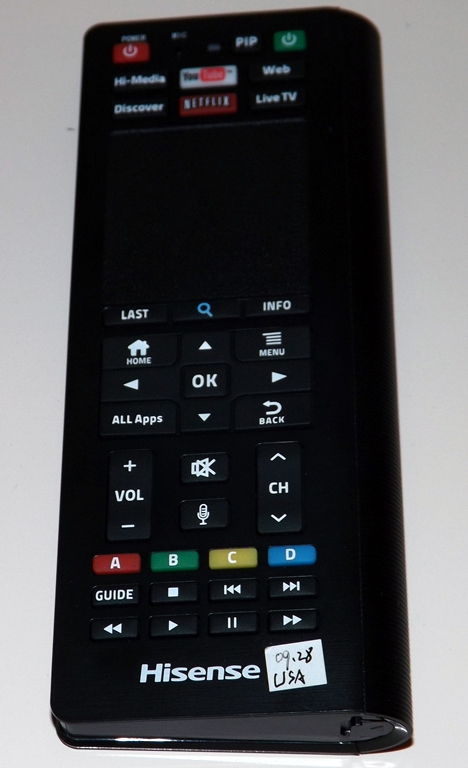 When we finally got the dual-sided QWERTY keyboard remote in our hands, we expected a herky-jerky, hiccup-prone experience; but what we got was a smooth, responsive version of Hisense’s SmartHub UI, the same interface built into Hisense’s smart TVs. Cycling swiftly through apps like YouTube and Flickster, we wondered aloud how Hisense could afford to offer the Pulse so cheaply. In fact, some of the company’s own employees even confessed that they were as befuddled as we were.
The Pulse simply does not feel like a cheap product, load times are short (slow connection notwithstanding), typing is quick and easy, the trackpad is responsive, and the whole experience felt more or less like browsing the Internet.
Still, if you want to step up the speed and smoothness, the downloadable smartphone app is the way to go. The app (available on Android and iOS) turns your mobile device into a Pulse remote, complete with touch-wheel control and a QWERTY keyboard. Navigating this way feels almost iPod-like, as you swipe your thumb in circles and cycle through content. This method offers ultra-smooth browsing — a bit too smooth for the clumsy thumbed among us.

The Pulse has HDMI, USB, and Ethernet inputs and works with both traditional cable boxes and satellite options. For the former, all it needs is the brand and model number. With those provided, you just hook up the IR blasters (which are included) and you’re ready to go. The Pulse pulls your electronic program guide (EPG) from online, and thus, effectively knows what will be on your TV before you do.
Considering that the typical SmartTV model costs over $100 more than a comparable, less-educated television, we’d have to proclaim the Pulse a solid buy. We were waiting for the other shoe to drop, but for now, the skies seem to be clear. The Pulse will be available in late November, bundled with the remote (originally billed as an add-on) at a suggested price of $100.