  1. Home
  2. Space
  3. News

Flight test for troubled Starliner capsule pushed back to April

Add as a preferred source on Google

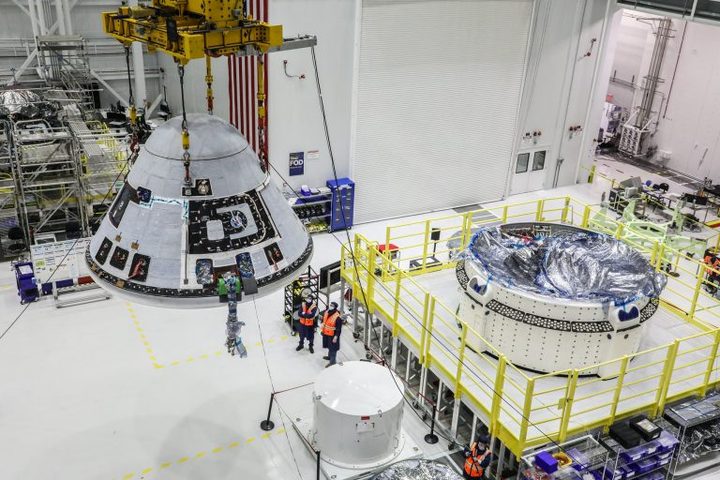
NASA and Boeing teams are adjusting the launch date of Orbital Flight Test-2 to allow more time for CST-100 Starliner spacecraft and hardware processing.
NASA and Boeing teams are adjusting the launch date of Orbital Flight Test-2 to allow more time for CST-100 Starliner spacecraft and hardware processing. Boeing/John Proferes

Boeing had been planning to test its upcoming crew capsule, the Starliner, next month. Now the date for the capsule’s second orbital test flight has been pushed back until April. The capsule will eventually carry astronauts between Earth and the International Space Station (ISS), but the upcoming test flight will be uncrewed.

Recommended Videos

“NASA and Boeing now are targeting no earlier than Friday, April 2, for launch of the agency’s Boeing Orbital Flight Test-2 to the International Space Station,” NASA announced in a blog post, continuing that, “teams remain focused on the safety and quality of the CST-100 Starliner spacecraft and successful launch of the end-to-end test to prove the system is ready to begin flying astronauts to and from the space station as part of NASA’s Commercial Crew Program.”

The development of the Starliner capsule has had its share of issues, like a number of problems with its first uncrewed orbital test flight in December 2019. The capsule didn’t make it to its planned destination of the International Space Station due to a computer error, and subsequent data showed a second software issue that could have caused the loss of the spacecraft.

Since then, Boeing has been working to fix the problems, and progress was made in other areas like the final parachute test and an emergency procedure rehearsal. The aim was to perform a second uncrewed orbital test flight to the ISS in March this year.

Now, that date is pushed back until April. The eight-day delay is due to the need to replace avionics units that were damaged by a power surge during a test.

“NASA continues to work alongside Boeing to prepare for this first mission of 2021,” Steve Stich, manager of NASA’s Commercial Crew Program, said in the NASA post. “The Boeing and NASA teamwork on all aspects of flight preparation including final certification, hazard analysis, and software testing is extraordinary. Even though this uncrewed flight test to the International Space Station is a key milestone on the path to the first Starliner crewed mission planned for later this year, we will fly when we are ready.”

Georgina Torbet
Georgina has been the space writer at Digital Trends space writer for six years, covering human space exploration, planetary…
Scientists warn Elon Musk’s orbital data centers could blind Earth’s biggest telescopes
A new ESO study suggests millions of satellites could make parts of the night sky effectively unusable for astronomy.
One hour of satellites over the northern Atacama Desert in Chile (October 2025)

The race to blanket Earth with satellite internet has unlocked faster connectivity for millions. But according to the European Southern Observatory (ESO), it could also make one of humanity's oldest hobbies, and one of its most important sciences, a whole lot harder. The organization warns that the rapid growth of satellite mega-constellations could severely disrupt observations made by some of the world's most powerful telescopes.

Astronomers say the night sky is reaching its limit

Read more
Amazon’s Starlink rival just crossed a major milestone, but don’t expect perfect internet just yet
Amazon finally showed up to the space internet party
Amazon Leo satellite layout across all launch vehicles

Amazon has taken a significant step toward launching its long-awaited satellite internet service. Following its latest rocket launch, the company now has 396 Project Kuiper satellites in low-Earth orbit, enough to begin offering continuous service across select regions. The milestone keeps Amazon on track for its previously announced goal of launching commercial service by mid-2026.

https://twitter.com/Weber44Chris/status/2072575499461963938?ref_src=twsrc%5Etfw%7Ctwcamp%5Etweetembed%7Ctwterm%5E2072575499461963938%7Ctwgr%5Ed727a1b853cbf519585e7bf2655943afb2f91bb8%7Ctwcon%5Es1_&ref_url=https%3A%2F%2Fwww.theverge.com%2Fscience%2F960563%2Famazon-leo-service-tipping-point

Read more
Amazon’s Starlink rival is set to launch satellite internet later this year
After launching nearly 400 satellites, Amazon says its Leo broadband service will go live later this year.
Atlas V launches 29 Amazon Leo satellites from Cape Canaveral, Florida

Amazon's long-awaited answer to SpaceX's Starlink is finally nearing liftoff. According to an exclusive report from Reuters, the company plans to begin offering its Leo satellite internet service later this year, after its latest rocket launch pushed the constellation to 394 satellites in orbit.

The pieces are finally falling into place for Project Kuiper

Read more