  1. Home
  2. Space
  3. News

Hubble captures a beautiful galaxy with a nautical theme

Add as a preferred source on Google

The Hubble Space Telescope has captured another stunning image of deep space — this one showing the distant galaxy NGC 3381. Located 115 million light-years away, this elegant shape is a classic spiral galaxy, located in the constellation of Vela.

The constellation of Vela has an interesting and nautical-related history, as the Hubble scientists describe in a NASA statement: “Vela was originally part of a far larger constellation, known as Argo Navis after the fabled ship Argo from Greek mythology, but this unwieldy constellation proved to be impractically large. Argo Navis was split into three separate parts called Carina, Puppis, and Vela – each named after part of the Argo. As befits a galaxy in a nautically inspired constellation, the outer edges of NGC 3318 almost resemble a ship’s sails billowing in a gentle breeze.”
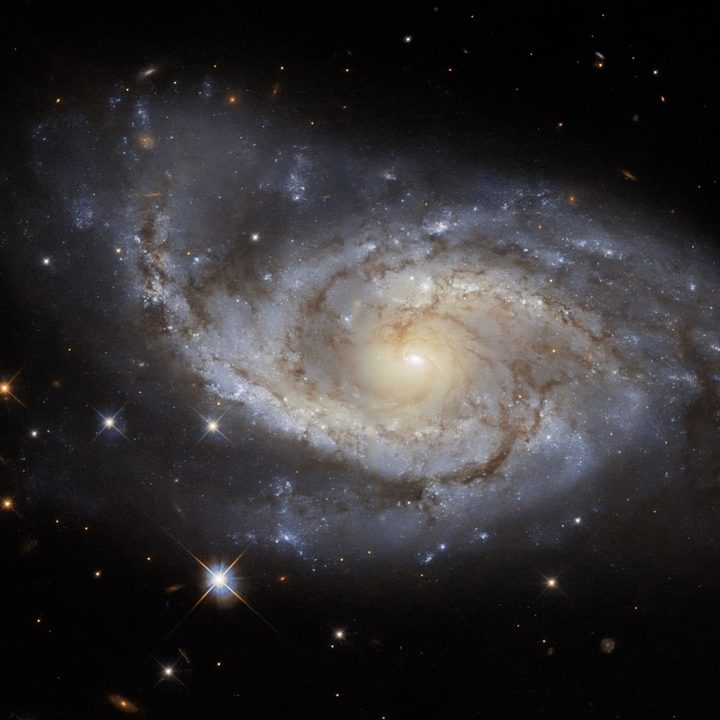
The spiral arms of the galaxy NGC 3318 are lazily draped across this image from the NASA/ESA Hubble Space Telescope.
The spiral arms of the galaxy NGC 3318 are lazily draped across this image from the NASA/ESA Hubble Space Telescope. This spiral galaxy lies in the constellation Vela and is roughly 115 million light-years away from Earth. ESA/Hubble & NASA, European Southern Observatory (ESO), R. J. Foley; Acknowledgment: R. Colombari

The Hubble Space Telescope is over 30 years old, having been launched back in 1990, but it continues to be an invaluable tool both for astronomy research and for sharing striking images of space with the general public. The telescope recently passed an impressive milestone of having been operational for one billion seconds, during which time it has uncovered vital information about the expansion of the universe as well as imaging targets both distant and in our own solar system.

Recommended Videos

The telescope suffered from two issues that caused it to be put into safe mode last year: One hardware failure and one synchronization issue, both likely related to its age. However, both issues were able to be fixed and it is currently continuing its work once again.


Georgina Torbet
Georgina has been the space writer at Digital Trends space writer for six years, covering human space exploration, planetary…
Space is becoming Bezos and Musk’s next data center site, and we have every reason to worry
The AI boom is coming for the night sky
How Vast's space station will look in orbit.

AI data centers already consume vast amounts of electricity and water on Earth, so Silicon Valley has begun looking somewhere considerably more spacious... literally.

Elon Musk's SpaceX and Jeff Bezos' Blue Origin, along with several other companies, have proposed enormous constellations of satellites designed to operate as orbital data centers. However, environmental groups and former space officials are now warning that putting them into orbit at the proposed scale could have severe consequences for Earth's atmosphere and the night sky.

Read more
The first possible exomoon is here, and it makes our Moon look hilariously tiny
Scientists may have found the first exomoon, except this one is the size of Jupiter
This artist’s concept depicts a potential volcanic moon between the exoplanet WASP-49 b, left, and its parent star. New evidence indicating that a massive sodium cloud observed near WASP-49 b is produced by neither the planet nor the star has prompted researchers to ask if its origin could be an exomoon.

We have already discovered more than 6,000 planets outside of our immediate neighborhood. Yet, finding a moon orbiting one of those distant worlds has proved considerably harder. Astronomers may finally have something close to the real deal, but this particular object stretches the word “moon” almost beyond recognition.

Using the European Southern Observatory’s Very Large Telescope in Chile, researchers detected strong evidence for a moon-like object in the CD-35 2722 system. Further observations are still necessary to confirm the discovery, but it could become the first confidently detected natural satellite outside our solar system. There is still one tiny complication though. This moon is apparently massive.

Read more
China’s answer to SpaceX’s reusable rockets literally catches boosters in a net
SpaceX catches boosters on legs. China just used a net.
Ammunition, Missile, Weapon

SpaceX's playbook for recovering a rocket booster generally involves legs, a precisely controlled vertical landing, and either a concrete pad or a drone ship. 

China just managed to pull off something similar, but in a slightly different way, and on July 10, it tested the method as well.

Read more
