1. Home
  2. Space
  3. News

How to watch NASA’s asteroid explorer Lucy launch this week

Add as a preferred source on Google

This week, NASA will be launching its newest explorer: Lucy, a spacecraft that will be traveling to the asteroids near Jupiter to learn about how the solar system formed. Lucy will launch early in the morning on Saturday, October 16 on a United Launch Alliance Atlas V 401 rocket from Space Launch Complex 41 at Cape Canaveral Space Force Station in Florida, and we’ve got the details on how you can watch the launch live.

NASA Live: Official Stream of NASA TV

What Lucy will be exploring

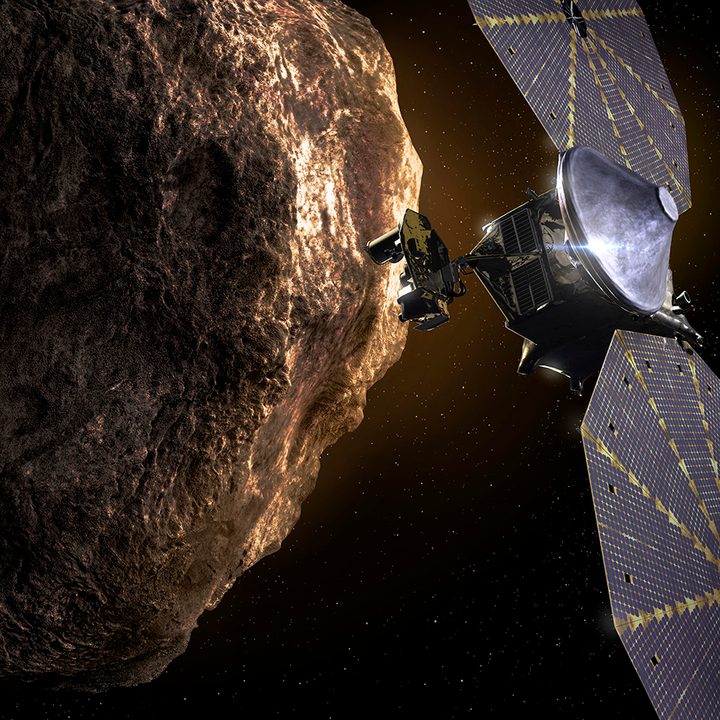
Artist’s illustration of the Lucy concept.
Artist’s illustration of the Lucy concept. Southwest Research Institute

Lucy will be heading out into the solar system to visit the Trojans, a group of asteroids in the orbit of Jupiter. These are believed to be leftovers from the formation of the outer planets, from a period more than 4 billion years ago.

Recommended Videos

“Over its 12-year primary mission, Lucy will explore a record-breaking number of asteroids,” NASA writes. “The spacecraft will fly by one asteroid in the solar system’s main belt and seven Trojan asteroids. Lucy’s path will circle back to Earth three times for gravity assists, which will make it the first spacecraft ever to return to our planet’s vicinity from the outer solar system.”

To learn more about Lucy’s goals, we spoke to the mission’s principal investigator, Hal Levison, about how it could unravel the mysteries of the solar system’s formation.

How to watch the launch

NASA will be livestreaming the launch of Lucy, as well as a variety of prelaunch activities like preparing for liftoff and commentary from experts. You can watch online either using the video embedded at the top of this page or by heading to NASA’s website.

The coverage of the launch will begin at 5 a.m. ET (2 a.m. PT) on Saturday, October 16. The launch itself is scheduled for 5:34 a.m. ET (2:34 a.m. PT).

If you want to learn more about the mission, there are two days of briefings and information that will be shown before the launch. On Thursday, October 14 there will be a live Lucy Rollout Show at 10 a.m. ET (7 a.m. PT) following by a science briefing at 1 p.m. ET (10 a.m. PT) with the researchers who will be working with the Lucy data, followed by an engineering briefing at 3 p.m. ET (12 p.m. PT) with the engineers who built the spacecraft.

On Friday, October 15 you can hear from NASA scientists about the mission in a briefing scheduled for 3:30 p.m. ET (12:30 p.m. PT).

Georgina Torbet
Georgina has been the space writer at Digital Trends space writer for six years, covering human space exploration, planetary…
You can now walk through space and gaze into a black hole at this VR exhibit
Smithsonian Starstruck lets you drift past dying stars and see the origin point of the universe for as little as $18 a person.
Smithsonian Starstruck featured

Most planetarium shows ask you to sit still and look up. The Smithsonian's new VR exhibit takes a different approach, letting visitors walk through the vast expanse of the universe, drifting past stars, planets, and a black hole to get a physical sense of its true scale.

A $29 ticket to the edge of the galaxy

Read more
Scientists warn Elon Musk’s orbital data centers could blind Earth’s biggest telescopes
A new ESO study suggests millions of satellites could make parts of the night sky effectively unusable for astronomy.
One hour of satellites over the northern Atacama Desert in Chile (October 2025)

The race to blanket Earth with satellite internet has unlocked faster connectivity for millions. But according to the European Southern Observatory (ESO), it could also make one of humanity's oldest hobbies, and one of its most important sciences, a whole lot harder. The organization warns that the rapid growth of satellite mega-constellations could severely disrupt observations made by some of the world's most powerful telescopes.

Astronomers say the night sky is reaching its limit

Read more
Amazon’s Starlink rival just crossed a major milestone, but don’t expect perfect internet just yet
Amazon finally showed up to the space internet party
Amazon Leo satellite layout across all launch vehicles

Amazon has taken a significant step toward launching its long-awaited satellite internet service. Following its latest rocket launch, the company now has 396 Project Kuiper satellites in low-Earth orbit, enough to begin offering continuous service across select regions. The milestone keeps Amazon on track for its previously announced goal of launching commercial service by mid-2026.

https://twitter.com/Weber44Chris/status/2072575499461963938?ref_src=twsrc%5Etfw%7Ctwcamp%5Etweetembed%7Ctwterm%5E2072575499461963938%7Ctwgr%5Ed727a1b853cbf519585e7bf2655943afb2f91bb8%7Ctwcon%5Es1_&ref_url=https%3A%2F%2Fwww.theverge.com%2Fscience%2F960563%2Famazon-leo-service-tipping-point

Read more