1. Home
  2. Space
  3. News

Track NASA’s Perseverance rover on its journey to Mars with this simulator

Add as a preferred source on Google

If you want to check in on NASA’s Perseverance rover, launched this week on its journey to Mars, there’s a NASA simulator that you can use to follow along with the mission’s progress.

Using NASA’s Eyes software, you can see a simulated view of the Mars 2020 spacecraft in real time as it travels on its journey. And if you zoom out to the Terran system and solar system views, you can see where the craft is in relation to the rest of the solar system, with the orbits of the planets including Mars and Earth shown.

Recommended Videos

The map also shows where other NASA missions are located as well, so in the Terran system, you can see objects such as the planet-hunting telescope TESS. If you zoom out even further to view the inner solar system, you can see the position of objects like the Parker Solar Probe, the Bennu spacecraft, and the metal asteroid and target of a future mission, Psyche. Clicking on the names of these objects or the planets will bring up statistics about each one and links of where to find more information.

If you continue to zoom out even further, you can see where the sun and our solar system are located within the Milky Way — and you also get some idea of just how large the distances between stellar systems are.

According to NASA, Perseverance has approximately 290 million miles still to go on its journey to Mars, which is expected to take until February 2021.

There were some concerns about the spacecraft on the day of its launch as NASA experienced a minor communications issue and the craft automatically went into safe mode as it experienced cold temperatures while in the shadow of the Earth. But the craft is now out of safe mode and operating as normal, and the communications were able to be established as required using the Deep Space Network. So Perseverance is healthy and happy and everything looks on track for its journey to Mars.

“With safe mode exit, the team is getting down to the business of interplanetary cruise,” Mars 2020 deputy project manager Matt Wallace of NASA’s Jet Propulsion Laboratory said in a blog post. “Next stop, Jezero Crater.”

Georgina Torbet
Georgina has been the space writer at Digital Trends space writer for six years, covering human space exploration, planetary…
Amazon’s Starlink rival just crossed a major milestone, but don’t expect perfect internet just yet
Amazon finally showed up to the space internet party
Amazon Leo satellite layout across all launch vehicles

Amazon has taken a significant step toward launching its long-awaited satellite internet service. Following its latest rocket launch, the company now has 396 Project Kuiper satellites in low-Earth orbit, enough to begin offering continuous service across select regions. The milestone keeps Amazon on track for its previously announced goal of launching commercial service by mid-2026.

https://twitter.com/Weber44Chris/status/2072575499461963938?ref_src=twsrc%5Etfw%7Ctwcamp%5Etweetembed%7Ctwterm%5E2072575499461963938%7Ctwgr%5Ed727a1b853cbf519585e7bf2655943afb2f91bb8%7Ctwcon%5Es1_&ref_url=https%3A%2F%2Fwww.theverge.com%2Fscience%2F960563%2Famazon-leo-service-tipping-point

Read more
Amazon’s Starlink rival is set to launch satellite internet later this year
After launching nearly 400 satellites, Amazon says its Leo broadband service will go live later this year.
Atlas V launches 29 Amazon Leo satellites from Cape Canaveral, Florida

Amazon's long-awaited answer to SpaceX's Starlink is finally nearing liftoff. According to an exclusive report from Reuters, the company plans to begin offering its Leo satellite internet service later this year, after its latest rocket launch pushed the constellation to 394 satellites in orbit.

The pieces are finally falling into place for Project Kuiper

Read more
NASA is investing $590 million in private contractors to build humanity’s first Moon outpost
NASA is counting on private companies to land its Moon Base dream.
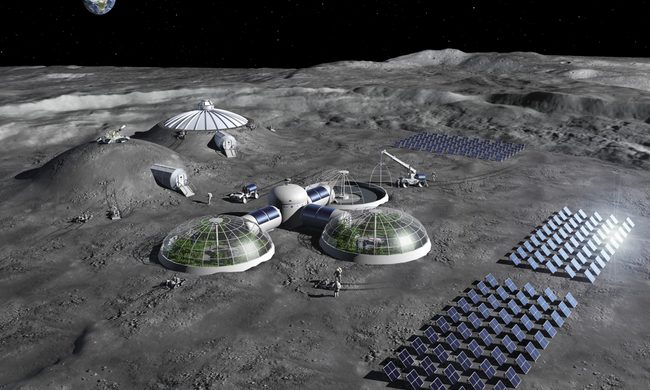
Artist impression of a Moon Base concept, with solar arrays for energy generation, greenhouses for food production, and habitats shielded with regolith.

Building a permanent base on the Moon sounds like science fiction, but NASA is making it feel a lot more real. The agency just handed $590 million in contracts to three private companies for four uncrewed lunar lander missions launching in late 2028.

These missions are part of Phase 1 of NASA's broader $30 billion Moon Base program, which needs to deliver landers, rovers, and scientific cargo up there before astronauts eventually move in. These efforts are closely tied NASA's Artemis program, which sent humans on a lunar flyby in April for the first time since the Apollo era.

Read more