  1. Home
  2. Space
  3. News

Solar Orbiter to make serendipitous pass through the tail of a comet

Add as a preferred source on Google

The European Space Agency’s Solar Orbiter spacecraft will soon have a fortuitous encounter with a comet. The craft’s main mission is to capture images of the sun’s poles, which have never been seen before. But while it is on its way to the sun, it is already firing up its instruments and collecting data.

As luck would have it, along its journey the Solar Orbiter will pass through the tail of an intriguing object, comet ATLAS. Discovered in December last year, this exceptionally bright comet fragmented into pieces this April in a process that scientists are still trying to understand.
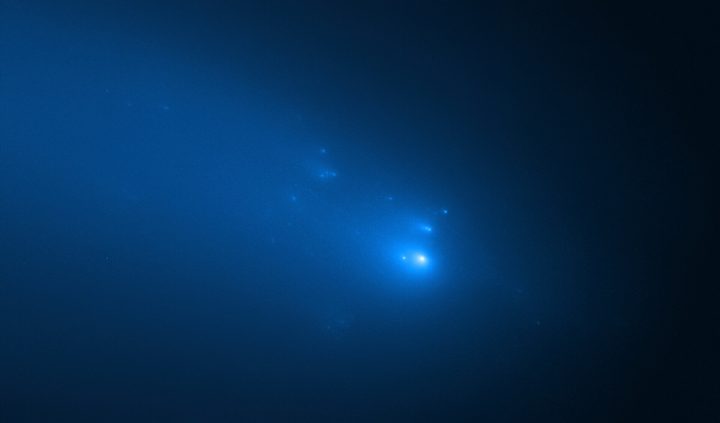
Hubble’s Observation of Comet C/2019 Y4 (ATLAS) on 23 April
A view of Comet C/2019 Y4 (ATLAS) obtained with the NASA/ESA Hubble Space Telescope on 23 April 2020. NASA, ESA, D. Jewitt (UCLA), Q. Ye (University of Maryland)

Given the size of the solar system, it’s very rare that a craft passes through the tail of a comet by chance. In fact, it has only happened six times before, and in all of these cases, it was only discovered when data was analyzed after the event.

Recommended Videos

The passing of the Solar Orbiter through the tail is the first time that such an event has been predicted in advance, which means that the researchers can turn on the most relevant instruments before the meeting to gather as much data as possible.

“With each encounter with a comet, we learn more about these intriguing objects,”  Geraint Jones of the UCL Mullard Space Science Laboratory and principal investigator of ESA’s future Comet Interceptor mission said in a statement.

“If Solar Orbiter detects Comet ATLAS’s presence, then we’ll learn more about how comets interact with the solar wind, and we can check, for example, whether our expectations of dust tail behavior agree with our models. All missions that encounter comets provide pieces of the jigsaw puzzle.”

The researchers are hoping that they’ll be able to capture a few precious particles from the comet’s dust tail. If a dust particle were to impact the craft it won’t do it any harm, but due to the extremely high speeds involved the particle would be instantly vaporized in a tiny cloud of plasma which may be detectable with its instruments.

“An unexpected encounter like this provides a mission with unique opportunities and challenges, but that’s good!” said Günther Hasinger, ESA Director of Science. “Chances like this are all part of the adventure of science.”

Georgina Torbet
Georgina has been the space writer at Digital Trends space writer for six years, covering human space exploration, planetary…
You can now walk through space and gaze into a black hole at this VR exhibit
Smithsonian Starstruck lets you drift past dying stars and see the origin point of the universe for as little as $18 a person.
Smithsonian Starstruck featured

Most planetarium shows ask you to sit still and look up. The Smithsonian's new VR exhibit takes a different approach, letting visitors walk through the vast expanse of the universe, drifting past stars, planets, and a black hole to get a physical sense of its true scale.

A $29 ticket to the edge of the galaxy

Read more
Scientists warn Elon Musk’s orbital data centers could blind Earth’s biggest telescopes
A new ESO study suggests millions of satellites could make parts of the night sky effectively unusable for astronomy.
One hour of satellites over the northern Atacama Desert in Chile (October 2025)

The race to blanket Earth with satellite internet has unlocked faster connectivity for millions. But according to the European Southern Observatory (ESO), it could also make one of humanity's oldest hobbies, and one of its most important sciences, a whole lot harder. The organization warns that the rapid growth of satellite mega-constellations could severely disrupt observations made by some of the world's most powerful telescopes.

Astronomers say the night sky is reaching its limit

Read more
Amazon’s Starlink rival just crossed a major milestone, but don’t expect perfect internet just yet
Amazon finally showed up to the space internet party
Amazon Leo satellite layout across all launch vehicles

Amazon has taken a significant step toward launching its long-awaited satellite internet service. Following its latest rocket launch, the company now has 396 Project Kuiper satellites in low-Earth orbit, enough to begin offering continuous service across select regions. The milestone keeps Amazon on track for its previously announced goal of launching commercial service by mid-2026.

https://twitter.com/Weber44Chris/status/2072575499461963938?ref_src=twsrc%5Etfw%7Ctwcamp%5Etweetembed%7Ctwterm%5E2072575499461963938%7Ctwgr%5Ed727a1b853cbf519585e7bf2655943afb2f91bb8%7Ctwcon%5Es1_&ref_url=https%3A%2F%2Fwww.theverge.com%2Fscience%2F960563%2Famazon-leo-service-tipping-point

Read more