1. Home
  2. Phones
  3. Mobile
  4. News

Oura ring now syncs its temperature data with Natural Cycles app

Add as a preferred source on Google

Oura has announced a partnership with Natural Cycles, a birth control app, to enable automatic syncing of temperature data collected by its smart ring. Although it may sound like a basic feature, especially as cross-app syncing in health and fitness products is common, it streamlines the process of using the Natural Cycles app considerably.

Up until now anyone using the Natural Cycles app needed to manually enter temperature data each day, after obtaining it with a thermometer. It’s through this data the app helps people understand fertility cycles. Now, Oura will share data gathered by the temperature sensors in its smart ring overnight with the app, making it easier to use.

Recommended Videos

Holly Shelton, Senior Vice President of Consumer Product at Oura, said:

“Partnering with Natural Cycles is a natural fit given our research has shown that skin temperature data from the Oura Ring can detect important temperature changes throughout the menstrual cycle, including increases around the LH surge, which occurs just before ovulation, and decreases nearing menstruation.”

Natural Cycles co-founder Dr. Elina Berglund Scherwitzl added:

“We have been actively working on delivering a seamless measuring experience for our users and we were thrilled when we received FDA clearance to use the Oura Ring with our algorithm. With the help of Oura data, Natural Cycles is powering the future of birth control.”

The app will be updated with a dedicated Oura Mode, which presumably removes the daily need to manually input temperature data. After giving permission in the app, Oura will share sleep data with Natural Cycles, including temperature, sleep stages and duration, and heart rate information. It’s noted that Natural Cycles does not share any sensitive data with Oura.

Natural Cycles has both clearance from the Food and Drug Administration (FDA) and the CE mark, and has a claimed 93% effectiveness with perfect use. It’s available for Android and iOS but requires a subscription to use, which costs $10 per month or $90 per year. The Oura smart ring starts at $300 and requires a $6 per month subscription to continue viewing all the collected data after six months of use.

It’s also the latest in a string of announcements from Oura. Recently the company added Strava integration to help increase appeal for more serious sports people, and its long-expected blood oxygen measurement feature has also finally been activated.

Andy Boxall
Andy has written about mobile technology for almost a decade. From 2G to 5G and smartphone to smartwatch, Andy knows tech.
Galaxy Z Flip 8 vs. Motorola Razr Ultra (2026): Samsung’s flip phone is cheaper, but is it better?
One flip phone wins on value. The other wins on hardware.
Electronics, Phone, Mobile Phone

Flip phones have quietly become one of the most competitive corners of the smartphone market. It provides buyers with a satisfying folding snap, reducing the footprint to half the original size, and that’s the entire point. Motorola never really left the format after reviving the Razr name, while Samsung has spent generations treating the Flip line as its scrappy, budget-friendlier sibling to the Fold. 

This year, though, the gap between the two camps has narrowed to the point where picking a winner requires genuinely reading the spec sheet and learning about the phones before putting your money into one. One phone leans hard into raw display firepower, while the other leans into a deeper software ecosystem and a friendlier price tag. 

Read more
Samsung finally switched to silicon-carbon battery on Galaxy Z Fold 8. What’s so special about it?
One of Galaxy Z Fold 8’s biggest upgrade is hiding inside
Galaxy Z Fold 8 Ultra with Fold 8

Samsung has finally joined the silicon-carbon battery race with its latest batch of premium foldables packing the new battery tech. But details for this change were rather hard to spot on the spec sheets. The company has confirmed during media briefings that the Galaxy Z Fold 8 Ultra, Galaxy Z Fold 8, and Galaxy Z Flip 8 all use silicon-carbon batteries.

Even then, the resulting capacities are hardly record-breaking. The Fold 8 Ultra carries a 5,000mAh battery, the regular Fold 8 gets 4,800mAh, and the Flip 8 has 4,300mAh. Rivals from Honor and Motorola have already crossed the 6,000mAh mark. But the figures only tell part of the story.

Read more
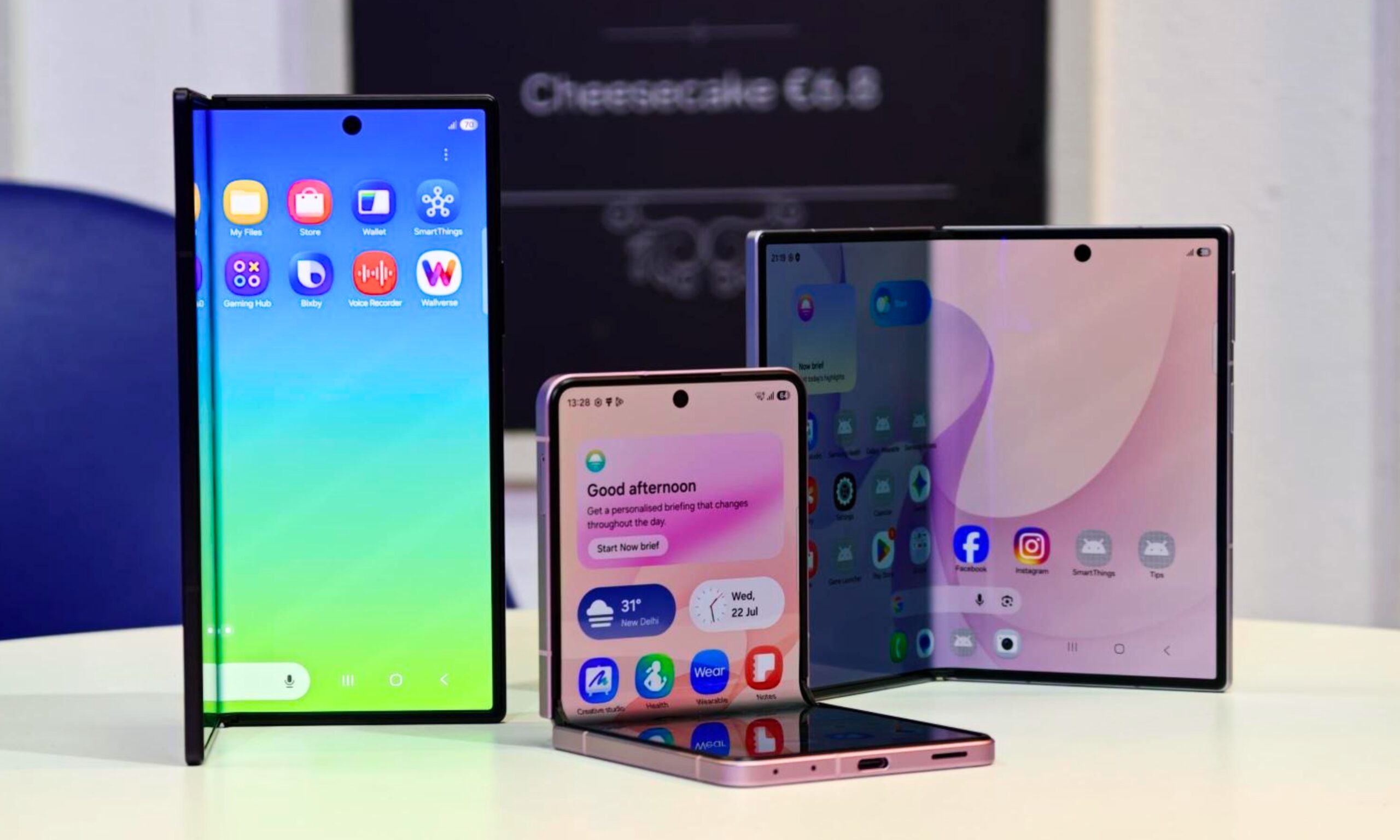
I’ve used foldable phones for years. Here’s how to pick the right one between the Galaxy Z Fold 8 and Flip 8
Samsung’s three new foldables solve very different problems
Galaxy foldables with its screen visible

After years of reviewing foldable smartphones, I have learned that choosing one involves much more than what looks pretty or how large you want. Book-style foldables are usually sold as productivity machines, while flip phones cater to people who value portability. Samsung’s latest lineup complicates that choice by introducing two very different book-style models alongside its familiar clamshell.

Most of their shared specifications fade into the background once you start using them. Their shapes and screens have a much greater impact on daily life. So here's how I'd make a decision when choosing between the new Galaxy Z Fold 8 Ultra, Galaxy Z Fold 8, and Galaxy Z Flip 8.

Read more