Do you feel as if you’ve gotten more spam calls than ever before this year? You’re not alone. Spam-skimming Truecaller has released its report on spam calls in 2018, and it seems that spam calls are on the rise, with numbers of nuisance calls rising in a large portion of the top 20 countries.
Brazil was the hardest hit by the increase, seeing a staggeringly large increase of 81 percent, and going from 20.7 spam calls per user to 37.5 — slightly more than one a day. Truecaller blames the Brazilian general election for the rise in calls, but also highlights a massive rise in scam calls, which went from 1 percent to 20 percent in just a single year. Operators maintain their notorious spot as the top spammers in Brazil though, sitting at 32 percent of all reported spam calls.
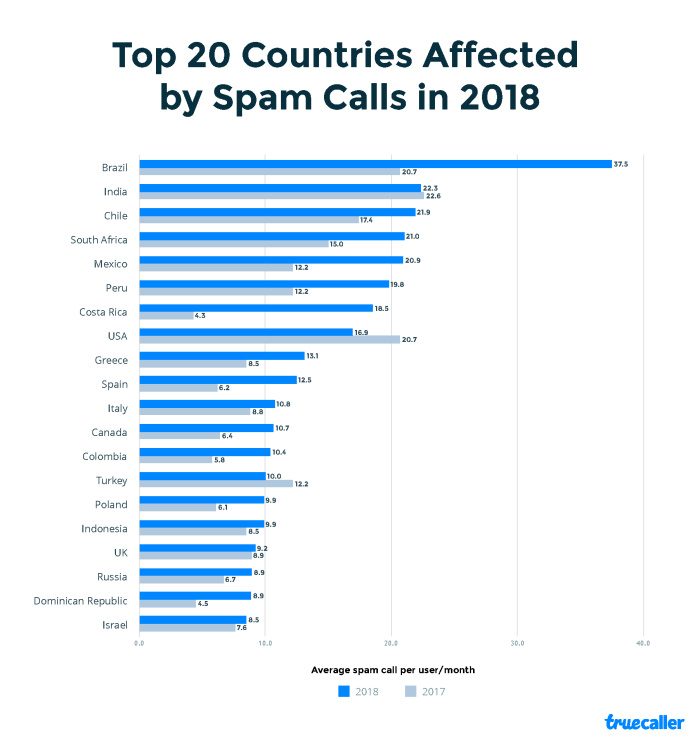
Operators were also the worst offender across the world, with calls to upgrade phones or add lines being the largest portion of spam calls in most countries. European countries also saw a rise in spam calls as a whole, with Spain, Italy, and the United Kingdom. all seeing an increase in spam. Spain, in particular, saw an increase of 100 percent in 2017. However, none of those countries score in the top five, with the positions after Brazil’s top spot being taken by India (last year’s No. 1), Chile, South Africa, and Mexico.
The United States saw a drop in average spam calls received per user, falling from 2017’s 20.7 to 16.9 in 2018 — but scam calls still account for a huge amount of money lost to fraud in the U.S. According to Truecaller’s stats, 1 in 10 Americans lost money from a scam call in the last 12 months, for an average loss of $357 lost per person. Laying those stats onto the American public and extrapolating upwards, Truecaller estimates that an estimated 24.9 million Americans were scammed in 2018, for a total loss of $8.9 billion. That’s almost half of NASA’s budget for 2018.
Free vacation scams were the fastest growing type of scam, closely followed by credit card debt scams. College graduates were more likely to fall prey to scams than people with no college education, and parents with a child under the age of 18 were also more likely to be scammed than those without.
With half of all total calls set to be scams by 2019, it’s the best time to make sure you’re protected from these sorts of cons. We’ve written a guide on keeping clear of phone-based phishing attacks, and we’ve also offered advice on how to avoid telemarketing calls too.