
The Federal Communications Commission has released its 15th Annual Mobile Wireless Competition Report (PDF), which takes a detailed look at the state of the mobile communications industry in the United States to assist in policy-making and how to regulate the industry (or not) to benefit consumers. Rolling in at 308 pages (including maps and appendices), there’s plenty of material to digest, much of it culled from the census and regulatory filings, along with third party surveys and studies. However, some of the figures stand out: some 89 percent of Americans have mobile phone service, and nearly a quarter (24.9 percent) have dropped landlines entirely in favor of mobile service. Broken down by age demographic, that last number gets even more interesting: over 50 percent of adults aged 25 to 29 live in wireless-only households.
Americans also seem to love mobile Internet, with some 55.8 million people—just over 18 percent of the population—subscribing to a mobile Internet plan with at least 200Kbps of bandwidth in one direction—that figure is more than double the number of mobile Internet subscribers in 2008.
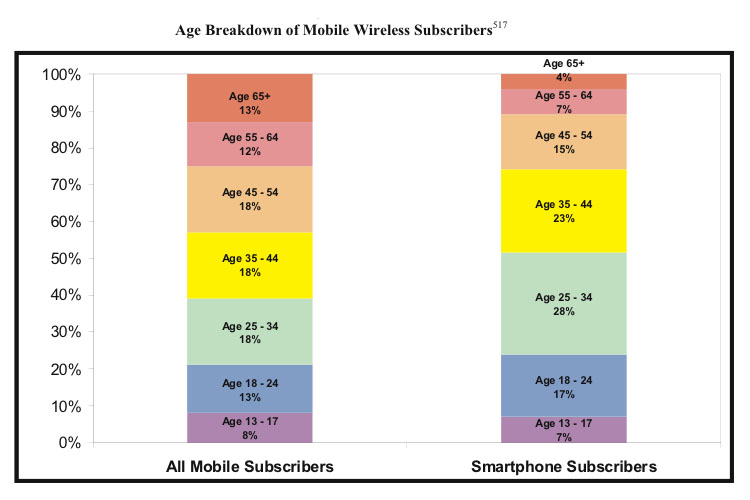
The report also finds some differentiation between folks who have a standard mobile phone (or feature phone) compared to a smartphone: mobile users aged 55 or over are more likely to have a feature phone than a smartphone, and mobile users aged 25 to 34 are more likely to have smartphones than feature phones (28 percent compared to 18 percent). However, in most other demographics, smartphones only hold a slight edge: 17 percent compared to 13 percent amongst 18 to 24 year-olds, 23 percent to 18 percent amongst 35 to 44 year-olds, and feature phones actually win out in the 45 to 54 crowd, 18 percent to 15 percent, respectively.
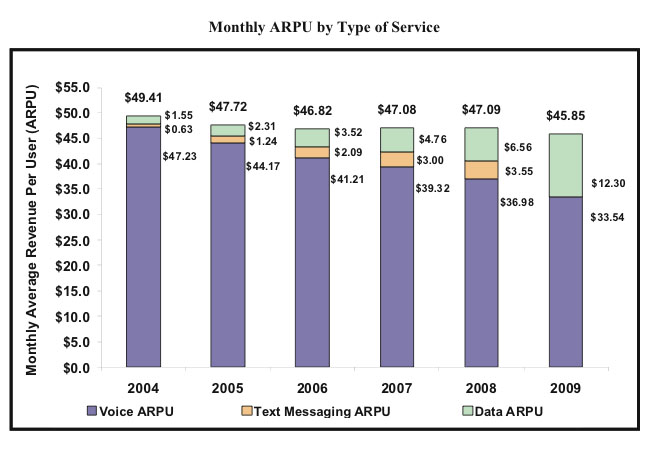
The FCC also breaks down mobile operator revenues by the top of service they provide—and, not surprisingly, voice service still makes up the bulk of providers revenue. The average amount paid by mobile subscribers across the industry for all services has dropped from $49.41 in 2004 to $45.85 in 2009, with voice service alone dropping from an average of $47.23 per month in 2004 to $33.54 in 2009. However, while text message fees accounted for less than 10 percent of average revenue in the overall industry in that time span, data services have taken off: where they accounted for just 3.1 percent of average subscriber monthly revenue in 2004, by 2009 that had jumped to 27.4 percent—and you can bet that figure is higher for 2010 and 2011.
The FCC report also shows major wireless carriers are reaping the financial benefits of consumers’ increasing adoption of smartphones and mobile data services. Verizon Wireless and AT&T pulled in record profit margins in 2009, and T-Mobile steered a pretty steady course from 2005 onwards.Only Sprint has seen a significant decline in its profit margin, and even it’s business was ticking along at 18.2 percent profit at the end of 2009.
Although the report is careful not to draw any conclusions—it’s intention is to provide raw data analysis for policy-makers—its content is sure to play a significant role as policy makers evaluate AT&T’s pending $39 billion acquisition of T-Mobile.


