Anyone who thinks they know what the future of VR is should think about the Palm Pilot.
No, seriously.
I’ve personally tried several virtual reality headsets. They’re otherworldly and fun — but also expensive, un-intuitive, and not at all practical for the average person.
Right now, VR is for geeks. Mainstream adoption is years, if not decades, away. And we’ve no idea what widespread consumer VR will look like, or what users will even do with such devices. The Palm Pilot’s story is worth reflecting on here.
When digital day-planners were the future
The original Palm Pilot 1000 was released in 1996 for $300. The handheld device offered a 12MHz processor, 124K of memory, and 500K of internal storage. It was 0.71 inches thick, more than many laptops today. It had no connectivity to speak of, outside a dock that connected to a PC serial port.
It was no powerhouse by modern standards, but a massive success at the time, selling a million units in 18 months.

Looking at the Palm Pilot 1000 in 1996, it was impossible to imagine the smartphone ecosystem that evolved 20 years later. Ubiquitous wireless internet was the stuff of science fiction, and social networks weren’t even conceived of yet. In that context, the Palm Pilot 1000 was compared to the technology it was meant to replace — the day planner.
In The New York Times, Katie Hafner outlined this contest in a retroactively fascinating article that pitted the Palm Pilot against paper. It wasn’t at all clear the gadget was winning.
For users of the Palm Pilot, it was impossible to imagine the smartphone that evolved.
“Whether this gadget is a tool or a toy — a help or a distraction — is open to debate,” Hafner wrote. “The Palm Pilot’s most avid users are self-confessed gadget freaks who spend hours — the time they presumably save by using an electronic organizer — loading their devices with digital paraphernalia.”
Whether portable computers can compete with a paper day-planner was, in retrospect, the wrong question to ask entirely. Sure, modern smartphones offer contacts, calendar, and to-do lists, but those are far from the main thing people use their smartphones for. Mobile usage is dominated by social media and messaging apps, things no Palm Pilot user even thought about.
And paper dayplanners remain to this day. Thousands of people use their phones to take pictures of their paper to-do lists, then share them on Instagram.
No Palm Pilot 1000 user could have predicted this kind of future. There have been so many technological and cultural changes since then — from mass internet adoption to the rise of social networks to an emergent nostalgia for paper systems — that make this current moment what it is.
We don’t know what VR will turn into
Which brings us back to Oculus Rift. We can safely assume that the Oculus Rift, along with other early headsets like the HTC Vive and Microsoft HoloLens, will seem laughably under-powered in twenty years. We can assume that we’ll have more processing power, more storage, higher resolution displays, and all around better versions of everything we have now.
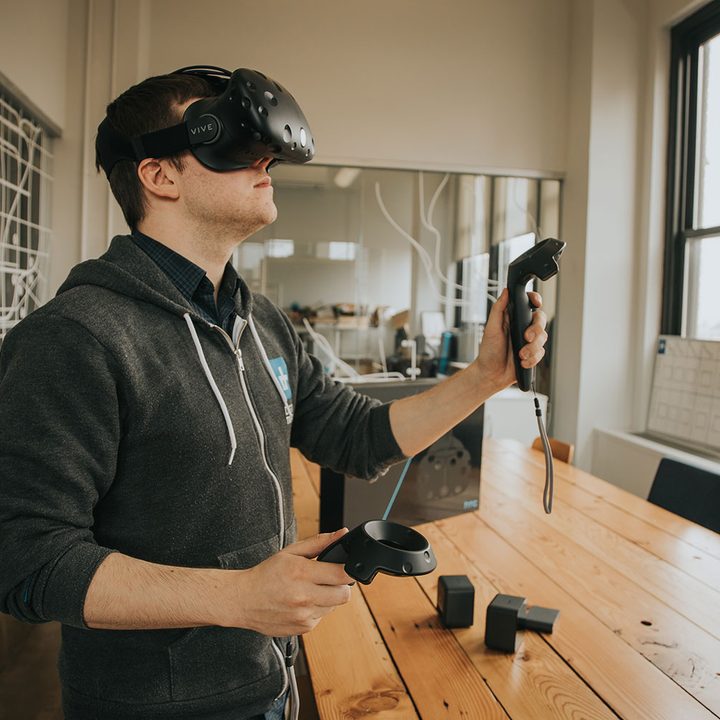
But we don’t know what auxiliary technology, or cultural change, will take virtual reality from a niche interest to a mainstream phenomenon. How could we?
Right now, we understandably think of the Rift as an alternative to existing technology. Just as we imagined the Palm Pilot as a replacement for a paper dayplanner in 1996, the Rift is marketed as an alternative to playing games on a monitor, or watching movies on a TV.
But if history is any guide, virtual reality will become something else entirely. Maybe full-body tracking and treadmills will be commonplace, and VR will be used in full rooms designed for that purpose. Or maybe an alternative system, where brainwaves control avatars directly, will negate the need for dedicated infrastructure. Maybe the online games of the future will take place in virtual reality, or maybe the biggest usage for the technology will be visiting friends who live far away.
In all probability, however, everything I just said will seem absurd to people in 2036.
Early adopters often miss the point, and that’s okay
I used a Palm device in college. Pursuing the best to-do list and calendar applications wasted way more of my time than I gained back through any productivity boost. But the appeal of the Palm Pilot 1000 wasn’t so much productivity as the idea of the device itself. A large group of people dreamed of a future where the calendar, to-do lists, and contacts could sync from your computer to a portable device that could be carried everywhere, and sank countless hours into setting this all up.
Today, that dream is a reality. But we mostly use the devices for other things.
Being an early adopter is fun, and it makes you think you’ve a clear idea of what the future will look like. Still, most of the time, early adopters can’t conceive of what the mainstream use for a current niche tech might be.
We missed the point with the Palm Pilot. We’re probably missing the point with the Rift, and other headsets. That’s okay. The surprising evolution of new techology is part of the fun. Now please excuse me: I hear a great new to-do list just came out.