Unwittingly drinking contaminated water is an awful thought, and one that’ll thankfully never become a reality for most people. But it’s a nightmare that residents of Flint, Michigan, endured for months when local government officials, eager to trim the beleaguered region’s costs, switched the metro’s water source from Lake Huron to the Flint River. The stream proved highly corrosive to Flint’s aging service lines, many of which contained lead, and resulted in predictable tragedy: residents and their children were exposed to dangerous chemicals that resulted in skin lesions, vision and hair loss, depression and anxiety, and, in severe cases, permanent neurological damage.
“Part of this is empowering people to become their own guardians and watchdogs, so they can double check what’s going on.”
It’s been two years since the Flint, Michigan water crisis began, and the problem persists even after the media attention has died down. History, if forgotten, is doomed to repeat itself, which is why Sean Montgomery, a neuroscientist and the CEO of technology company Connected Future Labs, created a mobile app that provides an easy way for citizens to test their home town’s water quality. It’s called CitizenSpring, and it launched on Kickstarter in early August.
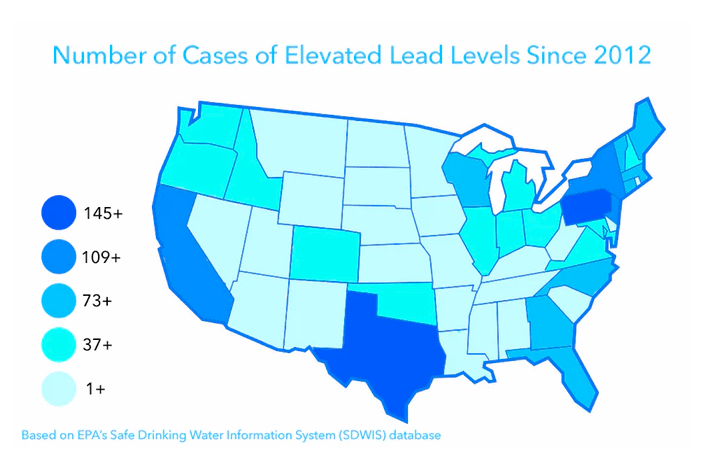
“When I first heard about Flint, I immediately thought: wow. Permanent brain damage in kids? Kidney problems? Not good,” Montgomery told Digital Trends. “And as the year went on, it became clear that it wasn’t just a Flint problem.” He cited a study published by the Center for Disease Control and Prevention, which found that more than 40 percent of states that reported 2014 lead test results showed higher rates of lead poisoning among children than Flint. “Now that people are aware there could be a problem, people are become aware there is a problem,” Montgomery said.
Montgomery’s initial solution involved tapping the government’s data on water quality. But there’s shocking dearth of data. It turns out only 27 states have reported childhood blood lead surveillance over the past two years, and in Texas, a state with a child population that exceeds 2 million, only 184 kids have received testing for lead poisoning.
An app seemed like an appropriate alternative. Smartphones, Montogomery reasoned, are essentially ubiquitous in the U.S. He’s not wrong — research firm eMarketer predicts the number of smartphone users in the U.S. will reach more than 236 million by 2019, or 71 percent of total people in the country. “It seemed like the quickest, easiest, and cheapest option,” he said. Specifically, Montgomery envisioned software that would guide users through the process of testing a water line, faucet, drinking fountain, or any other water source of potential concern. Users would buy an off-the-shelf, $10 strip test from a local supply store, stick it in the water, and the app would do the rest.
Lead testing isn’t exactly Connected Future Labs’ area of expertise — its website describes it as a “research and development” company — but it deals frequently and often with the technologies underlying Montgomery’s vision. It recently developed a technology that digitizes electronic medical records, for instance, and another that captures detailed 3D scans of the human body. “A central tenant of what we do is connecting the dots between different data points and different people,” he said. “And we’ve done a lot of object recognition.”
To that end, Montgomery and his team built an app capable not only of walking users through the process of conducting lead strip tests, but interpreting the results. By leveraging what Montgomery described as “computer vision,” the app is able to automatically tell whether lead levels in a given water source are within the EPA’s “safe” threshold. You hold a test strip up to your phone’s camera, press a button, and the app spits out the results. It even works offline.
The app’s second component is a crowdsourced database. Every test result is cataloged with the tester’s geographic coordinates, uploaded to cloud storage, and charted on a digital map. The intention is two-pronged: to inform folks of nearby water conditions, and, ultimately, to affect change.
“It’s an impoverished data problem,” said Montgomery. “We don’t have enough data. By sharing the results of test, people can, say, find out if they’re testing a faucet that hasn’t been tested before.”
At launch, CitizenSpring will remain relatively limited in scope. It’ll only test for lead, though Montgomery said support for additional strips could be added in the future. It’s launching on iOS first, with an Android version to come down the line. And it won’t integrate data from other sources, like government agencies and third-parties. But a streamlined experience was the intention from the start, said Montgomery: “We decided to make it as simple as we could.”
Montgomery hopes the app will encourage citizens to become stewards of their community’s water supply. “The people who are testing the water today sometimes have mixed incentives,” he said. Case in point: a 2011 Michigan study found that water from the Flint River would need to be treated with an anti-corrosion agent before it could be considered potable, a measure that experts estimate would have prevented “90 percent” of Flint’s water supply problems. “Part of this is empowering people to become their own guardians and watchdogs, so they can double check what’s going on and make sure that attention is being focused in the right places,” Montgomery said.
If you’d like to back the project or learn more, head to the Kickstarter campaign.