There’s nothing more annoying than an online store packed full of unsupported apps. They clog up the search engine when hunting down legitimate updated apps, and may not work correctly due to ignored bugs and/or a lack of optimization. They may even be outdated and long abandoned because the developer moved on to something else. Microsoft feels your pain, and is now removing some abandoned apps on the Windows Store — though not on the basis of bugs or a lack of updates.
Instead, these apps are being booted because they don’t fall under the new International Age Rating Coalition (IARC) rating system. Microsoft informed developers months ago that their public and private apps needed to be updated to meet the new age rating. Those that didn’t comply would face having their apps kicked off the Windows Store on September 30.
Instead of a localized age rating system like the Entertainment Software Rating Board (ESRB) system, the IARC provides a global, unified platform for games and apps so that customers from around the world know the age requirements for the software. The IARC was established in 2013, and makes it easy for developers to obtain age ratings from different regions. All developers need to do is answer a five-minute questionnaire about the app’s content and interactive elements.
“The questionnaire is programmed with unique algorithms that generate ratings reflecting each participating rating authority’s distinct standards, along with a generic rating for the rest of the world,” the IRAC explains. “IARC rating assignments also include content descriptors and interactive elements identifying apps that collect and share location or personal information, enable user interaction, share user-generated content, and/or offer in-app digital purchases.”
According to Microsoft, the first question asks a developer to choose a category that best describes the app. After that, specific questions will appear based on the developer’s previous answer. If a developer makes a mistake, he/she must go back to the beginning and start all over again to provide the correct answers. The app’s assigned ratings will then appear and the developer can continue to submit the app.
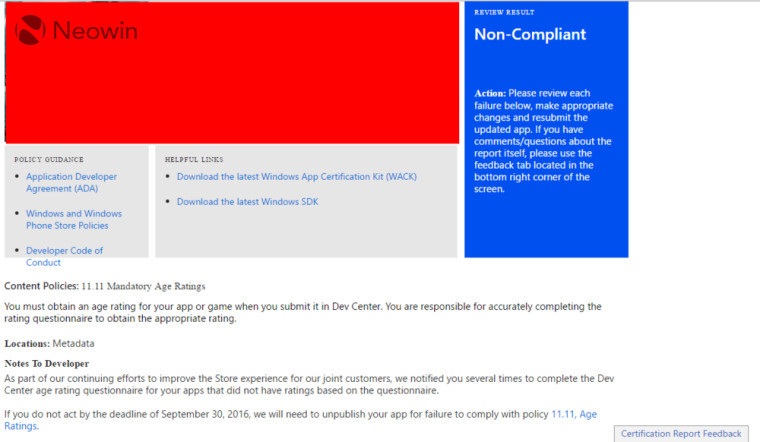
Microsoft’s requirement to comply falls under Content Policies 11.11 “Mandatory Age Ratings.” The company warned developers of the potential app removals in June through an email. The email appeared to be Microsoft’s last attempt to warn developers of the impending removal of their apps, stating that “we notified you several times to complete the Dev Center age rating questionnaire for your apps that did not have ratings based on the questionnaire.”
Previously, Microsoft’s Windows Store provided five ratings for apps and games: 3+ (suitable for young children), 7+ (suitable for ages 7 and older), 12+ (suitable for ages 12 and older), 16+ (suitable for ages 16 and older), and 18+ (suitable for adults). However, because the IARC is international, the unified age rating system will be different for each region.
The IARC is the result of a collaboration between a number of rating authorities including the Australian Classification Board, Brazil’s ClassLnd, Germany’s USK, Europe’s PEGI, and the local ESRB here in the United States. Storefronts participating in the IARC ratings program include Google Play, Nintendo’s eShop, and the Windows Store.