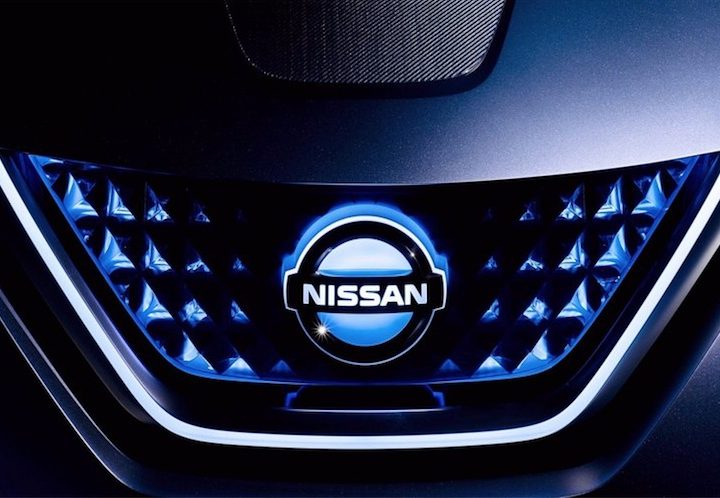
Nissan is about to give the all-electric Leaf a full makeover. It’s about time, too; the current, first-generation Nissan Leaf has been on the market since the end of 2010, and it’s getting a little bit long in the tooth. Its replacement won’t break cover for another few months, but the Japanese company is giving us an early look at some of its headline-grabbing tech features. Nissan USA recently tweeted a teaser image of its new Leaf, then added a background image showing the car’s entire front end (which has since been removed). The image below is our best look yet at the redesigned EV.
The next Leaf will finally usher in Nissan’s suite of semiautonomous driving features, a sign that the once-expensive technology is trickling down to more affordable models. Named ProPilot Assist, the software relies on sensors and cameras to help control acceleration, braking, and steering. It only works on the highway, particularly in dense traffic, and its job is merely to keep the car in its lane. Don’t expect it to change lanes on its own like the systems built by Mercedes-Benz and Tesla.
That’s just the beginning, though. Nissan promises its ProPilot tech will offer increasing levels of autonomy in the coming years. Eventually, it will even be able to drive itself through busy intersections in crowded urban centers. Nissan previewed its self-driving tech two years ago when it introduced the IDS Concept at the Tokyo Auto Show, and it has been testing the software all around the world ever since.
In July, Nissan shared a bit more information about what we can expect from ProPilot Assist. The technology is classified as SAE Level 2 semi-autonomous driving feature, which is to say that it’s only partially automated. You’re not meant to take your hands off the wheel even when the feature is enabled. That said, it’ll do a lot of driving for you. It’ll stay in one lane and manage your steering wheel to ensure that it stays in the center of said lane. It also features adaptive cruise control capable of bringing your Leaf to a complete stop, then reaccelerating when it senses that the car in front of it has begun moving again.
Operation of the system promises to be quite straight forward as well, as you’re effectively just turning on cruise control (which is actually the first step). Then, press the Nissan “Safety Shield” button, set your cruise control speed, and ProPilot Assist will take over.
Nissan isn’t ready to spill the beans about what will power its next Leaf. What’s certain is that the model will remain electric, and front-wheel drive. You didn’t think it would get a supercharged V8, did you?
It could offer up to 340 miles of range thanks to a much bigger battery pack than the one used by today’s model, according to British magazine Autocar. However, Nissan might also follow Tesla’s lead and offer a selection of two or three battery packs. Motorists who mostly drive in the city will pay less for less range, while those who need a long-range EV will be able to select a bigger, more expensive battery.
The 2018 Nissan Leaf will make its debut on September 5, just ahead of the biennial Frankfurt Motor Show. The battery-powered hatchback will be branded a 2018 model when it lands in showrooms across the nation during the first half of next year.
Update: Nissan revealed a bit more information about its upcoming ProPilot Assist feature.