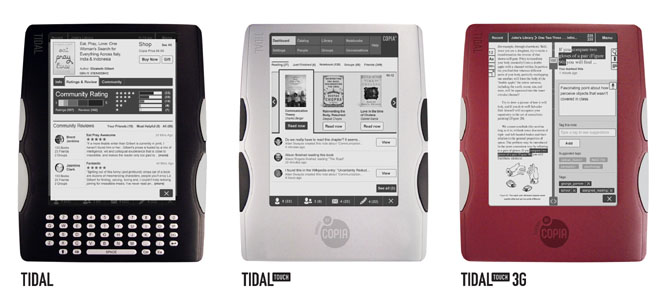
The market for ereaders may be largely dominated by the Amazon Kindle, but there’s certainly no shortage of challengers looking to bring electronic readers and mobile technology to the masses. Today DMC Worldwide unveiled its Copia platform, which aims to combine portable ereaders with mobile social networking capabilities so users can not only enjoy books, novels, blogs, magazines, newspapers, Internet sites, and more, but share what they think is important about them with friends, family, and the world—all from a single device. DMC will initially offer two product lines—the Ocean and the Tidal—with three readers each, along with an open platform the enables publishers and users to connect through a collaborative environment. Plus, third party device makers will be able to make new devices that latch into the Copia platform.
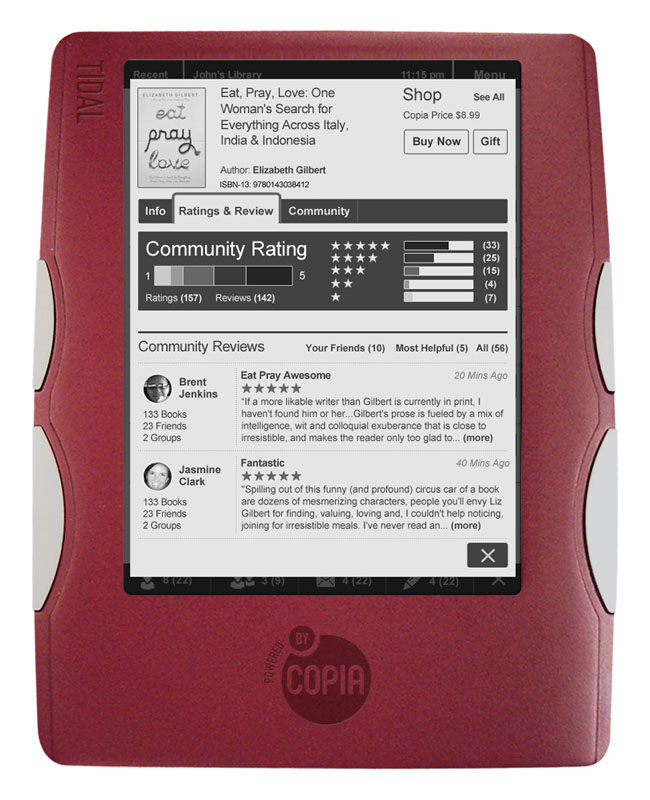
“Today, eBook content is delivered across one of two typical business models: a vast online store or a social networking service,” said DMC senior VP Anthony Antolino, in a statement. “The Copia platform is the first of its kind to combine content, collaboration, social networking, and e-commerce together to connect people through a collaborative experience. We developed Copia to allow users to discover and connect to each other through meaningful content regardless of the digital devices they are using.”
The Copia ereader lineup consists of six devices: three in the Ocean line and three in the Tidal line. The Ocean 6 features an 6-inch eInk display. 802.11b/g Wi-fi, a microSD card slot, a tilt sensor, and 4 GB of storage; the Ocean 9 jumps up to a 9-inch 1,024 by 768 eInk display, while the Ocean 9 3G actually runs on Linux, steps down to 2 GB of storage, but and offers optional 3G connectivity along with a speaker. The Tidal line follows a similar theme, except the Tidal touch and Tidal touch 3G offer a capacitive touchscreen, while the plain-old Tidal is the only unit in the bunch with a dedicated QWERTY soft keypad—but it doesn’t offer either Wi-Fi or 3G connectivity. In the Tidal line, only the Tidal Touch has 4 GB of storage; the Tidal touch 3G and plain-old Tidal have 2 GB each.
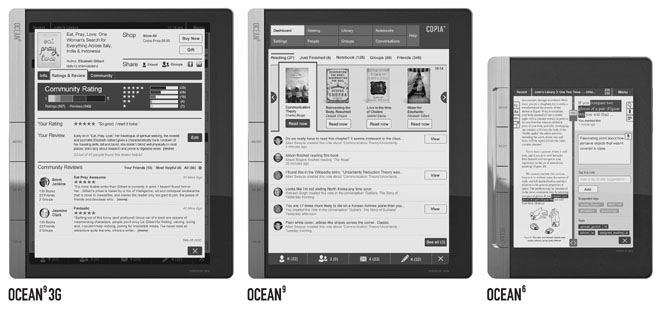
DMC plans to launch a private beta of the Copia service starting this month, and expects the Copia ereaders will be available for purchase starting in April 2010 with prices ranging from $199 to $299; no word on whether 3G connectivity will be rolled into the cost or whether users will have to sign up for a service plan. DMC is also promising an array of “compelling” content ranging from best-selling and popular books through public domain, entertainment,and textbook content, although no content partners have been announced yet.
All told, the Copia platform looks interesting, but it remains to be seen how users will interact with each other using the platform’s social networking tools, especially since some of the Copia readers have no connectivity at all. Perhaps, since the Copia platform is open, users are expected to be able to interact with each other using other tools like traditional Web browsers or mobile devices, and use the initial readers more like endpoint terminals. If the Copia readers support truly interactive social networking features with friends, family, and a broader ereader community, however, DMC might just have a winner on its hands.