  1. Home
  2. Phones
  3. Computing
  4. Mobile
  5. Smart Home
  6. Web
  7. News

Comcast claims new gateway can reach wireless speeds of 1.5 gigabits per second

Add as a preferred source on Google

Comcast’s new xFi Advanced Gateway is now available to all Xfinity broadband markets, the company said Wednesday. According to a blog written by Comcast’s Fraser Stirling, this new all-in-one device reportedly supports wireless speeds of more than 1.5 gigabits per second in the Comcast labs. It also includes an 8×8 antenna setup, meaning your connected device must have eight incoming and eight outgoing antennas to support the reported 1.5Gbps speeds.

In reality, promoted wireless speeds which are theoretical in nature, never translate into real-world speeds. Many factors come into play, including the channel width, local radio interference, neighboring networks, and more. Stirling says the new gateway sports an additional 160MHz channel width, which means there’s more air space for sending data back and forth from devices. Modern routers and gateways typically include 20MHz, 40MHz, and 80MHz channel widths.

Recommended Videos

“We use MU-MIMO (multi-user, multi-input, multi-output) technology to make sure that the xFi Advanced Gateway doesn’t just deliver great speed to one device, but because of the spatial diversity built into the design, it can simultaneously power dozens of devices without sacrificing performance on any of them,” Stirling says.

Of course, you can’t squeeze gigabit speeds out of a 300Mbps broadband subscription. The new xFi Advanced Gateway is available to all markets that support 300Mbps and up, and would seemingly be more ideal for the company’s Xfinity Gigabit Internet subscribers. Still, you’re not going to experience real-world wireless gigabit speeds with devices that aren’t built to support the technology. Comcast is merely laying a foundation for future devices.
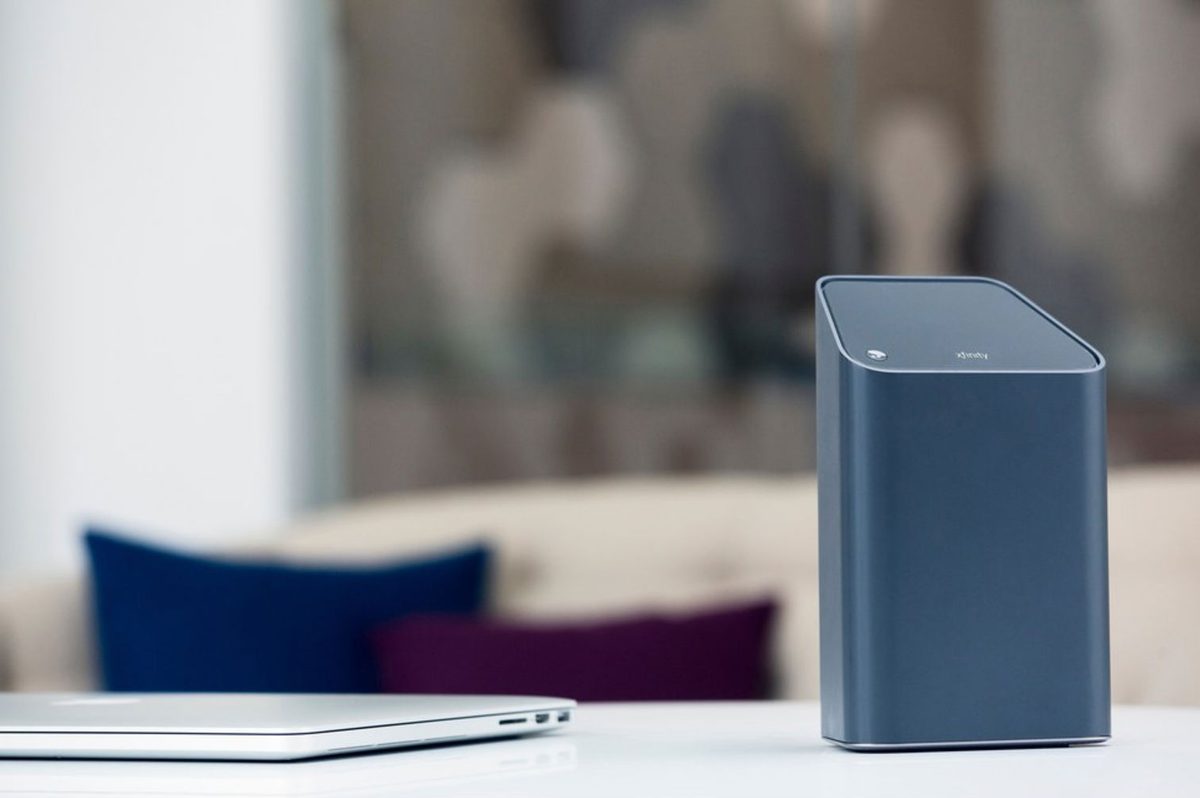
Image used with permission by copyright holder

“While there are currently no mass-market Wi-Fi connected devices capable of receiving gig speeds over Wi-Fi, those devices are coming,” he adds. “In the meantime, the power of the xFi Advanced Gateway delivers ultimate performance to your connected home.”

But speed isn’t the only selling point of Comcast’s new gateway. Because it resides in a central location in the home, the company wanted it to properly blend into its surroundings. Typically, gateways, modems, and routers are ugly devices with multiple flashing LEDs — some can even resemble mechanical spiders that are flat on their backs. But Comcast wanted a more elegant look, thus it switched out the LEDs for a single, soft and steady light. It also features a blend of neutral colors and soft-touch materials.

The company also considered the connected home when it designed the new gateway. The device includes not only a Bluetooth Low Energy component, but stand-alone radios for Zigbee and Thread (NEST, Philips Hue Home Automation) Internet of Things devices. The new gateway also provides plenty of customizable xFi-branded features, including per-user profile creation, access restrictions, device assignments, and more.

Comcast also plans to introduce a mesh-based networking system later this month. This won’t be a centralized unit like the new gateway, but will be made up of two or three satellite units that will blanket the entire home with mesh-like coverage. Additional details will be made available in the coming weeks.

Kevin Parrish
Kevin started taking PCs apart in the 90s when Quake was on the way and his PC lacked the required components. Since then…
Back-to-school phone shopping on a tight budget? Here’s the one phone I’d recommend without hesitation
The budget phone market got messy this year, but one phone still makes sense.
Galaxy A17 in all colors on gradient background

Somewhere between the last day of school and the first day back, your phone conked out. Perhaps the screen shattered after a particularly nasty fall, or its battery regularly gives up by noon, or apps take so long to launch that by the time they do, you've forgotten why you opened them in the first place. You don't think it'll last another school year, but between all the school supplies and everything else, a budget phone is all your wallet can handle right now.

Fortunately for you, cheap phones have come a long way, offering better screens, bigger batteries, and more capable cameras than devices launched just a couple of years ago. Since you're already prepping to head back to school, this is as good a time as any to lay your old phone to rest and lock in an upgrade. But unfortunately, the timing isn't great for the smartphone industry in general, and that has had a real impact on entry-level phones.

Read more
5 mid-range phones I’d recommend you spend your Back-to-School budget on
From the Pixel 10a to the Moto G Power 2026, these five phones prove you don't need flagship money for a great back-to-school upgrade.
Electronics, Mobile Phone, Phone

Does your phone have a cracked screen? A battery that barely makes it past 3 PM? Or a camera that captures a blurry mess instead of great memories? You know it's high time for a new one, and right now, while you're shopping for the new school year, is probably the best time to make the switch.

The best part is that you don't need to spend flagship money to get a phone that'll last you the next few years. Mid-range phones have gotten seriously good of late, closing the gap with flagships where it matters the most, be it battery life, performance, or camera quality. Whether you're upgrading your own phone or picking one out for your kid before classes start, here are the best mid-range phones worth your money this back-to-school season.

Read more
After four generations of camera stagnation, the Galaxy S27 might finally get a new main sensor
Samsung could turn to Sony for the Galaxy S27’s long-overdue main camera upgrade
Samsung Galaxy S26

Samsung might finally be ready to stop recycling the same main camera hardware on its standard Galaxy S phones, which it introduced with the Galaxy S22. GalaxyClub reports that some Galaxy S27 and Galaxy S27+ prototypes are being tested with a new 50MP Sony sensor for the main camera.

Such a move would break Samsung’s long-running preference for its own ISOCELL hardware in the primary cameras of Galaxy S phones, even if the resolution remains unchanged.

Read more