1. Home
  2. Computing
  3. Social Media
  4. News

Here’s how to check if Facebook shared your data with Cambridge Analytica

Add as a preferred source on Google

In keeping with earlier promises, Facebook has rolled out a tool that will show users whether their data was in the hands of Cambridge Analytica or any other company that has since been banned from the platform for illicitly accessing people’s personal data — something that may lead to regulation of the social network.

All right, so how can you find out if your data was shared? Simple. Just open Facebook in your browser or on your phone, then navigate to your news feed. If your data was shared or improperly accessed by Cambridge Analytica or any other company now banned from Facebook, you’ll have a notification at the top of your feed explaining just who had your data.
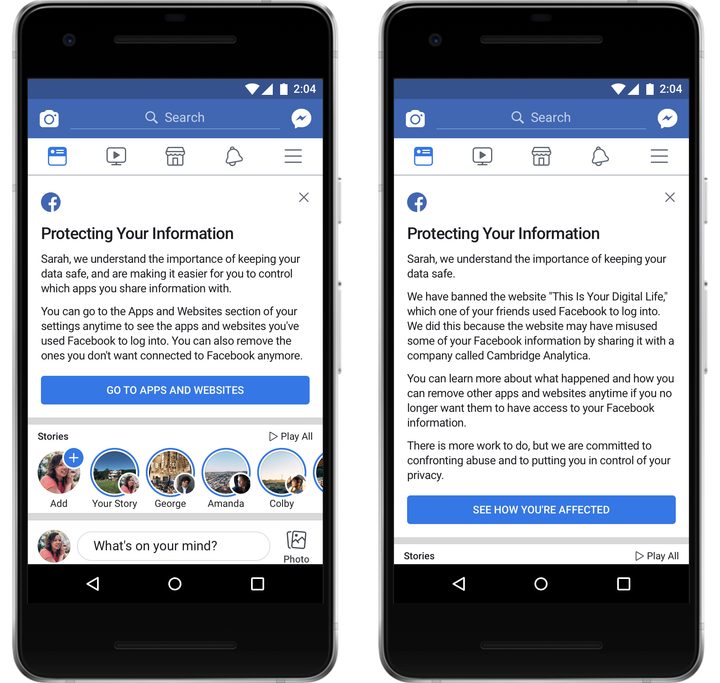
Facebook Privacy Notification
Image used with permission by copyright holder

The images above show what the new privacy notifications will look like. They very clearly state whether or not you were affected, as well as how to double-check which apps and websites currently have access to your data. It’s an important step for Facebook in the face of the Cambridge Analytica scandal, but it remains to be seen whether or not these new notifications will help keep you secure in the long run.

Recommended Videos

Did you miss the notification?

While many people will see the notification, many people won’t — and it’s always possible that you missed it. If you think you did, you can check at any time by going to this support link. It will tell you, in very simple terms, if your data was (or wasn’t) compromised.

“We have more work to do”

“Overall, we believe these changes will better protect people’s information while still enabling developers to create useful experiences,” the Facebook statement reads. “We know we have more work to do — and we’ll keep you updated as we make more changes.”

Facebook has been on its back foot ever since the Cambridge Analytica story broke, and founder and CEO Mark Zuckerberg is testifying before Congress this week, answering questions about what Facebook knew and when. Zuckerberg delivered a written statement that was released by Congress, in which he takes responsibility and promises to do better in the future.

“Over the past few weeks, we’ve been working to understand exactly what happened with Cambridge Analytica and taking steps to make sure this doesn’t happen again,” Zuckerberg wrote. “We took important actions to prevent this from happening again today four years ago, but we also made mistakes, there’s more to do, and we need to step up and do it.”

Jaina Grey
Former Digital Trends Contributor
Jaina Grey is a Seattle-based journalist with over a decade of experience covering technology, coffee, gaming, and AI. Her…
Gemini Notebook’s new Collections arrive just as Google turns it into a bigger workspace
Google is cleaning up notebook organization as the former NotebookLM expands across Gemini and Search
Gemini Notebook branding on a MacBook

Google has barely finished renaming NotebookLM, and it’s already addressing one of the headaches that comes with building a large research library.

Collections are rolling out to all Gemini Notebook users, giving them a way to group related notebooks while keeping everything visible under My Notebooks. The dashboard gets some structure without asking users to rearrange the library they’ve already built.

Read more
Samsung’s humanoid robot ambitions are real, but factories come first
Samsung’s new robotics division has humanoids in its sights, although its immediate business is far more practical factory automation
Robot Touch Human Finger

Samsung wants a place in the humanoid race, but its new robotics push begins with machines built for factories rather than homes.

The CEO-led RX robotics division will initially focus on manufacturing robots. Samsung has separately identified humanoids as a priority, although it hasn’t announced a commercial model or explained where one fits into the division’s immediate plans.

Read more
WhatsApp’s Liquid Glass redesign is finally coming to Mac after months of waiting
WhatsApp's Mac app is getting Apple's Liquid Glass-inspired makeover
WhatsApp

WhatsApp has been steadily adopting Apple's new design language across its apps, but Mac users have largely been left watching from the sidelines. That is finally beginning to change.

The messaging platform has started rolling out its Liquid Glass redesign for the WhatsApp Mac app, bringing the desktop experience much closer to what iPhone and iPad users have been seeing over the past few months. The update introduces a refreshed interface with redesigned navigation elements, updated menus, and a cleaner layout that aligns with Apple's latest software aesthetic. According to WABetaInfo, the rollout has begun through the latest Mac App Store update and is currently reaching a limited number of users.

Read more