At I/O this year, Google proclaimed that “2018 will mark the true kickoff point” for the immersive web, which brings virtual and augmented reality experiences to a browser near you. To help developers create VR and AR content for the web, Google unveiled the new WebXR. Some of these APIs are still in development, but Google is beginning to let developers experience these protocols today.
The immersive web is defined as a collection of new and upcoming technologies that prepares the web for the full spectrum of immersive computing, Brandon Jones of Google’s Chrome team said. “More generally, what we think of the immersive web is anything that gives the web a sense of depth, volume, scale, or place.”
There are two main technologies right now that power the immersive web — virtual reality and augmented reality. Jones described VR as tech that takes you anywhere, whereas AR is tech that brings anything to you.
 To bring VR to the web, Google is replacing the WebVR standard last year with its new WebXR protocol. In addition to supporting the deprecated WebVR specifications, WebXR also supports AR, better forward compatibility, a cleaner and more consistent user experience, and more optimizations. These WebXR optimizations allow VR headsets to display twice as many pixels — now up to 4 million pixels — at the same frame rate, remedying some of the limitations of WebVR, Jones highlighted.
With AR in the browser, WebXR leverages the device’s camera to place virtual objects in real life environments, similar to Snapchat’s filters. In an example, Chrome team product manager John Pallett showed how a statue can be placed on a surface on stage, allowing the viewer to understand the statue’s scale and size, as well as view details and information about the object.
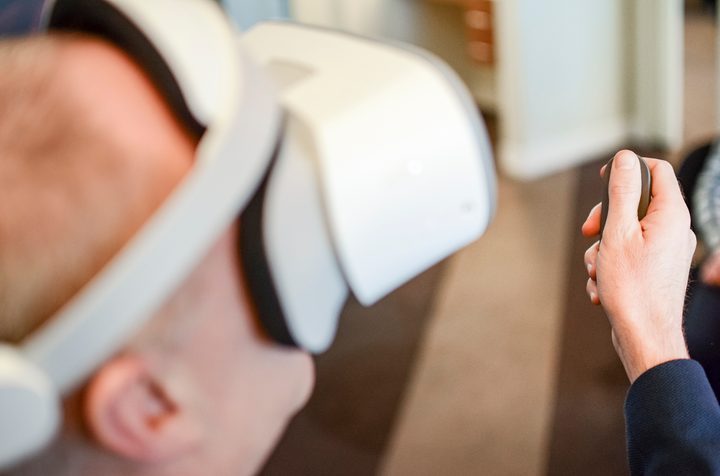
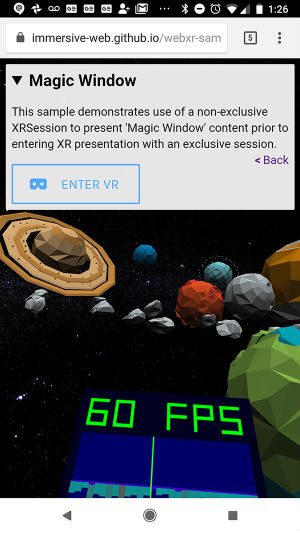
Developers can get started today by enabling the WebXR flag in the Chrome 67 beta. When the flags are enabled, VR content can be displayed in three different ways. First, VR can be shown through a headset, such as Daydream VR and on Cardboard. Second, it will work on desktop VR systems, like HTC Vive and Oculus Rift. And lastly, VR can be displayed in the browser for users who don’t have a headset through Magic Window. Magic Window tracks the view based on your phone’s sensors.
To expand the reach of the immersive web, developers can enable an easy transition between VR headsets and Magic Window with a single click. Additionally, with polyfill support, WebXR can be emulated on older WebVR-compatible browsers as well as JavaScript browsers like Mobile Safari.
The tools for handling AR right now are still being developed in the W3C community, of which Google is a member, Pallett said. The beauty with WebXR is progressive fallback. If a user is attempting to view AR content on a desktop without a camera, for example, developers can add support for Magic Window to convert the AR experience into a VR one.