  1. Home
  2. Computing
  3. News

Samsung looks to woo gamers with Thunderbolt 3-equipped curved QLED monitor

Add as a preferred source on Google
IFA 2026
This story is part of our coverage of IFA Berlin 2025
 

Samsung is bringing its quantum dot screen technology to gamers. At IFA 2018, the company unveiled the Samsung CJ79, a 34-inch curved monitor with a QLED panel, which should help it display more precise colors in a wider color space than traditional LED screens. Though Samsung is primarily marketing the high-end CJ79 at premium PC users — the company claims compatibility with both Macs and Windows devices — gamers who use AMD’s Radeon graphics card will also benefit from the CJ79’s adoption of FreeSync screen technology.

Recommended Videos

One of the hallmark features Samsung is trumpeting is that this display is the first to come with Thunderbolt 3 support. Although Thunderbolt 3 provides similar benefits to a standard USB-C connector — a single cable can be used to connect the monitor to a computer for power, data, and video — the Thunderbolt provides more power and faster data throughput than a standard USB-C connection. Older computers lacking a Thunderbolt 3 port can connect to the CJ79 through either HDMI or DisplayPort.

“The CJ79 is our latest endeavor in taking curved monitors to the next level that highlights our commitment to innovation,” said Seog-gi Kim, Samsung Electronics executive vice president of visual display, in a statement. “The addition of Thunderbolt 3 connectivity aligns to that vision and connects customers to infinite possibilities.”
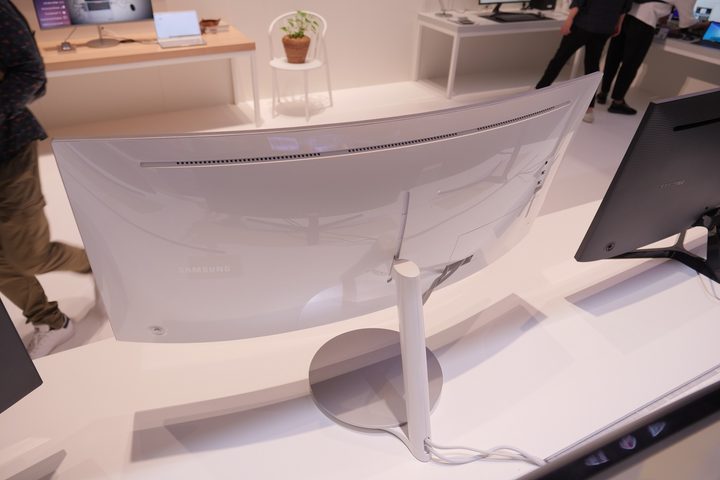
Image used with permission by copyright holder

The 34-inch VA (vertical alignment) panel supports an ultrawide QHD resolution of 3,440 x 1,440 pixels and comes with a 21:9 aspect ratio. The ultrawide aspect ratio allows you to multitask — or play immersive games — without having to connect two or more displays together for a multi-monitor setup. Multitaskers will also benefit from the picture-in-picture mode. And because the display is so wide, the 1,500R curvature helps to make sure you can see all your content. Samsung claims that the curvature follows the natural curve of the eyes for a comfortable experience.

The CJ79’s QLED panel supports 125 percent of the sRGB color spectrum and a 3000:1 contrast ratio, and Samsung claims that the screen produces deeper blacks and brighter whites. Gamers will benefit from reduction in screen tearing and stutter thanks to the FreeSync tech.

If the standard 34-inch panel is too small for you, Samsung has an even larger 43-inch super ultrawide curved panel called the CJ89. That one comes with a 3,840 x 1,200 resolution and 32:10 aspect ratio along with an integrated KVM switch to connect multiple computers to the same display. There’s also a built-in USB hub and stereo speakers on the larger CJ89.


Chuong Nguyen
Silicon Valley-based technology reporter and Giants baseball fan who splits his time between Northern California and Southern…
WhatsApp’s Liquid Glass redesign is finally coming to Mac after months of waiting
WhatsApp's Mac app is getting Apple's Liquid Glass-inspired makeover
WhatsApp

WhatsApp has been steadily adopting Apple's new design language across its apps, but Mac users have largely been left watching from the sidelines. That is finally beginning to change.

The messaging platform has started rolling out its Liquid Glass redesign for the WhatsApp Mac app, bringing the desktop experience much closer to what iPhone and iPad users have been seeing over the past few months. The update introduces a refreshed interface with redesigned navigation elements, updated menus, and a cleaner layout that aligns with Apple's latest software aesthetic. According to WABetaInfo, the rollout has begun through the latest Mac App Store update and is currently reaching a limited number of users.

Read more
NVIDIA’s new AI can detect deepfake videos in just 22 milliseconds
NVIDIA has a new AI tool that can tell fake videos from real ones in milliseconds
Nvidia logo

As generative AI becomes increasingly capable of producing videos that are nearly indistinguishable from real footage, the race is no longer just about creating synthetic media. It's about detecting it before it spreads.

At SIGGRAPH 2026, NVIDIA unveiled Synthetic Video Detector, a new AI-powered verification tool designed to identify AI-generated videos with remarkable speed and accuracy. Rather than replacing traditional fact-checking or forensic analysis, the company says the technology is intended to give newsrooms, broadcasters and enterprises another layer of confidence before synthetic videos enter the public domain.

Read more
Dell XPS 14 (2026) Review: Dell’s classic Windows laptop returns, and it’s hard to put down
The icon returns, and shows why it's still relevant
Dell XPS 14 Review: Featured

Quick take

Dell’s XPS line has always carried a certain weight. It is one of those Windows laptop families that people recognize even if they don’t follow laptops too closely. Clean design built with premium materials, sharp displays, and high-end hardware. The Dell XPS 14 DA14260 continues that legacy. 

Read more