  1. Home
  2. Emerging Tech
  3. News

Researchers develop ‘green liver’ houseplant that cleans the air in your home

Add as a preferred source on Google

Houseplants add an attractive touch of green to your home, but in the future they could help protect you from dangerous chemicals as well.

Researchers at the University of Washington have developed a houseplant that can clean the air in your home. Traditional methods of air cleaning like the use of HEPA filters can remove allergens and dust particles from the air, but there are other molecules which are too small to be filtered out. Small molecules like chloroform or benzene can build up in a home from sources like chlorinated water or gasoline and can be potentially harmful to your health.

Recommended Videos

In order to cleanse these smaller compounds from the air, scientists have taken a common houseplant, pothos ivy (also known as Devil’s ivy), and genetically modified it so that it absorbs chloroform and benzene. The modified plants can “eat” these potentially dangerous compounds and use them to fuel their own growth.
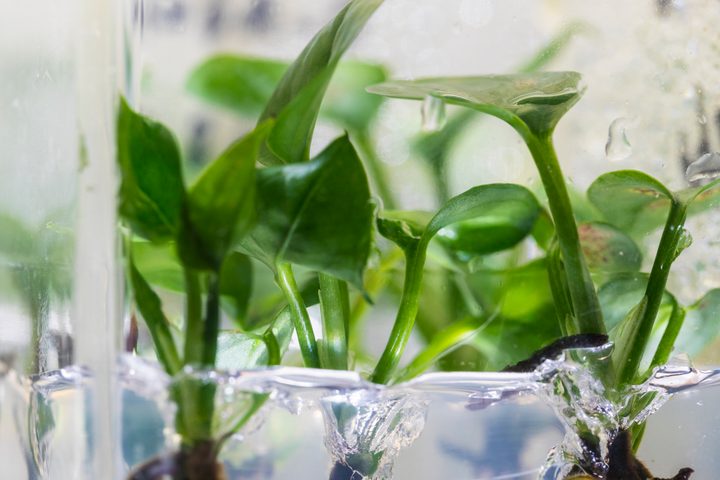
Researchers at the University of Washington have genetically modified a common houseplant — pothos ivy — to remove chloroform and benzene from the air around it. Mark Stone/University of Washington

To get the plants to absorb the compounds, the team was inspired by the functioning of the human liver. A protein called cytochrome P450 2E1 which is present in the liver of mammals acts on benzene to turn it into the safer chemical phenol, and acts on chloroform to turn it into carbon dioxide and chloride ions. However, cytochrome P450 2E1 is only produced by the liver after consuming alcohol, so it cannot act on pollutants in the air.

“We decided we should have this reaction occur outside of the body in a plant, an example of the ‘green liver’ concept,” lead author Professor Stuart Strand, head of the Strand Lab at University of Washington explained. “And 2E1 can be beneficial for the plant, too. Plants use carbon dioxide and chloride ions to make their food, and they use phenol to help make components of their cell walls.”

Once the scientists had modified the ivy plants to express the protein, they compared how well the plants absorbed pollutants compared to non-modified ivy by sealing both types of plants in glass tubes full of benzene or chloroform. After 11 days, the levels of pollutants in the tubes with non-modified plants stayed the same, but the level of pollutants in the tubes with the modified plants dropped. The modified plants absorbed 82 percent of the chloroform and 75 percent of the benzene.

Chloroform and benzene are just two of the many pollutants potentially found in homes, so next the team plans to modify the plants to break down molecules of another pollutant, formaldehyde, as well.

Georgina Torbet
Georgina has been the space writer at Digital Trends space writer for six years, covering human space exploration, planetary…
That Claude chat you shared? Google may have seen it too
Public chat links were indexed by Google, potentially exposing sensitive information shared with the AI.
Claude AI on an iPhone.

If you've ever shared a Claude conversation using a public link, it might be worth checking your privacy settings. Over the weekend, users discovered that publicly shared Claude chats and Artifacts were appearing in Google Search and other search engines through queries such as site:claude.ai/share. The indexed pages reportedly included everything from resumes and business documents to API keys, health information, and other sensitive conversations that users likely never expected to become searchable.

How did this happen?

Read more
The AI-hooked younger generation is sourcing chatbot help even for in-person talks
From pickup lines to angry emails, here's how young adults are using AI to script their social lives, and why psychologists say it's a risky habit.
Person using ChatGPT on a MacBook.

I've definitely rehearsed a text message in my head before hitting send, especially when it's a long email with dozens of jargon and diplomatic language. However, when it comes to in-person talks, I’ve never even thought about outsourcing them to an AI chatbot.

Turns out an entire generation has handed the whole script to AI instead (via The Wall Street Journal).

Read more
Google Flow Music Spaces is becoming an all-in-one AI music studio
The latest update brings song editing, stem splitting, image generation, lyrics, and video creation into a single workspace.
Google Flow Music Featured

The company has announced a major update for Flow Music Spaces, bringing a suite of new AI-powered creative tools directly into collaborative workspaces. Instead of jumping between different apps or sessions, users can now generate and edit songs, split audio stems, create images, write lyrics, and even generate videos without leaving a Space.

What's new in Flow Music Spaces?

Read more