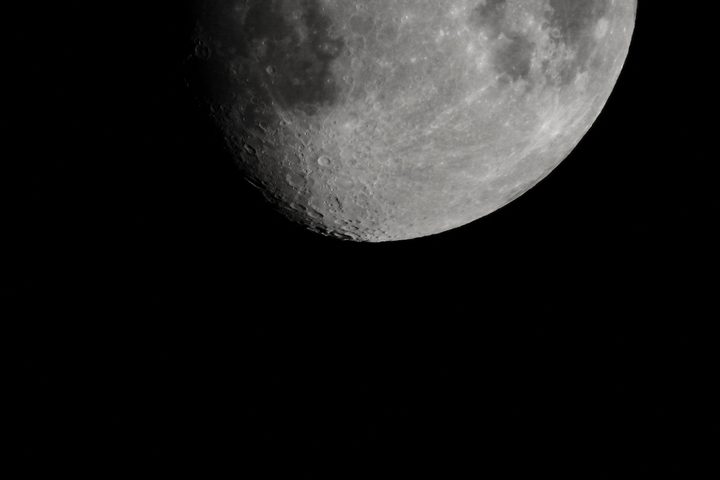
For a long time scientists believed there was no liquid water on the Moon and there were only small pockets of ice near its poles. But around 10 years ago they discovered there is in fact water on the Moon’s surface, mixed into the lunar soil (called the regolith). Now new data from NASA’s Lunar Reconnaissance Orbiter (LRO) has shown that water on the Moon moves in an intricate cycle.
Aboard the LRO is an instrument called the Lyman Alpha Mapping Project (LAMP) which searches for water in deep polar craters using ultraviolet light. The LAMP detects changes in a very thin layer of molecules on the surface which correspond to the movement of water particles. Scientists knew that surface water molecules were bound to the regolith, but they did not understand why water was found at certain times or in different locations on the Moon.
Now they know that the amount and location of water varies depending on the time of day, with water moving around the surface as it heats up. When surface temperatures reach their peak at lunar noon, the molecules are released from the regolith and either bounce to the nearest cold location or rise up into the thin atmosphere. Once the temperatures drop again, the molecules in the atmosphere return back to the surface.
“This is an important new result about lunar water, a hot topic as our nation’s space program returns to a focus on lunar exploration,” Dr. Kurt Retherford, the principal investigator of the LAMP instrument from Southwest Research Institute in San Antonio, Texas, said in a statement. “We recently converted the LAMP’s light collection mode to measure reflected signals on the lunar dayside with more precision, allowing us to track more accurately where the water is and how much is present.”
These findings are impressive because water molecules are difficult to detect from orbit. Light bounces off the Moon’s surface, making it hard to detect moving water molecules. Previously the “hopping” water molecules were thought to be an anomaly or an artifact of the way the light bounces, but now the LAMP has shown that the water is actually moving around the surface.
Accessing water is a key requirement for long-term missions to the Moon, so these findings could have real practical applications. “These results aid in understanding the lunar water cycle and will ultimately help us learn about accessibility of water that can be used by humans in future missions to the Moon,” Amanda Hendrix, a senior scientist at the Planetary Science Institute, said in the same statement. “Lunar water can potentially be used by humans to make fuel or to use for radiation shielding or thermal management; if these materials do not need to be launched from Earth, that makes these future missions more affordable.”