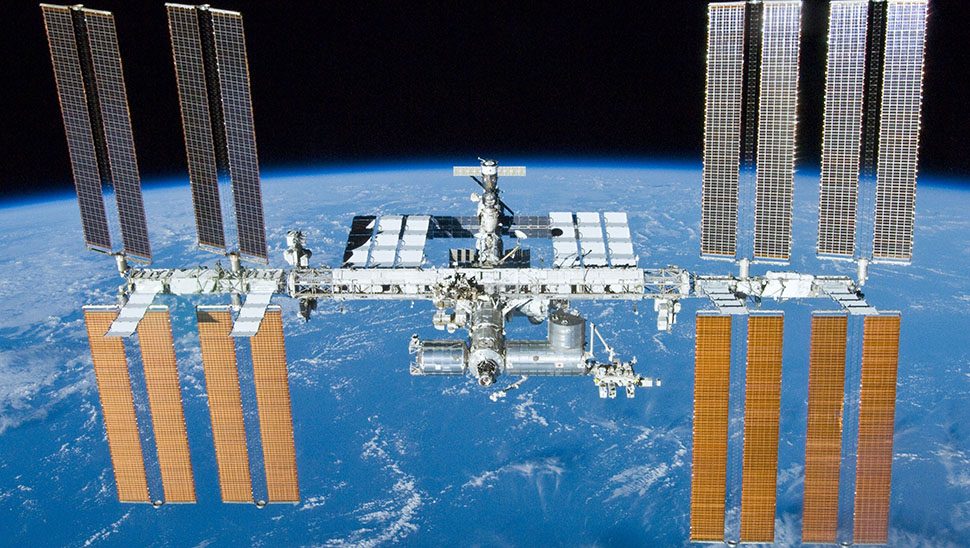
Whenever astronauts or cargo are shot into space, they can bring unwitting guests along with them in the form of bacteria. For long-term projects like the International Space Station (ISS), these cosmic stowaways can create a potentially serious health hazard.
Scientists aren’t entirely sure why, but they’ve noticed that bacteria tend to become more hardy and resistant to antibiotics when they enter space. A bacteria which is benign here on Earth can mutate into a drug-resistant superbug once it leaves Earth’s atmosphere. This problem is now being tackled by a team of microbiologists from Germany and Russia who have found a way to inhibit the spread of bacteria in the ISS.
“Spaceflight can turn harmless bacteria into potential pathogens,” senior study author Prof. Elisabeth Grohmann of Beuth University of Applied Sciences Berlin explained in a statement. “Just as stress hormones leave astronauts vulnerable to infection, the bacteria they carry become hardier – developing thick protective coatings and resistance to antibiotics – and more vigorous, multiplying and metabolizing faster.”
To inhibit the mutation and spread of bacteria, scientists applied a silver-based antimicrobial coating to a surface in the ISS which is known to host lots of bacteria — the toilet door.
Silver has been used for thousands of years to prevent infections, but it is now used so commonly that bacteria may be becoming resistant to it. So Grohmann’s team tested a new coating which is made of both silver and ruthenium and can kill off fungi, yeasts, and viruses as well as bacteria. “The effects are similar to bleach,” Grohmann explained, “except the coating is self-regenerating so it never gets used up.”
The results of the study were a resounding success: after six months of exposure on the ISS, not a single bacteria was recovered from the covered surfaces. Even after longer periods of 12 months to 19 months, only 12 bacteria were recovered. This represents a drop in the level of bacteria by 80 percent when compared to uncoated metal surfaces.
If testing for superbugs in space sounds like it would be dangerous for the astronauts living there, don’t worry, the scientists did take that into consideration. “Most importantly, no serious human pathogens were found on any surface,” Grohmann said. “Thus, the infection risk for the ISS crew currently is low.”
The findings are published in the journal Frontiers in Microbiology.