  1. Home
  2. Emerging Tech
  3. News

Asteroid Ryugu is porous, shaped like a spinning top, and is formed of rubble

Add as a preferred source on Google

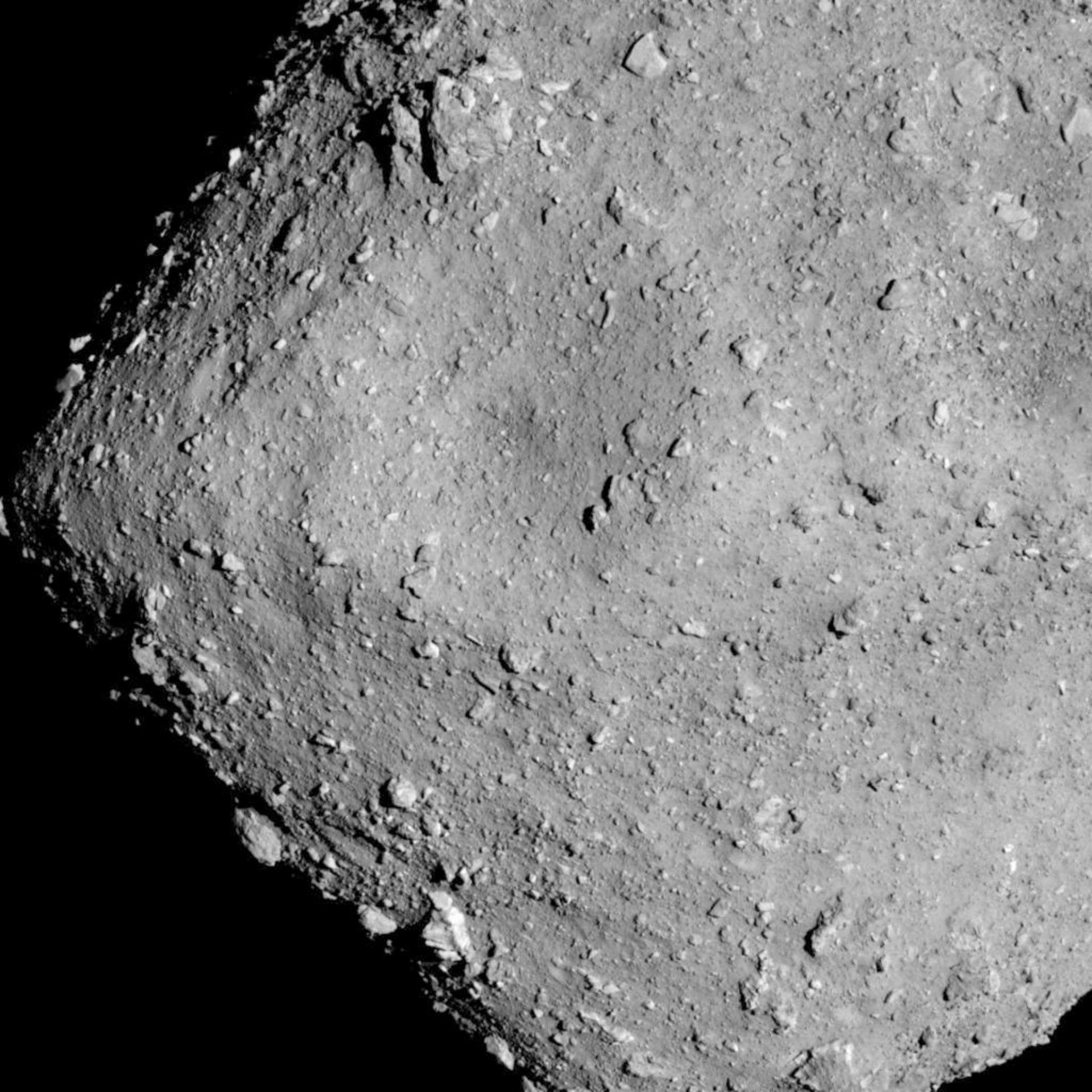
Hayabusa-2 image of the asteroid Ryugu as seen from a distance of 3.7 miles. JAXA / University of Tokyo / Kochi University / Rikkyo University / Nagoya University / Chiba Institute of Technology / Meiji University / University of Aizu / AIST.

The Japanese Space Agency, JAXA, has been exploring a distant asteroid named Ryugu with its probe, Hayabusa 2. After arriving at its destination 200 million miles from Earth, the probe managed to land on the asteroid in an incredible feat of engineering. Now the first results from study of the asteroid are in, with three new papers published.

Recommended Videos

The first finding is that Ryugu is porous and only loosely held together. It has “large surface boulders [that] suggest a rubble-pile structure,” according to a paper by Dr. Sei-Ichiro Watanabe of Nagoya University, Japan, and colleagues. This means the asteroid is an aggregate of many smaller rocks which are bound together by gravity, with a low level of cohesion and a high degree of porosity.

In addition, the large boulders observed on the surface like the one named Otohime suggest that rock fragments were pulled together to form Ryugu as they are too big to have been created by impacts. Overall, the asteroid has a “spinning top shape” which is similar to another asteroid currently being studied, Bennu.

The second study looked at the surface composition of Ryugu. Using near-infrared spectrometery, scientists found that hydrated minerals were spread across the surface. However, the asteroid was much drier than was expected.

“Just a few months after we received the first data we have already made some tantalizing discoveries,” Dr. Seiji Sugita, a researcher at the University of Tokyo and the Chiba Institute of Technology and co-author of the three studies, said to Science News. “The primary one being the amount of water, or lack of it, Ryugu seems to possess. It’s far dryer than we expected, and given Ryugu is quite young — by asteroid standards — at around 100 million years old, this suggests its parent body was largely devoid of water too.”

In the final study, the authors combined data from the other two papers to try to understand the origin of Ryugu. “Small asteroids, such as Ryugu, are estimated to have been born from much older parent bodies through catastrophic disruption and re-accumulation of fragments during the Solar System evolution,” the scientists told Science News. “Ryugu likely formed as rubble, ejected by an impact from a larger parent asteroid.”

This information sheds light not only on the composition and formation of Ryugu, but could also be applied to the study of other asteroids like Bennu. “That Bennu and Ryugu may be siblings yet exhibit some strikingly different traits implies there must be many exciting and mysterious astronomical processes we have yet to explore,” Dr. Sugita said.

The three papers are published in the journal Science.

Georgina Torbet
Georgina has been the space writer at Digital Trends space writer for six years, covering human space exploration, planetary…
Chrome is getting better at understanding the breaks and punctations you never say out loud
Voice typing in Chrome is about to feel much more natural
Google Chrome on Android Featured

Google is quietly making voice dictation in Chrome feel a lot more natural. With the latest Chrome 151 Beta, the company is introducing a new capability that allows the browser's speech recognition engine to automatically infer punctuation based on the way people speak, eliminating the need to explicitly say commands like "comma" or "full stop."

The update may sound minor at first glance, but it addresses one of the biggest frustrations with voice typing: speaking naturally often produces text that lacks punctuation unless users consciously dictate every punctuation mark. By teaching Chrome to understand pauses, rhythm, and speech patterns, Google is taking another step toward making conversations with computers feel more human.

Read more
Horror films play music to warn about danger. These headphones use the same trick to save you from robots
Spherephones replaces factory alarms with music that tells you what is coming and from where.
spherephones-georgia-tech

The ear has always processed what is coming before the eye does. In horror movies, the music always tells you something bad is coming. Now researchers at Georgia Tech are using the same idea in real life to keep factory workers safe around robots.

They have built a wearable headset called Spherephones that converts nearby robot movement into spatial music, giving you a warning before a machine gets too close. It helps the user stay aware without breaking their attention.

Read more
Elon Musk refutes report claiming that an AI device is in development at SpaceX
The billionair's two-word denial on X doesn't explain what part of the Wall Street Journal's report he's disputing.
Elon Musk speaking into a microphone with a blue background

Elon Musk has denied a Wall Street Journal report claiming SpaceX showed investors a prototype AI device before its recent IPO. "Utterly false," Musk wrote on X, responding to a post about the report that has since been deleted, offering no further explanation.

A denial that leaves more questions than it answers

Read more