  1. Home
  2. Emerging Tech
  3. News

Is it a bird? Is it a plane? No, it’s a super-speedy pulsar

Add as a preferred source on Google

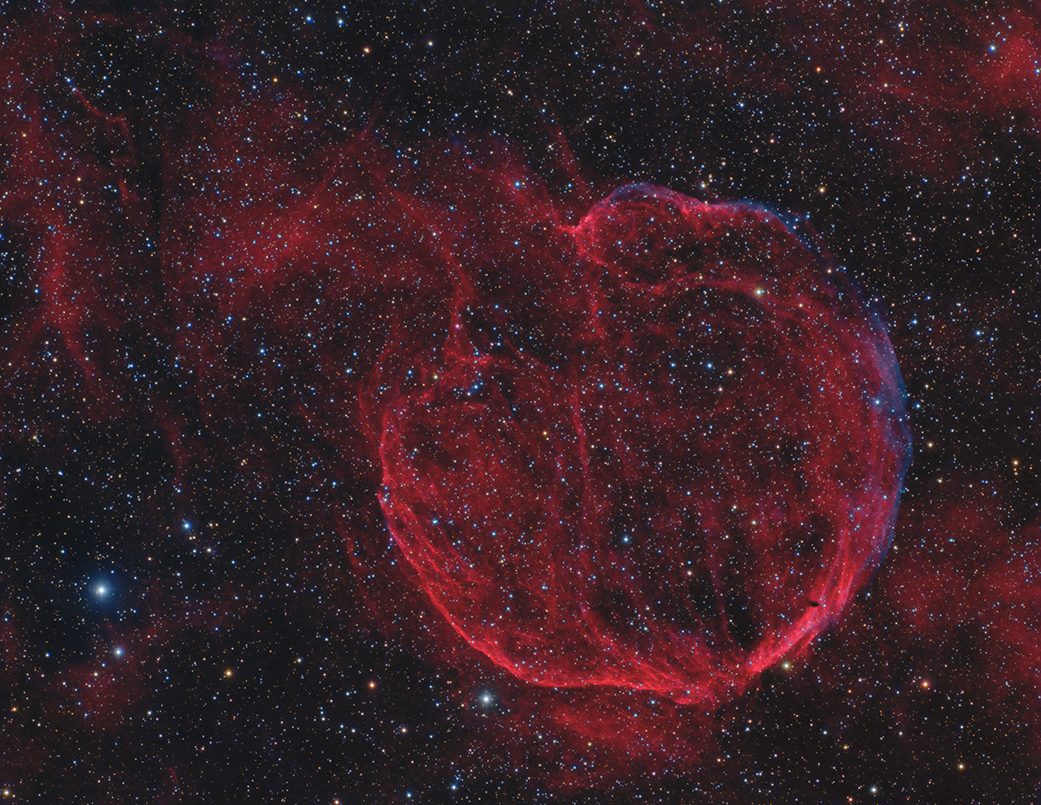
CTB 1, seen here in a deep exposure that highlights visible light from hydrogen gas, is the expanding wreckage of a massive star that exploded some 10,000 years ago. The pulsar, formed in the center of the collapsing star, is moving so fast it has completely exited the faint shell. Scott Rosen/NASA/GSFC

A super-speedy pulsar has been spotted dashing across the sky, discovered using NASA’s Fermi Gamma-ray Space Telescope and the National Science Foundation’s Karl G. Jansky Very Large Array (VLA).

Recommended Videos

The pulsar, named PSR J0002+6216 or J0002 for short, is traveling at a breathtaking 2.5 million miles an hour, fast enough that it could travel between the Earth and the Moon in just six minutes. A type of neutron star, pulsars are what is left behind after the supernova explosion of a massive star. They are very dense and spin quickly, creating a tail of radio emissions which points toward their origin.

“Thanks to its narrow dart-like tail and a fortuitous viewing angle, we can trace this pulsar straight back to its birthplace,” said Frank Schinzel, a scientist at the National Radio Astronomy Observatory (NRAO) in Socorro, New Mexico, said in a statement. “Further study of this object will help us better understand how these explosions are able to ‘kick’ neutron stars to such high speed.”

The pulsar is located 53 light-years away from the remnant of a supernova called CTB 1, and its tail suggests that this was where it was born around 10,000 years ago.

NASA's Fermi Satellite Clocks a 'Cannonball' Pulsar

The J0002 pulsar was discovered by a citizen scientist who combed through the Fermi data as part of the Einstein@Home project, using the processing power of volunteers’ computers to identify astronomical features of interest. This has helped scientists to analyzed the huge amount of data that Fermi collects.

“The longer the data set, the more powerful the pulsar timing technique is,” co-author Matthew Kerr said in a statement. “Fermi’s lovely 10-year data set is essentially what made this measurement possible.”
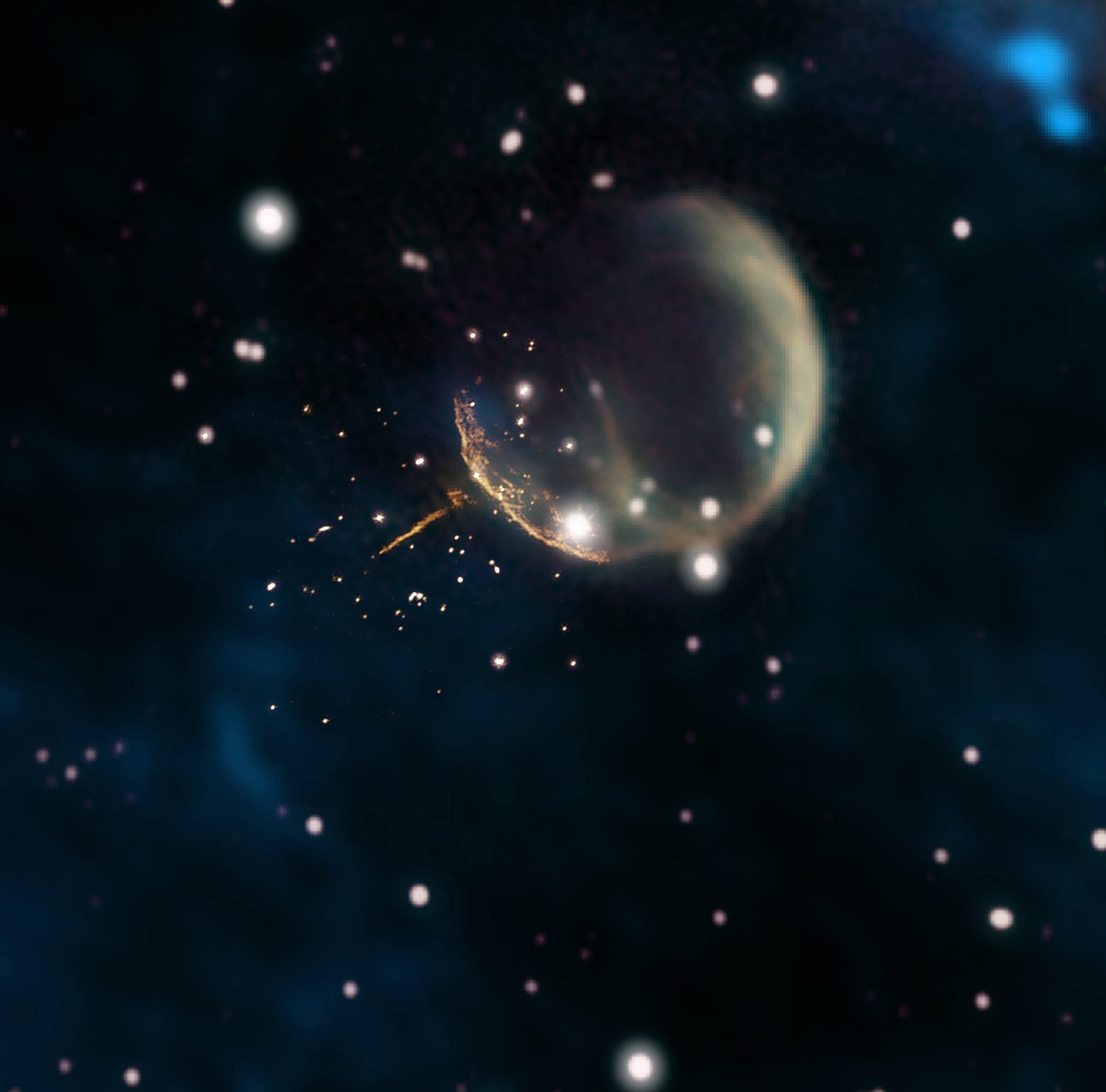
The CTB 1 supernova remnant resembles a ghostly bubble in this image, which combines new 1.5 gigahertz observations from the Very Large Array (VLA) radio telescope (orange, near center) with older observations from the Dominion Radio Astrophysical Observatory’s Canadian Galactic Plane Survey (1.42 gigahertz, magenta and yellow; 408 megahertz, green) and infrared data (blue). The VLA data clearly reveal the straight, glowing trail from pulsar J0002+6216 and the curved rim of the remnant’s shell. CTB 1 is about half a degree across, the apparent size of a full Moon. Composite by Jayanne English, University of Manitoba, using data from NRAO/F. Schinzel et al., DRAO/Canadian Galactic Plane Survey and NASA/IRAS

Exactly how the pulsar came to be traveling at such tremendous speeds is still a mystery. Schinzel and Kerr are hopeful that further study of J0002 will reveal more about how it reaching its supercharged speed.

Georgina Torbet
Georgina has been the space writer at Digital Trends space writer for six years, covering human space exploration, planetary…
Google Flow Music Spaces is becoming an all-in-one AI music studio
The latest update brings song editing, stem splitting, image generation, lyrics, and video creation into a single workspace.
Google Flow Music Featured

The company has announced a major update for Flow Music Spaces, bringing a suite of new AI-powered creative tools directly into collaborative workspaces. Instead of jumping between different apps or sessions, users can now generate and edit songs, split audio stems, create images, write lyrics, and even generate videos without leaving a Space.

What's new in Flow Music Spaces?

Read more
A Florida pastor asked ChatGPT if he was okay. It nearly got him killed.
When "just relax and recover" turns out to be the worst medical advice you could get.
ChatGPT on iPhone

Scott Winters, a pastor from Florida, is suing OpenAI after ChatGPT allegedly gave him what his lawsuit calls "extremely dangerous" medical advice, advice that nearly cost him his life.

What happened to the pastor?

Read more
Scientists made robots curious like toddlers, and it helped them learn language twice as fast
Give a robot curiosity, and it starts learning language (and misbehaving) just like a toddler.
robots and kids photo

Scientists have been trying to figure out how kids pick up language so fast for decades, and a new study out of the Okinawa Institute of Science and Technology (OIST) might have cracked part of the puzzle: curiosity.

Researchers built a virtual robot with a brain-inspired neural network and set it loose in a simulated 3D world full of shapes, colors, and simple commands like "push left magenta dumbbell." 

Read more