  1. Home
  2. Emerging Tech
  3. News

Pluto’s atmosphere could freeze and disappear by the year 2030

Add as a preferred source on Google

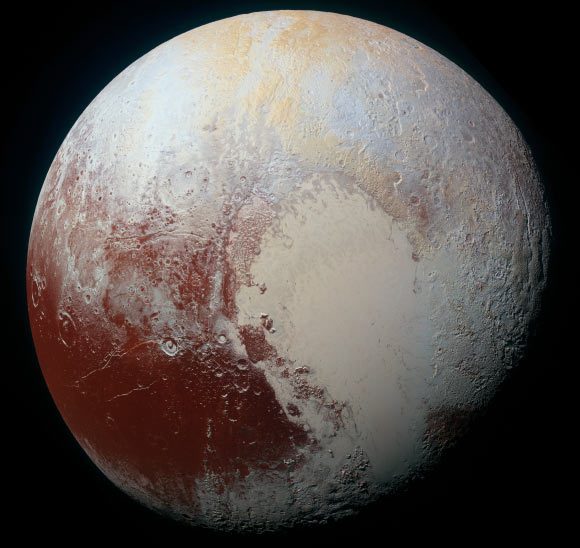
A high-resolution image of Pluto taken by New Horizons on July 14, 2015. The image has been color-enhanced to show the different geological features of the surface. NASA / Johns Hopkins University Applied Physics Laboratory / Southwest Research Institute.

Life is tough for dwarf planet Pluto. After being stripped of its status an a planet in 2006 for its small size, it may be facing an upcoming atmospheric armageddon.

Recommended Videos

Astronomers have been studying the seasonal changes to Pluto’s surface pressure using a technique called ground-based stellar occultations. An occultation occurs when an object like a moon or planet blocks the light coming to Earth from a more distant object like a star, like a solar eclipse. By observing how Pluto blocks the light from distant stars, information about the atmosphere’s density, pressure, and temperature can be measured.

“We were able to construct seasonal models of Pluto and how it responds to changes with the amount of sunlight it receives as it orbits the Sun,” Andrew Cole of the University of Tasmania said in a statement. “What we found was when Pluto is farthest away from the Sun, and during its winter in the northern hemisphere, nitrogen freezes out of the atmosphere.”

It is already pretty chilly on the surface of Pluto, with a surface temperature that varies between minus 378 and minus 396 degrees Fahrenheit (minus 228 to minus 238 degrees Celsius). Now we know that some seasons are colder than others — cold enough for nitrogen, which makes up the majority of the atmosphere — to freeze.

And the atmosphere is changing over time as well. Atmospheric pressure has increased by three times over the last thirty years. Models of the dwarf planet show that the majority of the atmosphere will condense outwards until almost nothing remains. “What our predictions show is that by 2030 the atmosphere is going to frost out and vanish around the whole planet,” Cole said.

If this happens, it will change the way that Pluto appears to us. The nitrogen freezing would reflect more sunlight, so Pluto would actually appear brighter in the sky. But the terrain of the dwarf planet will look different too. The colors observed by the New Horizons mission to Pluto in 2015, like the bright red terrain shown in the image above, may be hidden beneath nitrogen frost.

The findings will soon be published in the journal Astronomy & Astrophysics, and you can see the paper on the pre-publication archive arXiv.

Georgina Torbet
Georgina has been the space writer at Digital Trends space writer for six years, covering human space exploration, planetary…
Google’s new AI gives robots better balance, smarter hands, and teamwork capabilities
Google just made robots a lot less clumsy and a lot more helpful.
Gemini robotics 2.0

Google DeepMind just brought sci-fi robots closer to reality, and it is very exciting. Building on its original Gemini Robotics model, the company has introduced Gemini Robotics 2, an AI system designed to help robots think, move, and even work together. Unlike most robots today, which rely on pre-programmed routines or someone controlling them remotely, this new system lets robots figure things out on their own when situations get unpredictable.

Can robots finally handle whole-body tasks?

Read more
Remember Samsung’s Ballie home robot? It may finally be inching closer to reality
Leaked app wireframes give the strongest hint yet that Samsung's Ballie home robot, first shown at CES 2020, might still be headed toward an actual release.
Samsung Ballie robot in a room next to a dog feeder.

Samsung's rolling home robot has been the industry's longest-running "will it ever actually ship" joke, and I'll admit I'd mostly given up on it. Now, there's finally a glimmer of hope.

Samsung first unveiled Ballie as a concept at CES 2020. Then, it showed it as a significantly upgraded version four years later. However, the company never confirmed a release date or committed to releasing it at all. 

Read more
Polar is yet another AI browser, but it goes beyond just automating the mundane web chores
Polar wants to turn your browser into an AI-powered productivity tool
Polar AI browser

The AI browser race is entering a new phase. After spending much of 2025 trying to reinvent web search with built-in chatbots, startups are increasingly shifting their attention toward browser agents that can automate repetitive work instead of simply answering questions. The latest company to embrace that transition is Polar, a startup founded by former Perplexity engineer Kevin Zhang, which has raised $5.7 million in seed funding led by Madrona.

Unlike the first generation of AI browsers that targeted everyday consumers, Polar is designed specifically for knowledge workers. Its premise is straightforward: instead of replacing Google Search, the browser aims to eliminate repetitive tasks that professionals perform across dozens of browser tabs every day.

Read more