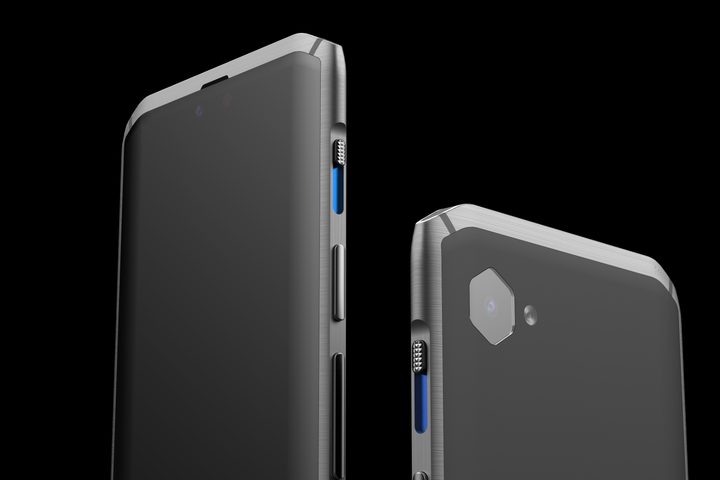
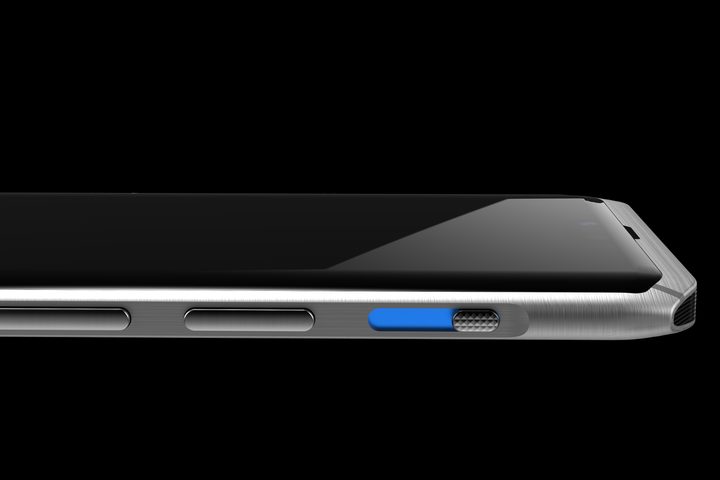
Finnish startup Centinel Mobiles is working on a new Android smartphone that focuses on privacy and promises reduced exposure to radiation. The phone, which is currently in development, will sport a sliding privacy switch with three positions to offer owners a fully configurable way to reduce or cut connectivity and functionality. The device will also monitor exposure to radiation in real time and reject congested or poor signals that use more power and potentially increase radio frequency exposure.
“Centinel takes cell phone privacy seriously,” co-founder Pasi Ala-Mieto told Digital Trends. “And we want to ensure user well-being by reducing radiation levels. Centinel aims to be the most responsible supplier of cell phones.”
The idea with the privacy switch is that people could slide it on when needed. They can configure precisely what each switch position does, so they may, for example, switch it to position one before going into a meeting to turn off the microphone and camera, or slide to position two to cut GPS, Bluetooth, and Wi-Fi in a public area. The idea is that the switch would work on a hardware level, separate from the Android operating system, so that Android has no access to the switch to control it, making it impossible to hack. People can dictate precisely what the switch cuts in each position.
The issue of privacy has spawned a few niche phones and devices in recent years, such as Sirin Labs’ Solarin, Dark Matter’s Katim, and Silent Circle’s Blackphone, but none of them have really caught on. While there’s a niche market for government officials and corporate executives with legitimate spying concerns, the general public haven’t shown a great deal of interest. Centinel hopes to change that with an affordable device that offers more than just privacy.
“Cell phone radiation has been a concern for two decades now, and continues to be an even bigger preoccupation as cell phones are having an increasingly serious role in our everyday life, and being used from a very young age,” Ala-Mieto said.
Some people are certainly worried about the potentially negative impact of cell phone radiation. A recent report published by the German Federal Office for Radiation Protection revealed which smartphones emit the most and least radiation by measuring each device’s specific absorption rate, or SAR. This refers to the radiofrequency waves that smartphones emit and that may be absorbed by our bodies. Ala-Mieto has been working at Cellraid for the last few years, a company that focuses on monitoring cell phone radiation with an app that measures SAR output among other things.


- 1. Janne Knuutinen
- 2. Pasi Ala-Mieto
There’s still a great deal of debate about whether cell phone radiation is dangerous. It was classified as “possibly carcinogenic to humans” by the World Health Organization’s International Agency for Research on Cancer in 2011, but coffee is in the same category. The rise of 5G has also sparked radiofrequency exposure concerns, but there’s still a lot of argument on the topic.
Centinel plans to use Cellraid’s Quanta Algorithm to monitor exposure to radiation levels in real time and to act to reduce them when they hit a certain level. It’s also adopting an antenna design that will focus on connecting to strong signals and rejecting congested or poor signals because it’s poor signals that cause the phone to boost power, causing more radiation and draining your battery faster in the process.
Centinel Mobiles was founded by Janne Knuutinen who worked in R&D at Nokia for several years, which is also where Ala-Mieto began his career. The company is still developing the new phone and aiming for a “late 2019 or early 2020” release. The Centinel phone is expected to cost around 600 euros (around $670). We’ll keep you posted on its development. In the meantime, learn how to improve your Android privacy.